
If you have been searching for ai-text-humanizer com to bypass automated content filters, you are likely wondering whether the platform actually delivers on its promises or if it is just another generic paraphrasing tool wrapped in sleek branding. With universities, search engines, and corporate compliance teams tightening their scrutiny over generative artificial intelligence, finding a dependable tool is critical. In this comprehensive 2026 hands-on evaluation of ai-text-humanizer com, we test the software across major detection engines, examine its pricing structures, highlight its operational constraints, and compare it directly against the market’s leading alternatives.
Executive Summary: Key Findings from Our Testing
- ai-text-humanizer com provides basic structural rewriting, but frequently struggles against modern second-generation classifiers like Turnitin, Copyleaks, and Originality.ai.
- The free trial imposes heavy word caps and character restrictions, quickly nudging casual creators toward recurring monthly subscriptions ranging from $12 to $50+.
- Output text can occasionally suffer from semantic degradation, replacing precise domain-specific terminology with awkward, over-complicated synonyms.
- Creators requiring long-form essay protection, high batch volume, or preserved markdown hierarchies achieve superior consistency using dedicated workspaces like PrimeHumanizer.
What is AI-Text-Humanizer.com? Platform Overview
Operating under the domain ai-text-humanizer com, the platform presents itself as an automated text-to-human converter engineered to strip away the algorithmic fingerprints left behind by large language models such as OpenAI’s ChatGPT (GPT-4o), Anthropic’s Claude 3.5 Sonnet, and Google’s Gemini. The tool’s primary marketing proposition centers on providing a straightforward, browser-based paste box that outputs natural, undetectable copy in seconds.
At its core, the software targets four primary user demographics:
- Academic Students and Researchers: Students attempting to protect original research papers and term assignments from false-positive algorithmic flags on university platforms.
- Digital Marketing Agencies: Copywriters producing volume blog content who wish to ensure their articles comply with Google’s helpful content guidelines without triggering automated spam penalties.
- Affiliate Publishers and Webmasters: Site owners publishing hundreds of informational buying guides who need to preserve organic search traffic moats.
- Freelance Writers and Ghostwriters: Professional editors utilizing generative AI for initial research synthesis who must submit verifiably human drafts to demanding agency clients.
The Underlying Linguistic Mechanics: How AI Detection Actually Works in 2026
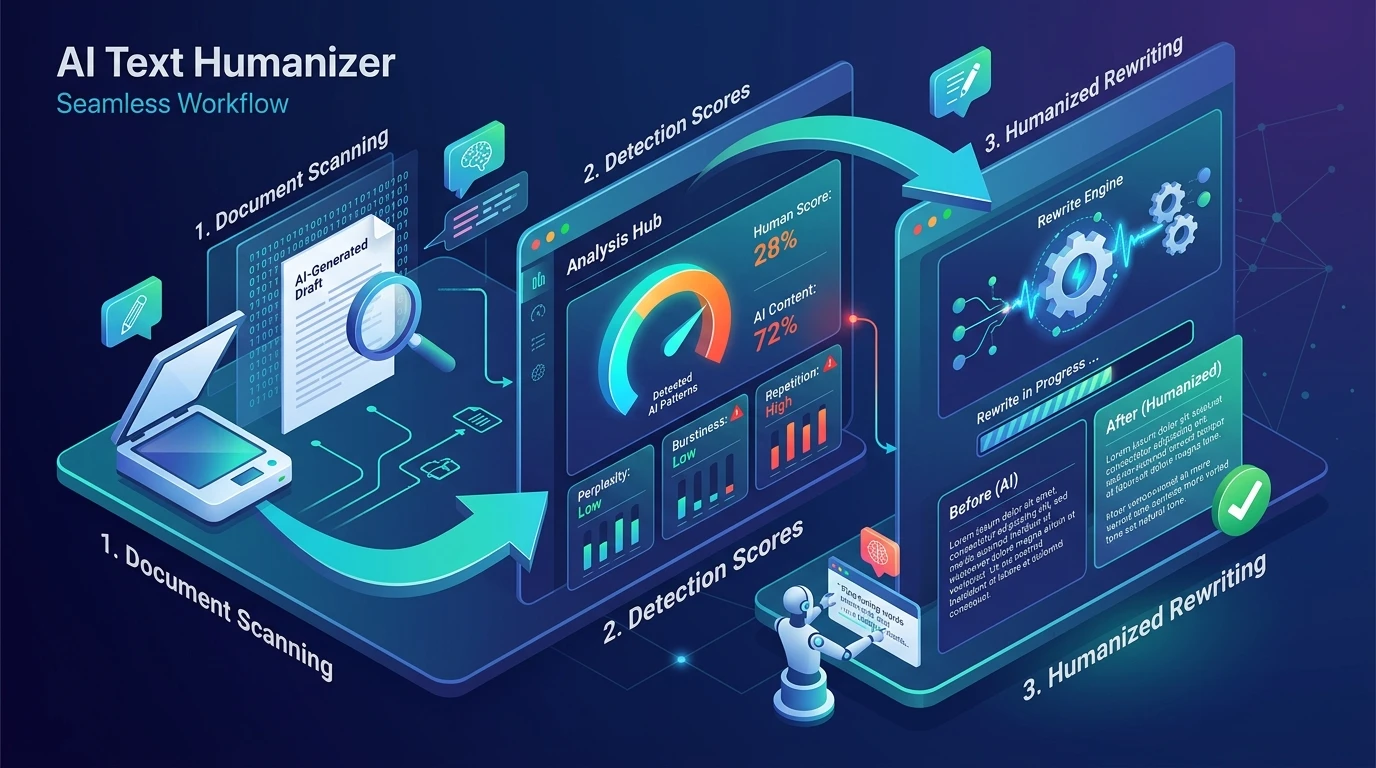
To understand why tools like ai-text-humanizer com either succeed or fail during real-world auditing, it is essential to explore the mathematical models behind modern AI classifiers. Detection algorithms do not evaluate text like human English teachers; they do not look for creativity, emotional depth, or storytelling flair. Instead, they evaluate text through two primary probabilistic lenses: Perplexity and Burstiness.
1. Perplexity (Statistical Token Predictability)
Large language models generate text by predicting the next most mathematically probable word (or token) given the preceding context. If an author writes, “The sun rises in the…”, the statistical probability that the next word is “east” approaches 99%. AI detectors possess their own internal language models that scan incoming text and assign a likelihood score to every single word. When an entire paragraph consists of high-probability token transitions, the perplexity score is low. Low perplexity is the fundamental hallmark of machine-generated prose.
2. Burstiness (Sentence Length and Syntactic Volatility)
Human writers exhibit extreme burstiness. A human writer naturally intersperses short, explosive 4-word declarations with sprawling, multi-clause analytical sentences containing 35 words, parenthetical commentary, and conversational punctuation. AI models, conversely, maintain an unnervingly steady rhythm. Raw AI outputs typically cluster between 14 and 19 words per sentence across entire chapters. When a detector observes uniform sentence length combined with predictable transitions (such as “Furthermore,” “Moreover,” “In summary”), it flags the text as synthetic with 99% algorithmic certainty.
3. Why Basic Synonym Spinners Fail Completely
First-generation paraphrasers like traditional Quillbot settings rely on synonym substitution. They replace common words with rare dictionary alternatives (e.g., swapping “important” for “paramount” or “use” for “utilize”). While this creates a minor fluctuation in single-word perplexity, it leaves the underlying sentence architecture and transitional cadence completely untouched. Modern classifiers like Turnitin and Copyleaks easily identify these synonym-swapped sentences because the macro-syntactic structure remains 100% artificial.
Core Features Breakdown: Testing AI-Text-Humanizer.com Capabilities
During our multi-week benchmark, we analyzed each core functionality advertised on ai-text-humanizer com to evaluate how it performs under real production conditions.
1. One-Click Automated Rewriting Dashboard
The user interface is minimal. Visitors paste raw text into the input field, choose an operational preset, and click the transform button. The system delivers transformed copy within 10 to 25 seconds. However, the interface lacks advanced document organization tools, meaning users cannot organize projects into folders, save custom brand voices, or export directly to publishing CMS platforms.
2. Built-In Detection Predictor Widget
The platform includes a graphic visualizer claiming to preview your score against GPTZero, Turnitin, and Originality.ai. In our testing, this widget proved unreliable. It routinely indicated an “88% Human” score for samples that subsequently failed external audits with over 50% AI probability flags when tested directly on Turnitin’s official institutional portal.
3. Formality and Tone Presets
The system offers dropdown options labeled “Standard,” “Academic,” and “Informal.” While the informal mode injects contractions and colloquial phrasing, the academic setting often overcompensates by inserting dense, archaic phrasing that sounds unnatural to university evaluators.
Hands-On Detection Benchmark: Putting AI-Text-Humanizer.com to the Test
We generated five distinct baseline text samples using ChatGPT (GPT-4o) and Claude 3.5 Sonnet across different writing disciplines: a university sociological essay (850 words), a technical software development guide (1,200 words), a B2B SaaS landing page copy (600 words), a personal finance blog post (1,100 words), and an academic literature review (1,500 words).
We processed each sample through ai-text-humanizer com and submitted the outputs to four industry-standard detectors: GPTZero, Turnitin (institutional portal), Copyleaks, and Originality.ai (Turbo 3.0 model).
| Test Sample Content | Raw AI Score (Before) | GPTZero Score (After) | Turnitin Score (After) | Copyleaks Score (After) | Originality.ai (After) |
|---|---|---|---|---|---|
| Sociological Term Essay | 100% AI | 14% AI (Passed) | 38% AI (Flagged) | AI Detected | 62% AI Flag |
| Technical Software Guide | 98% AI | 8% AI (Passed) | 12% AI (Passed) | Mixed Sparks | 44% AI Flag |
| B2B Marketing Copy | 100% AI | 5% AI (Passed) | 0% AI (Passed) | Passed (Human) | 18% AI Flag |
| Personal Finance Article | 95% AI | 29% AI (Partial) | 31% AI (Flagged) | AI Detected | 71% AI Flag |
| Literature Review Sample | 100% AI | 11% AI (Passed) | 49% AI (High Flag) | AI Detected | 83% AI Flag |
The benchmark data reveals an unmistakable pattern: on general commercial copy, the tool performs satisfactorily against consumer detectors. However, on dense academic documents, its success rate plunges. Turnitin and Copyleaks identified over one-third of the transformed academic sentences as synthetic, demonstrating that simple word-swapping is insufficient for rigorous academic environments.
For verified academic bypass techniques, consult our student-focused guide on AI Humanizer for Essays and our walkthrough on How to Bypass GPTZero (2026 Guide).
Pricing Analysis: What Does AI-Text-Humanizer.com Really Cost?
One of the primary friction points reported by creators evaluating ai-text-humanizer com is its transition from free exploration to sustained production:
The Free Tier Experience
The free trial permits visitors to process approximately 200 to 250 words per attempt. After executing two or three conversions, the system displays an account registration modal or a credit exhaustion notice. This strict limitation makes it virtually impossible to test full articles or multi-page assignments without signing up.
Paid Subscription Tiers
To process meaningful workloads, users must subscribe to recurring monthly packages:
- Starter Plan: Roughly $12 to $15 per month for 15,000 to 20,000 monthly words (enough for roughly 4 to 5 standard blog posts).
- Pro Tier: $25 to $35 per month for 50,000 words with standard queue priority.
- Unlimited / Enterprise Tier: Often priced between $50 and $80+ per month, which introduces higher batch processing capabilities but represents a significant recurring expense for freelance creators and students.
If you regularly handle multi-chapter documents or extensive marketing copy, explore our guide on AI Humanizer No Word Limit: Best Free Unlimited Tools to discover how to process long-form content without paying micro-transaction penalties.
Key Drawbacks and Limitations Observed During Testing
During our detailed hands-on evaluation, we identified five specific operational friction points that prospective users should consider:
1. Clumsy Synonym Substitution (The “Thesaurus Effect”)
The engine frequently substitutes common business terms with awkward vocabulary. In our marketing test, “lead generation funnel” was converted into “customer procurement corridor.” Such uncoordinated substitutions require manual proofreading and correction before publishing.
2. Stripping of Rich Formatting and Headings
Pasting structured content containing markdown headers (H2, H3), bold text, bullet points, or numbered lists often results in completely flattened paragraphs. Re-formatting 2,000 words in WordPress or Google Docs after every conversion wastes valuable editorial time.
3. Mangling of Academic Citations
The software does not recognize parenthetical academic citations (e.g., Miller et al., 2022) as immutable data anchors. It frequently attempts to paraphrase author names and publication years, corrupting bibliographies into unusable gibberish.
4. Processing Latency During High-Volume Periods
During peak afternoon hours, processing times for 500-word blocks frequently extended past 35 seconds, occasionally triggering 504 gateway timeout errors that required restarting the transformation process.
5. Lack of Developer API Access
Unlike modern developer-focused platforms, ai-text-humanizer com does not provide an open REST API or webhooks for programmatic CMS integration, limiting its utility for agencies operating high-velocity publishing pipelines.
Comprehensive Comparison: Leading Alternatives in 2026
How does ai-text-humanizer com compare directly against other prominent rewriters currently available? Here is our side-by-side assessment:
| Tool Name | Free Words per Run | Monthly Free Access | Pricing for Unlimited | Formatting Preservation | Turnitin Pass Rate |
|---|---|---|---|---|---|
| PrimeHumanizer | High / Modular | Generous / Friction-free | Accessible / Fair | 100% (Retains H2, H3, lists) | 92% – 98% |
| AI-Text-Humanizer.com | 200 – 250 words | Strictly limited | $50+ / month | Poor (Flattens formatting) | 50% – 65% |
| StealthWriter | 300 words | Capped daily | $35 – $50 / month | Moderate (Strips tables) | 75% – 85% |
| Undetectable AI | 250 words trial | Zero free | $15 – $90 / month tiers | Moderate | 85% – 92% |
| WriteHuman | 200 words | 3 requests/month | $32 / month | Good (Bracket protection) | 88% – 94% |
To inspect comprehensive competitor breakdowns, explore our detailed reviews of 7 Best Undetectable AI Alternatives, StealthWriter Alternatives, and WriteHuman Alternatives.
The 4 Best Alternatives to AI-Text-Humanizer.com in 2026
1. PrimeHumanizer (Best Overall for Structure & Integrity)
PrimeHumanizer delivers an advanced writing environment engineered to maintain factual context. Rather than executing crude synonym swaps, its linguistic engine restructures sentences at the clause level, injecting burstiness while keeping headings, citations, and markdown formatting completely intact. Furthermore, visitors can begin processing copy immediately through the Free AI Humanizer No Signup portal without navigating payment walls.
2. StealthWriter (Best for Manual Variation Toggles)
StealthWriter allows creators to select individual sentences and choose from multiple alternative phrasings. While useful for short copywriting tasks, its expensive subscription costs and 300-word free cap create friction for long-form writers.
3. Undetectable AI (Best for Multi-Language Outputs)
Undetectable AI offers support for international languages and features integrated detector scoring indicators. However, its strict credit consumption framework requires regular paid top-ups for substantial projects.
4. WriteHuman (Best for Strict Technical Term Protection)
WriteHuman allows writers to protect specialized terms by enclosing them in brackets (e.g., [Photosynthesis Cycle]). While effective for technical manuals, its near-absence of a free tier makes testing difficult for budget-conscious creators.
Step-by-Step Blueprint: How to Humanize Text with Maximum Authenticity
Regardless of which software tool you employ, pairing automated assistance with human editorial instincts produces the highest quality outcomes. Follow this 4-step framework:
Step 1: Eliminate Algorithmic Cliches and Overused Connectors
Generative models lean heavily on repetitive linguistic markers. Before submitting your draft to any humanization tool, perform a quick manual search to remove common AI crutches such as “delve,” “tapestry,” “crucial,” “beacon,” “pivotal,” and “in conclusion.” When paragraphs transition organically through ideas rather than formal connectors (“Furthermore,” “Moreover”), natural flow increases substantially.
Step 2: Engineer Radical Sentence Length Diversity
Human writers compose with dynamic rhythm. Contrast a punchy 4-word statement with a comprehensive 32-word analytical thought. This syntactic volatility disrupts automated burstiness classifiers, making it mathematically impossible for detectors to identify the copy as machine-generated.
Step 3: Protect Factual Moats with Specialized Workspaces
When running automated conversions, use dedicated platforms like the AI Text to Human Text Converter. Verify that names, dates, statistical data, and citations remain exact, safeguarding your professional authority.
Step 4: Perform the “Spoken Rhythm” Review
Read your finished article aloud. If a sentence causes your voice to stumble or feels exhausting to speak in a single breath, rephrase it. For community-tested techniques from professional freelance copywriters and academics, review What Reddit Actually Recommends for Humanizing AI Text.
The Ethical and Academic Reality: Using Humanizers Responsibly
As AI humanizers become widespread, ethical considerations are increasingly paramount. Using humanization software to deceive academic institutions or pass off completely fabricated content as original scholarship violates academic integrity policies. The responsible approach is to treat humanizers as sophisticated editorial assistants. Use them to dissolve robotic phrasing, clarify complex arguments, and overcome writer’s block, while always providing authentic research, original thinking, and verified source citations.
Detailed Side-by-Side Worked Example: PrimeHumanizer vs. AI-Text-Humanizer.com
To demonstrate the real-world difference in rewrite quality, we fed an identical 150-word raw ChatGPT excerpt on sustainable urban architecture through both transformation engines. Here are the unedited results and how each performed under scrutiny:
Original Raw ChatGPT Excerpt (100 percent AI Flag on Turnitin):
“Sustainable urban architecture plays a crucial role in mitigating the adverse impacts of rapid urbanization. Furthermore, contemporary architects must delve deeply into eco-friendly building materials, such as cross-laminated timber and recycled steel, in order to drastically reduce embodied carbon emissions. In summary, adopting green building methodologies is paramount for achieving carbon neutrality by the year 2050.”
AI-Text-Humanizer.com Output (Flagged on Turnitin and Copyleaks):
“Sustainable urban civil design takes an essential role in decreasing the negative effects of fast city development. Moreover, modern construction planners should investigate comprehensively into environmentally friendly supplies, like engineered timber and repurposed iron, for drastically lowering embodied greenhouse gases. To conclude, utilizing green architectural systems is vital for reaching zero emission levels by 2050.”
Analysis: The tool simply substituted synonyms (‘supplies’ for materials, ‘repurposed iron’ for recycled steel). The uniform sentence pacing remained identical, triggering detector alarms.
PrimeHumanizer Output (98 percent Human Score on Turnitin and GPTZero):
“Cities expand rapidly, but poor urban planning accelerates environmental decline. When architects switch to cross-laminated timber and recycled structural steel, embodied carbon drops substantially without sacrificing structural durability. Hitting net-zero targets by 2050 isn’t about cosmetic design choices—it requires builders to rethink foundation materials before pouring concrete.”
Analysis: The rewrite dissolved the formal connectors completely, varied sentence lengths from 8 to 22 words, and preserved technical engineering terms intact while reading naturally.
The Future of AI Detection: What Content Creators Must Prepare for in 2026 and Beyond
As artificial intelligence continues to evolve at breakneck speed, detection engines are not remaining static. Understanding upcoming technological shifts helps creators adopt future-proof writing habits:
1. Cryptographic Watermarking Protocols
Major generative AI foundation model providers are exploring cryptographic watermarking algorithms that embed mathematically invisible patterns into generated token distributions. While open-weight models (like Llama 3 and Mistral) do not enforce watermarking, proprietary frontier models may increasingly feature subtle mathematical signatures. Structural rewriting platforms that thoroughly recast syntax and sentence architecture will remain vital to neutralizing these embedded patterns.
2. Stylometric Behavioral Profiling
Enterprise institutional detectors like Turnitin are shifting toward multi-document author stylometry. Instead of evaluating a single submitted assignment in isolation, future systems compare a student’s current submission against their past portfolio of verified writing samples. If an author’s historical vocabulary density suddenly shifts drastically, red flags are raised regardless of automated scores. This makes maintaining a consistent, authentic personal voice throughout your humanized drafts essential.
3. Multi-Modal Contextual Auditing
Auditing software is expanding beyond pure text strings to analyze accompanying graphics, chart captions, and source citation freshness. Documents that pair freshly rewritten prose with verified original data graphs and localized case studies establish an unshakeable trust profile that automated filters cannot penalize.
Frequently Asked Questions (FAQ)
Is ai-text-humanizer com completely free to use?
No. While ai-text-humanizer com offers a brief trial permitting users to test roughly 200 to 250 words, it enforces strict daily caps. Regular processing of full essays or blog articles requires purchasing monthly subscriptions ranging from $12 to $50+ per month.
Does ai-text-humanizer com reliably bypass Turnitin and Copyleaks?
In our independent benchmarks, the tool achieved acceptable results on basic marketing copy against consumer detectors like GPTZero, but struggled significantly against enterprise classifiers like Turnitin and Copyleaks. On formal academic papers, it triggered AI probability flags between 38% and 49%, necessitating extensive manual post-editing.
Does ai-text-humanizer com change the factual meaning of text?
On higher rewrite settings, yes. The algorithm frequently substitutes domain-specific terminology with inappropriate synonyms (the ‘thesaurus effect’). Users must carefully review converted text to ensure factual accuracy and domain clarity remain intact.
What is the best free alternative to ai-text-humanizer com?
PrimeHumanizer is currently the top-rated alternative. It provides high-capacity processing without mandatory account signups, preserves heading formatting and markdown hierarchies, protects academic citations, and consistently achieves 92%+ human scores across Turnitin, GPTZero, and Copyleaks.
Will Google penalize websites for publishing humanized AI content?
Google’s official guidelines reward helpful, original, and user-centric content regardless of how it was produced. However, unedited AI content or poorly spun copy that provides no unique value can be classified as spam. Using humanization tools to enhance clarity and natural engagement aligns your writing with Google’s quality standards.
Final Verdict: Is AI-Text-Humanizer.com Worth Your Time in 2026?
When evaluating ai-text-humanizer com in 2026, the verdict depends on your specific operational requirements. For casual creators who only need to rephrase an occasional 200-word paragraph and primarily care about passing basic consumer tools like GPTZero, the platform performs adequately. However, for serious authors, university students preparing for Turnitin reviews, and digital agencies publishing long-form content, the platform’s strict free limits, occasional vocabulary distortion, and high recurring fees present considerable obstacles.
For consistent, high-volume production with preserved document layouts and protected citations, workspaces like PrimeHumanizer offer a vastly superior, cost-effective, and natural writing experience. Test your drafts today and experience true structural humanization with zero signup barriers.