
Academic Citation & Formatting Standard
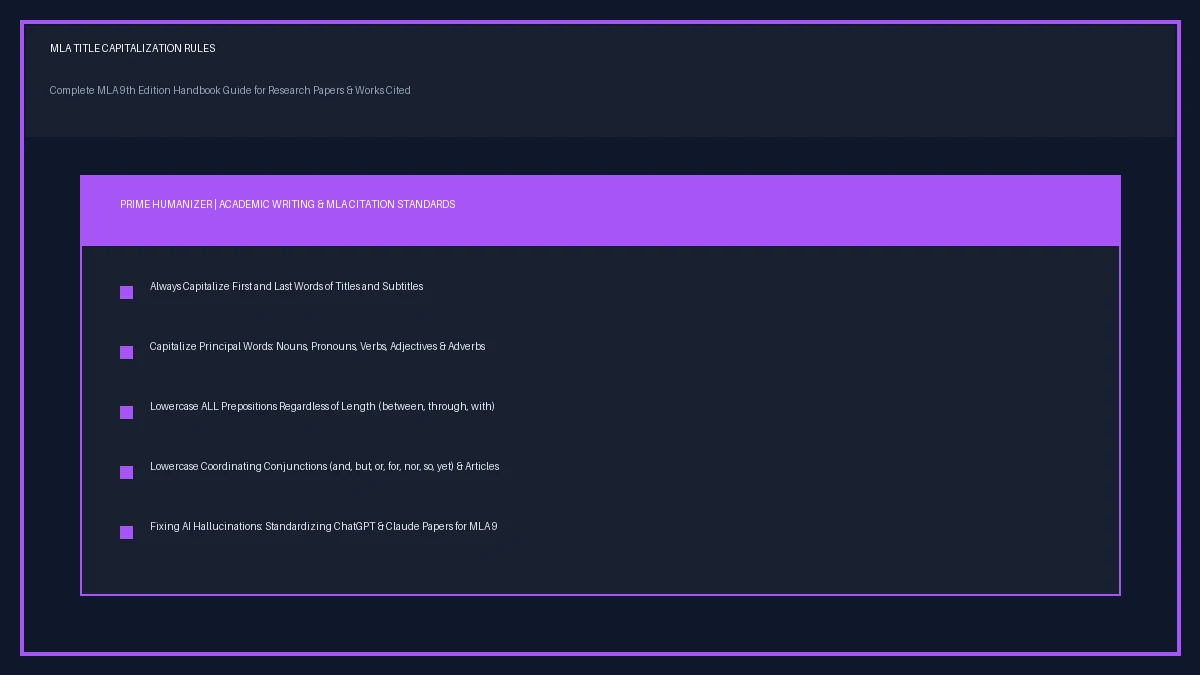
Quick Rule: The Core MLA Capitalization Principle
In MLA style (Modern Language Association 9th Edition), titles use title case (headline style). Always capitalize the first word, the last word, and all principal words (nouns, pronouns, verbs, adjectives, adverbs, and subordinating conjunctions). Lowercase all prepositions regardless of length (e.g., between, through, with), articles (a, an, the), and coordinating conjunctions (and, but, for, nor, or, so, yet).
Introduction to MLA Title Capitalization (Headline Style)
When drafting humanities research papers, literary critiques, historical analyses, or bibliographic entries in the Modern Language Association style, adhering to exact capitalization conventions is fundamental to academic credibility. The MLA Handbook (9th Edition) mandates headline-style capitalization (commonly referred to as title case) for all titles and subtitles of works referenced in your paper and your Works Cited list.
Unlike APA style—which strictly requires sentence case in its reference list—MLA maintains consistent headline capitalization across both parenthetical in-text citations and bibliographic citations. However, students, researchers, and professional writers frequently struggle with specific nuances: which prepositions to lowercase, how to treat compound hyphenated words, how to punctuate subtitles following a colon, and how to format italicized vs. quotation-marked titles.
Furthermore, with the widespread use of generative AI tools like ChatGPT, Claude, and Gemini for literature review drafting, automated title outputs frequently default to inconsistent capitalization patterns that trigger academic plagiarism and AI-detection flags. Standardizing your titles and ensuring human-level grammatical polish with tools like PrimeHumanizer ensures your academic papers meet strict institutional standards.
The Core Rules of MLA 9th Edition Capitalization
The MLA Handbook outlines explicit principles for capitalizing titles and subtitles. Below is the definitive rule hierarchy:
1. Always Capitalize the First and Last Word
Regardless of the part of speech, the very first word and the final word of any title or subtitle must be capitalized. Even if a title begins with an article (The, A, An) or ends with a preposition (such as in phrasal verbs like Call In or Look Up), capitalization is strictly required:
- The Old Man and the Sea (First word capitalized)
- What Are We Waiting For? (Preposition capitalized because it is the last word)
- Looking Ahead: A Retrospective on Modern Drama (First word of subtitle after colon capitalized)
2. Capitalize Principal Parts of Speech
In MLA format, all “principal words” must be capitalized. This category includes:
- Nouns: Author, Discourse, Novel, Theory, Shakespeare, Universe
- Pronouns: He, She, It, They, Whom, That, Who, This, Everything
- Verbs: Runs, Was, Is, Are, Be, Became, Analyzing, Humanizing (including all forms of the verb to be)
- Adjectives: Linguistic, Historical, Postmodern, Brilliant, Complex
- Adverbs: Quickly, Thoroughly, Always, Not, Very
- Subordinating Conjunctions: Because, Although, Since, If, Unless, Whereas, After
3. Always Lowercase These Three Word Categories
Unless they appear as the very first or very last word of a title or subtitle, keep the following lowercase:
- Articles: a, an, the
- Coordinating Conjunctions: and, but, for, nor, or, so, yet (remember the FANBOYS acronym)
- Prepositions (Regardless of Length!): about, above, across, after, against, along, among, around, at, before, behind, below, beneath, beside, between, beyond, by, down, during, except, for, from, in, inside, into, like, near, of, off, on, onto, out, outside, over, past, since, through, throughout, to, toward, under, underneath, until, up, upon, with, within, without
⚠️ Crucial Difference: MLA vs. APA Preposition Rule
In APA 7th Edition, prepositions containing four or more letters (such as With, From, Between, Through, Against) must be capitalized. In MLA 9th Edition, ALL prepositions are lowercase, regardless of letter count. For example: APA writes A River Runs Through It, whereas MLA writes A River Runs through It.
Complete Comparison: MLA 9 vs APA 7 vs Chicago (CMOS)
Below is an authoritative cross-style matrix illustrating how major academic citation guides treat identical title elements:
| Rule Element | MLA 9th Edition | APA 7th Edition | Chicago Manual (CMOS 17) |
|---|---|---|---|
| 4+ Letter Prepositions (Through, Between) | Lowercase (through, between) | Capitalize (Through, Between) | Lowercase (through, between) |
| First Word After a Colon (Subtitle) | Always Capitalize | Always Capitalize | Always Capitalize |
| Bibliography / Reference List Style | Headline Style (Title Case) | Sentence Case (except journals) | Headline Style (Title Case) |
| Verb ‘To Be’ (is, are, was, were) | Capitalize (Is, Was, Were) | Capitalize (Is, Was, Were) | Capitalize (Is, Was, Were) |
| Subordinating Conjunctions (As, If, Because) | Capitalize (As, If, Because) | Capitalize (As, If, Because) | Capitalize (As, If, Because) |
Handling Subtitles in MLA Style
When an academic work, book, or article features both a main title and an explanatory subtitle, separate them with a colon followed by a space. The first word following the colon must always be capitalized, even if it is an article, preposition, or coordinating conjunction:
- Frankenstein: Or, The Modern Prometheus (The word “Or” is capitalized because it begins the subtitle)
- Teaching with AI: A Practical Guide to Higher Education (“A” is capitalized)
- Digital Poetics: In Search of a New Literary Aesthetic (“In” is capitalized as the first word of the subtitle)
Hyphenated Compounds in MLA Titles
Hyphenated terms frequently cause confusion in academic formatting. MLA 9th Edition provides clear guidelines:
- First Element: Always capitalize the first part of a hyphenated compound: Anti-intellectualism, Pre-Columbian.
- Second Element: Capitalize the second element if it is a noun, pronoun, adjective, verb, or adverb: Self-Reflective Writing, Twenty-First Century Literature.
- Lowercase Suffixes and Simple Prefixes: Keep the second element lowercase if it is an article, preposition, or coordinating conjunction: How-to Manual, Run-in Sentence.
- Hyphenated Numbers: In spelled-out numbers from twenty-one to ninety-nine, lowercase the second word: Thirty-two Essays on Semiotics.
Italics vs. Quotation Marks: When to Use Which
In MLA documentation, the container type determines typographical presentation:
Italics (Larger, Independent, Self-Contained Works)
Italicize titles of publications that stand alone as independent units:
- Books and Novellas (To Kill a Mockingbird, Beloved)
- Academic Journals and Magazines (Modern Philology, The Atlantic)
- Plays and Films (Hamlet, Oppenheimer)
- Websites and Digital Databases (JSTOR, Wikipedia)
- Podcasts and Television Series (Hardcore History, Succession)
Quotation Marks (Shorter Works Contained Within Larger Collections)
Place quotation marks around titles of works published within larger collections or containers:
- Journal, Magazine, and Newspaper Articles (“The Role of Syntax in Modernist Poetry”)
- Chapters or Sections in Books (“The Rhetoric of Deconstruction”)
- Poems and Short Stories (“The Raven”, “The Lottery”)
- Webpage and Blog Post Titles (“MLA Title Capitalization Rules Explained”)
- Individual Episodes of Television or Podcast Series (“Connor’s Wedding”)
Common Capitalization Mistakes and How to Avoid Them
Even seasoned researchers commit predictable errors when applying MLA headline capitalization:
- Capitalizing Short Prepositions: Do not write The Catcher In The Rye. Write The Catcher in the Rye. Prepositions like in, on, of, for must be lowercase.
- Lowercasing Verbs with Few Letters: Words like Is, Was, Be are complete verbs and must be capitalized: What Is Literature? (not What is Literature?).
- Confusing Subordinating Conjunctions with Prepositions: Words like as, because, since, if functioning as conjunctions are capitalized in MLA: As I Lay Dying.
- Failing to Capitalize Subtitles: Always capitalize the first word following a colon, even if it is the, a, or in.
Refining AI-Generated Academic Papers with PrimeHumanizer
Modern students and academics frequently leverage AI assistants like ChatGPT, Claude, and Gemini to generate paper outlines, brainstorm research angles, or format bibliographic lists. However, large language models frequently oscillate between APA, Chicago, and AP style rules within the same document, producing erratic capitalization that alerts plagiarism and AI detection algorithms (such as Turnitin and GPTZero).
By running your drafts through PrimeHumanizer, you ensure comprehensive academic formatting consistency. PrimeHumanizer standardizes your MLA headings, harmonizes sentence rhythm, removes robotic syntactical markers, and preserves legitimate academic voice while bypassing automated detection mechanisms.
Ready to Perfect Your Academic Paper?
Convert formulaic AI drafts into naturally fluent, academically rigorous essays that comply with MLA 9th Edition standards and pass Turnitin without false positives.