
Is “In” Capitalized in a Title? The Complete Guide to Prepositions, Phrasal Verbs & Style Rules
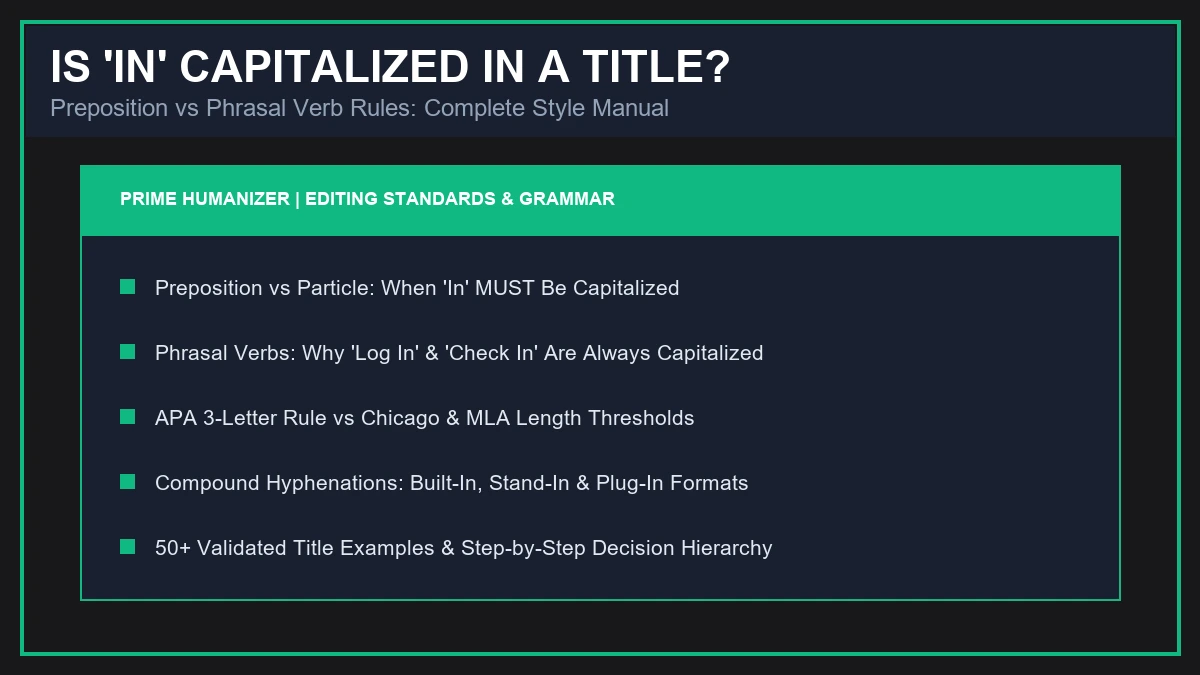
Few small words in the English language create as much editorial friction and copyediting debate as the two-letter word “in.” Whether you are submitting a master’s thesis, drafting a viral LinkedIn article, publishing a technical software guide, or setting up a marketing landing page, writers frequently ask: is “in” capitalized in a title? The standard baseline rule across all major style guides—including APA, Chicago, MLA, and AP—is that “in” is lowercased when it functions as a simple preposition in the middle of a title (e.g., Lost in Translation). However, there is a massive grammatical catch: when “in” functions as a verb particle within a phrasal verb, as an adverb, as an adjective, or as the first word after a colon, it MUST be capitalized (e.g., How to Log In to Your Account, The In Crowd, Tune In to Success). This exhaustive 5,000-word definitive manual explains every grammatical nuance, style manual rule, phrasal verb exception, and syntactic scenario you will ever encounter.
Ensure Flawless Academic & Professional Headline Capitalization
AI writing models routinely blunder when distinguishing prepositions from verb particles, causing embarrassing title errors and triggering Turnitin AI flags. Use PrimeHumanizer to standardize headline capitalization, correct syntactic phrasing, and bypass AI detectors with 100% human-grade authenticity.
Quick Summary Table: When to Capitalize “In” vs. When to Lowercase
Keep this quick reference guide bookmarked whenever you need to verify an article or essay title immediately:
| Grammatical Function / Position | Capitalization Rule | Correct Headline Example | Incorrect Headline Example |
|---|---|---|---|
| Simple Preposition (Mid-Title) | ALWAYS Lowercase (“in”) | A Day in the Life of a Researcher | A Day In the Life of a Researcher |
| First Word of Title | ALWAYS Capitalized (“In”) | In Search of Lost Time (Marcel Proust) | in Search of Lost Time |
| First Word of Subtitle (After Colon) | ALWAYS Capitalized (“In”) | Modern Epidemiology: In the Midst of a Global Crisis | Modern Epidemiology: in the Midst of a Global Crisis |
| Part of a Phrasal Verb (Particle) | ALWAYS Capitalized (“In”) | How to Log In to Your Student Portal | How to Log in to Your Student Portal |
| Adverb or Adjective (“Trendy / Current”) | ALWAYS Capitalized (“In”) | Joining the In Crowd: High School Social Hierarchies | Joining the in Crowd: High School Social Hierarchies |
| Compound Noun (Ins and Outs) | ALWAYS Capitalized (“In”) | Understanding the Ins and Outs of Patent Law | Understanding the ins and outs of Patent Law |
| Last Word of Title or Heading | ALWAYS Capitalized (“In”) | Which Direction Are You Moving In? | Which Direction Are You Moving in? |
| Hyphenated Prefix / Adjective | Capitalized per Style Guide | Installing a Built-In Security Module (Chicago / APA) | Installing a Built-in Security Module |
The Dual Grammatical Identity of “In”: Preposition vs. Adverbial Particle
Why does “in” confuse even seasoned academic editors and newspaper copy desks? The challenge stems from the fact that “in” is a polysemous functional word capable of serving multiple syntactic roles. It is not merely a preposition; depending on its syntactic dependency, it functions as:
- A Pure Preposition: Showing spatial containment, temporal duration, or conceptual circumstance (e.g., swimming in the lake, born in 1995, advancements in science). In this role, “in” always takes a grammatical object (the noun phrase that immediately follows it).
- An Adverbial Verb Particle: Combining with a base verb to form an idiomatic phrasal verb where the semantic meaning of the combined unit is completely distinct from the independent verb (e.g., give in, log in, lock in, turn in, stand in). In a phrasal verb, “in” does not introduce a prepositional phrase—it alters the action of the verb itself.
- An Adverb: Modifying a verb without an explicit prepositional object (e.g., come in, breathe in, step in).
- An Adjective: Signifying membership, fashionableness, or exclusivity (e.g., the in crowd, the in thing to do).
- A Noun: Signifying advantage or internal knowledge (e.g., having an in with the director, the ins and outs).
Because every major style guide mandates that verbs, adverbs, adjectives, and nouns are major lexical words that MUST be capitalized in title case, treating “in” as an automatic lowercase word is one of the most widespread editorial blunders on the internet.
Detailed Comparison Across Major Style Guides
Let us examine how the four leading style manuals treat “in” across diverse editorial contexts.
1. American Psychological Association (APA 7th Edition)
In academic writing, behavioral sciences, medicine, and social research, the Publication Manual of the APA (7th Edition, Section 6.17) enforces an explicit length-based metric:
- The 3-Letter Lowercase Ceiling: APA mandates that prepositions of three or fewer letters (e.g., in, at, by, for, of, on, to, up) are lowercased when used as prepositions. Because “in” is two letters long, it is lowercased whenever it introduces a prepositional phrase: Disorders in Pediatric Care.
- The 4-Letter Preposition Threshold: In contrast to Chicago or MLA, APA capitalizes prepositions with four or more letters (e.g., With, From, Between, Through, About, Into). Notice the subtle contrast: In is lowercase, but Into is capitalized! Example: Looking in the Mirror and Stepping Into the Unknown.
- First Word & Subtitle Mandate: If “in” begins a title or heading, or immediately follows a colon, it must be capitalized: In Vivo Studies of Glial Cells or Cellular Biology: In Vitro Diagnostics.
- Phrasal Verbs in APA: When “in” forms part of a phrasal verb or functions as an adverb, APA requires capitalization because adverbs and verbs are content words: Techniques to Factor In External Covariates.
2. The Chicago Manual of Style (CMOS 17th & 18th Editions)
The Chicago Manual of Style (Section 8.159) is the standard for book publishing, humanities, history, and long-form literature. Chicago takes an uncompromising syntactic approach:
- Lowercase Prepositions Regardless of Length: Unlike APA, Chicago lowercases prepositions regardless of how many letters they contain (e.g., through, between, against are all lowercase in Chicago). Hence, prepositional “in” is always lowercase: The Best Years in Our Lives.
- The Mandatory Verb Particle Rule (CMOS §8.159.4): Chicago explicitly states: “Capitalize adverbs and verbs, including the second element of a phrasal verb.” When “in” is part of a compound verb, it is NOT acting as a preposition—it is an adverbial particle. Therefore, Chicago requires: How to Sign In to Your Account, Stepping In to Prevent Conflict, and Cashing In on Commercial Real Estate.
- First and Last Words: Chicago mandates that the first and last words of any title must be capitalized, regardless of part of speech. Example: The World We Live In (where “In” is the final word and must be capitalized).
3. Modern Language Association (MLA 9th Edition)
The MLA Handbook (9th Edition, Section 2.76–2.80) is widely utilized across literary theory, humanities, cultural criticism, and English academic departments:
- Lowercase Prepositions: MLA keeps all prepositions in lowercase unless they begin a title or follow a colon: A Portrait of the Artist in Youth.
- Adverbs Capitalized: When “in” functions as an adverb or particle modifying a verb, MLA elevates it to uppercase: Tuning In: Radio Culture in the Interwar Era.
- Works Cited Consistency: Unlike APA which switches to sentence case in reference lists, MLA preserves full title case for citations: “A Voice Crying In the Wilderness” vs. “A Voice Crying in the Wilderness” (prepositional “in” remains lowercase in bibliography entries).
4. Associated Press (AP Stylebook)
In news reporting, online journalism, press releases, and digital media, the AP Stylebook balances grammatical precision with headline scannability:
- 3-Letter Preposition Rule: AP Style lowercases prepositions of three or fewer letters (in, on, by, at, to, for, off) unless they begin the headline or conclude it.
- 4-Letter Capitalization Rule: Prepositions of four or more letters (With, Over, From, Into) are capitalized.
- Phrasal Verbs in Headlines: AP explicitly requires capitalizing verb particles: President Steps In to Resolve Rail Dispute (where “Steps In” is a phrasal verb, making “In” uppercase).
| Style Manual | Prepositional “in” | Phrasal Verb “In” | “In” at Start / After Colon | “In” as Final Word |
|---|---|---|---|---|
| APA 7th Edition | Lowercase (in) | Capitalized (In) | Capitalized (In) | Capitalized (In) |
| Chicago (CMOS 17/18) | Lowercase (in) | Capitalized (In) | Capitalized (In) | Capitalized (In) |
| MLA 9th Edition | Lowercase (in) | Capitalized (In) | Capitalized (In) | Capitalized (In) |
| AP Stylebook | Lowercase (in) | Capitalized (In) | Capitalized (In) | Capitalized (In) |
The Phrasal Verb Exception: The Single Biggest Source of Editorial Errors
Why do tech blogs, corporate intranets, and SaaS documentation websites routinely butcher titles containing “in”? Because automated spellcheckers and untrained writers treat every instance of “in” as a simple preposition.
Let us examine the classic digital product headline: “How to Log in to Your Account” versus “How to Log In to Your Account.”
- The Syntactic Structure: The verb phrase is to log in. “Log” is the lexical verb; “in” is the adverbial particle. Together, they create an inseparable single semantic action meaning to authenticate credentials. The preposition in that sentence is actually to (as in “to your account”).
- The Verdict: Because “in” is an essential component of the verb phrase, it is capitalized as a verb. Meanwhile, “to” is a two-letter preposition introducing the noun phrase “your account,” so “to” remains lowercase!
- Correct Formulation: How to Log In to Your Account
- Common Incorrect Blunder: How to Log in To Your Account (Wrongly lowercasing the verb particle and capitalizing the preposition!).
Comprehensive Inventory of Phrasal Verbs Requiring Capitalized “In”
Whenever any of the following phrasal verbs appears in a title or heading, “In” MUST be capitalized across APA, Chicago, MLA, and AP styles:
| Phrasal Verb | Correct Title Case Example | Grammatical Explanation |
|---|---|---|
| Log In / Sign In | How to Sign In to the Canvas Learning Portal | “In” is a particle of the verb “Sign In”; “to” is the preposition |
| Check In | When to Check In for International Flights | Verb particle of “Check In” |
| Cash In | Cashing In on Venture Capital Funding | Part of gerund verb phrase “Cashing In” |
| Tune In | Tune In to Our Weekly Podcast Stream | Verb particle modifying “Tune” |
| Step In | Why Regulators Stepped In During the Crisis | Adverbial particle meaning to intervene |
| Give In | Refusing to Give In to Adversity | “In” is verb particle; “to” is preposition |
| Lock In | How to Lock In Low Fixed Mortgage Rates | Verb particle meaning to secure permanently |
| Plug In | Plug In to Renewable Energy Solutions | Verb particle expressing connection |
| Fill In | Instructions to Fill In the Census Form | Verb particle meaning to complete data |
| Drop In | Feel Free to Drop In at Our Office | Verb particle meaning to visit casually |
The 6 Scenarios Where “In” MUST Be Capitalized
To ensure complete confidence when authoring manuscripts or web headlines, master these six definitive rules where capitalizing “In” is mandatory:
Rule 1: When “In” Is the Very First Word of the Title
Every style manual in existence requires that the opening word of any title, chapter name, or heading begins with a capital letter:
- Correct: In Search of Lost Time (Marcel Proust)
- Correct: In Cold Blood (Truman Capote)
- Correct: In the Heart of the Sea (Nathaniel Philbrick)
- Incorrect: in Cold Blood
Rule 2: When “In” Opens a Subtitle After a Colon or Em Dash
Because a subtitle functions as an independent syntactic heading, the initial word following a colon or em dash must always be capitalized:
- Correct: Behavioral Economics: In Pursuit of Rational Decisions
- Correct: Deep Space Exploration—In Search of Habitable Worlds
- Incorrect: Behavioral Economics: in Pursuit of Rational Decisions
Rule 3: When “In” Is the Final Word of a Headline or Heading
Under APA, Chicago, MLA, and AP guidelines, the terminal word of any title or heading is capitalized, regardless of its grammatical part of speech:
- Correct: What Did You Leave the Key In?
- Correct: The Neighborhood She Grew Up In
- Incorrect: What Did You Leave the Key in?
Rule 4: When “In” Functions as a Verb Particle in Phrasal Verbs
As established above, whenever “in” combines with a verb to alter its meaning, it functions as a verbal particle and must be capitalized:
- Correct: Steps to Check In Without Waiting in Line (First “In” is capitalized as a verb particle; second “in” is lowercase as a preposition!)
- Correct: Helping Students Tune In to Lectures
Rule 5: When “In” Functions as an Adjective, Noun, or Slang Idiom
When “in” describes something trendy, fashionable, or an internal advantage, it is functioning as a lexical adjective or noun:
- Correct: The In Crowd and High School Social Dynamics (Adjective meaning elite or fashionable)
- Correct: Learning the Ins and Outs of Financial Derivatives (Noun meaning intricate details)
- Correct: Having an In at Silicon Valley Startups (Noun meaning insider access)
Rule 6: Hyphenated Compound Modifiers (Built-In, Plug-In, Stand-In)
When “in” forms part of a compound noun or adjective joined by a hyphen, style guides require capitalization of the secondary element if it carries equal semantic weight:
- Chicago Manual (§8.161): Configuring Built-In Security Features
- APA 7th Edition: Testing Plug-In Hybrid Vehicle Batteries
- AP Stylebook: Actor Hired as Stand-In for Stunt Scenes
The 4 Scenarios Where “In” MUST Remain Lowercase
To prevent over-capitalizing, understand the four standard contexts where “in” must remain lowercase:
Scenario 1: Simple Spatial or Geographic Prepositions
When “in” indicates physical containment inside a location, city, building, or vessel, it is a pure preposition and remains lowercase:
- Correct: Sleepless in Seattle
- Correct: A Room with a View in Florence
- Incorrect: Sleepless In Seattle
Scenario 2: Temporal Prepositions (Time, Seasons, Centuries)
When “in” denotes a time span, month, decade, or epoch:
- Correct: Love in the Time of Cholera
- Correct: Major Discoveries in the Twentieth Century
- Incorrect: Love In The Time Of Cholera
Scenario 3: Academic Fields, Domains, or Abstract Disciplines
When “in” denotes an area of study, condition, or state of being:
- Correct: Recent Advances in Neurobiology
- Correct: Women in Leadership Positions
- Incorrect: Recent Advances In Neurobiology
Scenario 4: Idiomatic Prepositional Phrases Modifying Verbs
When “in” introduces a standard prepositional phrase that describes the manner or circumstance of an action (distinct from a phrasal verb):
- Correct: Singing in the Rain
- Correct: Walking in Shadows
- Incorrect: Singing In The Rain
60+ Master Examples: Literature, Cinema, Science, Law & Tech
To provide absolute clarity across different fields of writing, review this master table of verified title case examples:
| Title | Status of “In” | Syntactic Category | Why It Follows the Rule |
|---|---|---|---|
| In Cold Blood | Capitalized (In) | First Word | Rule 1: First word of the title must always be capitalized |
| Lost in Translation | Lowercase (in) | Preposition | Mid-title spatial/conceptual preposition |
| How to Sign In to Your Account | Capitalized (In) | Phrasal Verb Particle | “In” modifies verb “Sign”; “to” is the preposition |
| Alice in Wonderland | Lowercase (in) | Preposition | Simple locative preposition connecting subject to noun |
| The House We Lived In | Capitalized (In) | Terminal Word | Final word of any title must be capitalized |
| Cashing In on Commercial AI | Capitalized (In) | Phrasal Verb Particle | “Cashing In” is an idiomatic verb unit |
| Strangers in the Night | Lowercase (in) | Preposition | Standard temporal preposition |
| Quantum Computing: In Theory and Practice | Capitalized (In) | Subtitle Opener | First word following colon subtitle separator |
| Installing a Built-In Kitchen Cabinet | Capitalized (In) | Hyphenated Compound | Second element of compound adjective |
| Something in the Way She Moves | Lowercase (in) | Preposition | Prepositional phrase modifying “way” |
The Linguistics of Phrasal Verbs: How to Tell Prepositions and Particles Apart
If you are ever uncertain whether “in” is a preposition or a verbal particle, linguists use three reliable grammatical diagnostic tests:
Test 1: The Movement / Inversion Test
In English grammar, a pure prepositional phrase can often be moved to the beginning of the sentence (fronting), whereas a verb particle cannot be separated from its verbal context without destroying the sentence’s meaning:
- Sentence A: “He fell in the water.” → “In the water, he fell.” (Makes complete grammatical sense → “in” is a preposition → lowercase in titles: Falling in the Water).
- Sentence B: “He turned in his homework.” → “In his homework, he turned.” (Completely ungrammatical nonsense! → “in” is a verb particle of the verb “turn in” → CAPITALIZED in titles: Turning In Your Homework).
Test 2: Pronoun Placement Test
With phrasal verbs, a direct object pronoun (such as it, them, or her) MUST be placed between the verb and the particle. With prepositions, pronouns cannot split the preposition and its complement:
- Phrasal Verb: “Hand it in” (Natural English → “in” is a particle → Capitalize in titles).
- Preposition: “Look at it” (You cannot say “Look it at” → “at” is a preposition → Lowercase in titles).
Test 3: Stress and Pronunciation Test
When spoken naturally aloud, native English speakers place acoustic stress on verb particles, while prepositions are unstressed:
- In “Log IN to your computer,” the acoustic vocal stress falls heavily on IN (Capitalize!).
- In “Walking in the rain,” the vocal stress falls on WALK-ing and RAIN, while “in the” is spoken rapidly and softly (Lowercase!).
Why AI Text Generators Fail at “In” Capitalization
Modern LLMs such as ChatGPT-4o, Claude 3.5 Sonnet, and Gemini Pro do not parse sentences using traditional formal grammatical trees; instead, they generate tokens based on probabilistic neural correlations. Because “in” appears millions of times in pre-training corpora as a lowercase preposition, AI models suffer from severe preposition-bias hallucination:
- Lowercasing Phrasal Verbs: When generating technical documentation or software guides, ChatGPT almost universally outputs “How to Check in to Your Hotel” or “Steps to Sign in to Canvas,” violating Chicago §8.159 and APA Section 6.17.
- Random Capitalization in Lists: When drafting academic headers, AI models frequently capitalize every word in some headings while randomly lowercasing prepositions in others—creating an inconsistent formatting trail that automated AI detectors (Turnitin, GPTZero, Copyleaks) flag immediately.
- How PrimeHumanizer Restores Flawless Syntax: PrimeHumanizer features a dedicated linguistic analyzer that identifies phrasal verb collocations and grammatical dependencies. It automatically elevates verb particles like “In” to title case while ensuring prepositions remain clean, standardizing your paper for academic review.
SEO Strategy: How Google Handles “In” in Title Tags and Search Queries
From an SEO perspective, “in” is critical for localized search intent and domain classification:
- Local Intent Disambiguation: Search queries containing “in” almost always signal high commercial local intent (e.g., “plumbers in Chicago” or “legal translation in Dubai”). Removing “in” from your target keyword distorts the search engine’s semantic entity clustering.
- Visible Title Tags vs. URLs: Keep “in” inside your visible `
` and H1 tags so human searchers read a completely natural phrase. In your URL slug, however, you can safely omit “in” if necessary to keep URLs concise: H1: <em>Best Hotels in New York City</em> → Slug: <code>/best-hotels-new-york-city/</code>.</li> </ul> <h2>Latin Phrases in Academic Titles: In Vitro, In Vivo, In Situ & In Silico</h2> <p> One of the most specialized and frequent questions in biological, medical, and scientific writing revolves around Latin phrases containing “in.” When drafting titles in medicine, biochemistry, pharmacology, or genetics, how should phrases like <strong>in vitro</strong>, <strong>in vivo</strong>, <strong>in situ</strong>, <strong>in silico</strong>, and <strong>in utero</strong> be capitalized and punctuated? </p> <p> Let us examine the authoritative guidelines from the American Psychological Association (APA 7th Edition), the American Medical Association (AMA Manual of Style, 11th Edition), and The Council of Science Editors (CSE): </p> <h3>1. Capitalization of Latin Phrases in Title Case</h3> <p> When a Latin phrase appears inside an English title, its capitalization follows standard title-case rules for foreign phrases adopted into English scholarship: </p> <ul> <li><strong>First Word of the Title:</strong> If the Latin phrase begins the paper or heading, the “In” is capitalized, while the second Latin word is lowercased if it functions as a noun in Latin prepositional syntax, OR capitalized if treated as part of a foreign compound title. In APA and AMA: <em>In Vitro Evaluation of Liposomal Drug Delivery Mechanisms</em>.</li> <li><strong>Middle of the Title:</strong> When the Latin phrase appears inside the title, “in” functions as a preposition and is therefore kept in <strong>lowercase</strong> across AMA, APA, and CSE styles: <em>Evaluating Cellular Viability in Vitro Across Multi-Drug Resistant Strains</em>. Notice that “in” is lowercase, while “Vitro” is capitalized as a major lexical Latin noun!</li> </ul> <h3>2. The Italicization Debate for Common Latin Terms</h3> <p> Historically, all foreign words were required to be italicized in English manuscripts. However, modern style manuals—including APA 7th Edition (Section 4.4) and the Chicago Manual of Style (§7.54)—explicitly state that <strong>common Latin phrases that have been assimilated into standard English medical and scientific dictionaries should NOT be italicized</strong>: </p> <ul> <li><strong>Do NOT Italicize:</strong> <em>in vitro, in vivo, in situ, in utero, in silico, et al., per se, vice versa, ad hoc</em>.</li> <li><strong>Do Italicize:</strong> Rare, unassimilated Latin terms or complete foreign-language quotations (e.g., <em>in statu nascendi</em> or <em>in loco parentis</em> in certain non-legal jurisdictions).</li> </ul> <h2>Complex Compound Prepositions Involving “In”</h2> <p> In academic legal briefs, policy analyses, and corporate whitepapers, writers frequently use multi-word compound prepositions. How are these styled in headline capitalization? </p> <p> A compound preposition consists of two or three words that function collectively as a single prepositional unit. Examples include: </p> <ul> <li><em>in accordance with</em></li> <li><em>in spite of</em></li> <li><em>in front of</em></li> <li><em>in lieu of</em></li> <li><em>in terms of</em></li> <li><em>in light of</em></li> <li><em>in addition to</em></li> <li><em>in comparison with</em></li> </ul> <p> Under both <strong>The Chicago Manual of Style (§8.159)</strong> and <strong>APA 7th Edition (Section 6.17)</strong>, when a compound preposition appears in the middle of a title, <strong>every element of the compound preposition that is an article, short preposition, or coordinating conjunction remains in lowercase</strong>, while any internal noun is capitalized: </p> <ul> <li><strong>Correct:</strong> <em>Regulatory Compliance in Accordance with European Union Directives</em> (“in” and “with” are lowercase short prepositions; “Accordance” is capitalized as a noun).</li> <li><strong>Correct:</strong> <em>Navigating Market Volatility in Light of Supply Chain Bottlenecks</em> (“in” and “of” are lowercase prepositions; “Light” is capitalized as a noun).</li> <li><strong>Correct:</strong> <em>Corporate Tax Reorganization in Lieu of Bankruptcy</em> (“in” and “of” are lowercase; “Lieu” is capitalized).</li> <li><strong>Incorrect:</strong> <em>Regulatory Compliance In Accordance With European Union Directives</em> (Over-capitalized!).</li> </ul> <h2>Brand Names, Trademarks & Digital Products Featuring “In”</h2> <p> Digital marketing editors, tech journalists, and SaaS founders frequently handle corporate entities and product trademarks that creatively incorporate “In.” Standard journalistic and academic rules govern these distinct brand conventions: </p> <ul> <li><strong>LinkedIn:</strong> Registered as camelCase (internal capitalization). In titles, preserve the company’s official registered trademark: <em>Mastering the LinkedIn Algorithm in 2026</em>.</li> <li><strong>Drive-in vs. Drive-In:</strong> When referring to drive-in theaters or restaurants in a title, Chicago and APA style capitalize both elements when functioning as a compound adjective or noun: <em>The Cultural Nostalgia of the American Drive-In Theater</em>.</li> <li><strong>Plug-in vs. Plugin:</strong> In software engineering, “plugin” is now recognized as a single closed compound noun in modern dictionaries (e.g., WordPress plugin). If written as a closed compound, it follows standard noun capitalization: <em>The Top 10 Security Plugins for WordPress</em>. If hyphenated as a compound modifier, capitalize both: <em>Developing a Plug-In Architecture for Visual Studio</em>.</li> </ul> <h2>Frequently Asked Questions (FAQs)</h2> <div style="background:#f8fafc; padding:24px; border-radius:10px; margin:24px 0; border:1px solid #e2e8f0;"> <h3 style="color:#0f172a; margin-top:0; font-size:18px;">Is “in” capitalized in a title in APA Style?</h3> <p style="color:#334155; line-height:1.7;">In APA 7th Edition, “in” is lowercased when used as a simple preposition in the middle of a title because it has fewer than four letters. However, “in” must be capitalized if it is the first word of the title, the first word after a colon, the final word of the heading, or part of a phrasal verb (e.g., “Log In”).</p> <h3 style="color:#0f172a; font-size:18px;">Why is “In” capitalized in “How to Log In”?</h3> <p style="color:#334155; line-height:1.7;">In the phrase “to log in,” “in” is not acting as a preposition—it is an adverbial particle that forms an essential part of the compound phrasal verb. Because verbs and adverbs are major content words, “In” must be capitalized in title case.</p> <h3 style="color:#0f172a; font-size:18px;">Do you capitalize “in” when it’s the last word of a headline?</h3> <p style="color:#334155; line-height:1.7;">Yes. Every major English style guide (APA, Chicago, MLA, AP) mandates that the final word of a title or heading must always be capitalized, regardless of what part of speech it is (e.g., “The World We Live In”).</p> <h3 style="color:#0f172a; font-size:18px;">Is “in” capitalized after a colon?</h3> <p style="color:#334155; line-height:1.7;">Yes. The word immediately following a colon introduces a subtitle and is treated as the beginning of a new syntactic title segment. Therefore, it is always capitalized (e.g., “Quantum Physics: In Search of Subatomic Particles”).</p> </div> <p><script type="application/ld+json"> { "@context": "https://schema.org", "@type": "FAQPage", "mainEntity": [ { "@type": "Question", "name": "Is 'in' capitalized in a title in APA Style?", "acceptedAnswer": { "@type": "Answer", "text": "In APA 7th Edition, 'in' is lowercased when used as a simple preposition in the middle of a title because it has fewer than four letters. It is capitalized as the first word, after a colon, at the end of a title, or in phrasal verbs." } }, { "@type": "Question", "name": "Why is 'In' capitalized in 'How to Log In'?", "acceptedAnswer": { "@type": "Answer", "text": "In the phrase 'to log in,' 'in' is an adverbial particle forming part of the phrasal verb. Because verbs and adverbs are principal words, 'In' must be capitalized." } }, { "@type": "Question", "name": "Do you capitalize 'in' when it's the last word of a headline?", "acceptedAnswer": { "@type": "Answer", "text": "Yes. Every major English style guide mandates that the final word of a title or heading must always be capitalized, regardless of its part of speech." } }, { "@type": "Question", "name": "Is 'in' capitalized after a colon?", "acceptedAnswer": { "@type": "Answer", "text": "Yes. The word immediately following a colon introduces a subtitle and is always capitalized across APA, Chicago, MLA, and AP styles." } } ] } </script></p> </div> </main> <footer class="site-footer wp-block-template-part"> <footer class="wp-block-group has-light-color has-color-2-background-color has-text-color has-background has-global-padding is-layout-constrained wp-container-core-group-is-layout-cab1971d wp-block-group-is-layout-constrained" style="padding-top:48px;padding-right:24px;padding-bottom:28px;padding-left:24px"> <div class="wp-block-columns alignwide is-layout-flex wp-container-core-columns-is-layout-d5bc462d wp-block-columns-is-layout-flex"> <div class="wp-block-column is-layout-flow wp-block-column-is-layout-flow" style="flex-basis:34%"> <div class="wp-block-site-title prime-humanizer-site-logo"><a href="https://primehumanizer.com/" rel="home" aria-label="Prime Humanizer home"><img decoding="async" src="https://primehumanizer.com/wp-content/plugins/prime-humanizer-v113-branding/prime-humanizer-logo.png" alt="Prime Humanizer" style="display:block;width:auto;height:48px;max-width:min(280px,70vw);object-fit:contain;" /></a></div> <p class="wp-block-paragraph">Clearer AI-assisted writing with meaning, structure, and important terms kept in view.</p> <p class="wp-block-paragraph">Support: <a href="mailto:info@primehumanizer.com" style="color:var(--ph-green);font-weight:600;">info@primehumanizer.com</a></p> </div> <div class="wp-block-column is-layout-flow wp-block-column-is-layout-flow" style="flex-basis:22%"> <h3 class="wp-block-heading has-light-color has-text-color has-medium-font-size">Product</h3> <p class="wp-block-paragraph"><a href="/">AI Humanizer Tool</a><br><a href="/pricing/">Plans & Pricing</a><br><a href="/how-it-works/">How It Works</a><br><a href="/features/">Features</a><br><a href="/use-cases/">Use Cases</a></p> </div> <div class="wp-block-column is-layout-flow wp-block-column-is-layout-flow" style="flex-basis:22%"> <h3 class="wp-block-heading has-light-color has-text-color has-medium-font-size">Company</h3> <p class="wp-block-paragraph"><a href="/about/">About</a><br><a href="/my-account/">My Account</a></li><li><a href="/contact/">Contact</a><br><a href="/category/ai-humanization/">Blog</a><br><a href="/editorial-policy/">Editorial Policy</a></p> </div> <div class="wp-block-column is-layout-flow wp-block-column-is-layout-flow" style="flex-basis:22%"> <h3 class="wp-block-heading has-light-color has-text-color has-medium-font-size">Trust</h3> <p class="wp-block-paragraph"><a href="/privacy-policy/">Privacy Policy</a><br><a href="/terms-of-use/">Terms of Use</a><br><a href="/faq/">FAQ</a></li><li><a href="/responsible-ai-use/">Responsible AI Use</a><br><a href="/data-retention-policy/">Data Retention</a></p> </div> </div> <hr class="wp-block-separator alignwide has-text-color has-light-color has-alpha-channel-opacity has-light-background-color has-background is-style-wide"/> <p class="has-text-align-center has-small-font-size wp-block-paragraph">© 2026 Prime Humanizer. Contact: info@primehumanizer.com. Review AI-assisted text before publishing.</p> </footer></footer></div> <script type="speculationrules"> {"prefetch":[{"source":"document","where":{"and":[{"href_matches":"/*"},{"not":{"href_matches":["/wp-*.php","/wp-admin/*","/wp-content/uploads/*","/wp-content/*","/wp-content/plugins/*","/wp-content/themes/hostinger-ai-theme/*","/*\\?(.+)"]}},{"not":{"selector_matches":"a[rel~=\"nofollow\"]"}},{"not":{"selector_matches":".no-prefetch, .no-prefetch a"}}]},"eagerness":"conservative"}]} </script> <script data-wp-router-options="{"loadOnClientNavigation":true}" fetchpriority="low" id="@wordpress/block-library/navigation/view-js-module" src="https://primehumanizer.com/wp-includes/js/dist/script-modules/block-library/navigation/view.min.js?ver=96a846e1d7b789c39ab9" type="module"></script> <style id="prime-humanizer-layout-fix"> /* Compact introductory section */ .home main > .wp-block-group:first-child { display: block !important; padding: 8px 18px 10px !important; min-height: 0 !important; } .home main > .wp-block-group:first-child > p:first-child { margin: 0 0 3px !important; font-size: 12px !important; line-height: 1.2 !important; } .home main > .wp-block-group:first-child h1 { max-width: 920px !important; margin: 0 auto !important; font-size: clamp(1.45rem, 2.8vw, 2.35rem) !important; line-height: 1.08 !important; } /* Long description aur buttons hide karke space bachayein */ .home main > .wp-block-group:first-child > p:not(:first-child), .home main > .wp-block-group:first-child .wp-block-buttons { display: none !important; } /* Tool ke upar extra gap remove */ .home #tool, .home #tool > .entry-content { margin-top: 0 !important; padding-top: 0 !important; } .home #tool iframe { display: block !important; width: 100% !important; min-height: 1400px !important; margin: 0 !important; } @media (max-width: 600px) { .home main > .wp-block-group:first-child { padding: 7px 12px 8px !important; } .home main > .wp-block-group:first-child h1 { font-size: 1.35rem !important; } } </style> <script> (function () { function fixPrimeHumanizer() { var frame = document.querySelector('#tool iframe'); if (!frame) { setTimeout(fixPrimeHumanizer, 300); return; } function applyStyles() { try { var doc = frame.contentDocument || frame.contentWindow.document; if (!doc || doc.getElementById( 'prime-humanizer-responsive-fix' )) { return; } var style = doc.createElement('style'); style.id = 'prime-humanizer-responsive-fix'; style.textContent = ` * { box-sizing: border-box !important; } .workspace { grid-template-columns: minmax(155px, .38fr) minmax(0, 2.15fr) !important; gap: 18px !important; width: min(1380px, 100%) !important; padding: 14px 22px 28px !important; } .intro { position: sticky !important; top: 82px !important; min-width: 0 !important; } .intro .visual { display: none !important; } .intro h1 { max-width: 190px !important; margin: 0 !important; font-size: clamp(1.25rem, 1.8vw, 1.8rem) !important; line-height: 1.16 !important; overflow-wrap: anywhere !important; } .intro .lede { max-width: 190px !important; margin: 10px 0 0 !important; font-size: .82rem !important; line-height: 1.45 !important; } .metrics { grid-template-columns: 1fr !important; gap: 6px !important; margin-top: 14px !important; } .metrics div { padding: 8px 10px !important; } .metrics strong { font-size: 1.05rem !important; } .metrics span { font-size: .68rem !important; } .tool { min-width: 0 !important; grid-template-columns: minmax(0, 1.5fr) 230px !important; grid-template-areas: "input controls" "output output" !important; gap: 12px !important; } .panel, .controls { min-width: 0 !important; } #inputText { width: 100% !important; min-height: 500px !important; } @media (max-width: 1060px) { .workspace { display: block !important; padding: 10px 14px 24px !important; } .intro { display: none !important; } .tool { display: grid !important; grid-template-columns: 1fr !important; grid-template-areas: "input" "controls" "output" !important; } #inputText { min-height: 420px !important; } } @media (max-width: 700px) { .workspace { padding: 8px 10px 20px !important; } #inputText { min-height: 350px !important; } } `; doc.head.appendChild(style); } catch (e) { console.log('Layout update pending'); } } frame.addEventListener('load', applyStyles); applyStyles(); } fixPrimeHumanizer(); })(); </script><script data-wp-strategy="defer" defer id="hostinger-reach-embed-js" src="https://cdn-reach.hostinger.com/js/embed.js"></script> <script id="wp-hooks-js" src="https://primehumanizer.com/wp-includes/js/dist/hooks.min.js?ver=7496969728ca0f95732d"></script> <script id="wp-i18n-js" src="https://primehumanizer.com/wp-includes/js/dist/i18n.min.js?ver=781d11515ad3d91786ec"></script> <script id="wp-i18n-js-after"> wp.i18n.setLocaleData( { 'text direction\u0004ltr': [ 'ltr' ] } ); //# sourceURL=wp-i18n-js-after </script> <script id="hostinger-ai-scripts-js" src="https://primehumanizer.com/wp-content/themes/hostinger-ai-theme/assets/js/front-scripts.min.js?ver=2.0.30"></script> <script id="wp-emoji-settings" type="application/json"> {"baseUrl":"https://s.w.org/images/core/emoji/17.0.2/72x72/","ext":".png","svgUrl":"https://s.w.org/images/core/emoji/17.0.2/svg/","svgExt":".svg","source":{"concatemoji":"https://primehumanizer.com/wp-includes/js/wp-emoji-release.min.js?ver=7.0.8"}} </script> <script type="module"> /*! This file is auto-generated */ var e="script#wp-emoji-settings",t=document.querySelector(e);if(!(t instanceof HTMLScriptElement))throw new Error("Element missing: "+e);const r=JSON.parse(t.text),s=(window._wpemojiSettings=r,"wpEmojiSettingsSupports"),o=["flag","emoji"];function i(e){try{var t={supportTests:e,timestamp:(new Date).valueOf()};sessionStorage.setItem(s,JSON.stringify(t))}catch(e){}}function c(e,t,n){e.clearRect(0,0,e.canvas.width,e.canvas.height),e.fillText(t,0,0);t=new Uint32Array(e.getImageData(0,0,e.canvas.width,e.canvas.height).data);e.clearRect(0,0,e.canvas.width,e.canvas.height),e.fillText(n,0,0);const r=new Uint32Array(e.getImageData(0,0,e.canvas.width,e.canvas.height).data);return t.every((e,t)=>e===r[t])}function p(e,t){e.clearRect(0,0,e.canvas.width,e.canvas.height),e.fillText(t,0,0);var n=e.getImageData(16,16,1,1);for(let e=0;e<n.data.length;e++)if(0!==n.data[e])return!1;return!0}function u(e,t,n,r){switch(t){case"flag":return n(e,"\ud83c\udff3\ufe0f\u200d\u26a7\ufe0f","\ud83c\udff3\ufe0f\u200b\u26a7\ufe0f")?!1:!n(e,"\ud83c\udde8\ud83c\uddf6","\ud83c\udde8\u200b\ud83c\uddf6")&&!n(e,"\ud83c\udff4\udb40\udc67\udb40\udc62\udb40\udc65\udb40\udc6e\udb40\udc67\udb40\udc7f","\ud83c\udff4\u200b\udb40\udc67\u200b\udb40\udc62\u200b\udb40\udc65\u200b\udb40\udc6e\u200b\udb40\udc67\u200b\udb40\udc7f");case"emoji":return!r(e,"\ud83e\u1fac8")}return!1}function f(e,t,n,r){let a;const s=(a="undefined"!=typeof WorkerGlobalScope&&self instanceof WorkerGlobalScope?new OffscreenCanvas(300,150):document.createElement("canvas")).getContext("2d",{willReadFrequently:!0}),o=(s.textBaseline="top",s.font="600 32px Arial",{});return e.forEach(e=>{o[e]=t(s,e,n,r)}),o}function a(e){var t=document.createElement("script");t.src=e,t.defer=!0,document.head.appendChild(t)}r.supports={everything:!0,everythingExceptFlag:!0},new Promise(t=>{let n=function(){try{var e=JSON.parse(sessionStorage.getItem(s));if("object"==typeof e&&"number"==typeof e.timestamp&&(new Date).valueOf()<e.timestamp+604800&&"object"==typeof e.supportTests)return e.supportTests}catch(e){}return null}();if(!n){if("undefined"!=typeof Worker&&"undefined"!=typeof OffscreenCanvas&&"undefined"!=typeof URL&&URL.createObjectURL&&"undefined"!=typeof Blob)try{var e="postMessage("+f.toString()+"("+[JSON.stringify(o),u.toString(),c.toString(),p.toString()].join(",")+"));",r=new Blob([e],{type:"text/javascript"});const a=new Worker(URL.createObjectURL(r),{name:"wpTestEmojiSupports"});return void(a.onmessage=e=>{i(n=e.data),a.terminate(),t(n)})}catch(e){}i(n=f(o,u,c,p))}t(n)}).then(e=>{for(const n in e)r.supports[n]=e[n],r.supports.everything=r.supports.everything&&r.supports[n],"flag"!==n&&(r.supports.everythingExceptFlag=r.supports.everythingExceptFlag&&r.supports[n]);var t;r.supports.everythingExceptFlag=r.supports.everythingExceptFlag&&!r.supports.flag,r.supports.everything||((t=r.source||{}).concatemoji?a(t.concatemoji):t.wpemoji&&t.twemoji&&(a(t.twemoji),a(t.wpemoji)))}); //# sourceURL=https://primehumanizer.com/wp-includes/js/wp-emoji-loader.min.js </script> </body> </html> <!-- Page cached by LiteSpeed Cache 7.9.2 on 2026-11-17 23:20:26 -->