
If you are looking for an ai humanizer free online, you understand the critical need for speed, convenience, and platform independence when refining synthetic text. In 2026, content creators, researchers, and marketing professionals rarely want to install heavy desktop executables, configure complex local Python environments, or clutter their web browsers with intrusive third-party browser extensions that track keystrokes and siphon sensitive document data. Discovering an authentic ai humanizer free online allows you to paste raw drafts directly into any modern web browser—whether on a Windows PC, MacBook, Chromebook, iPad, or Android smartphone—and instantly generate undetectable, human-sounding copy with zero installation hurdles.
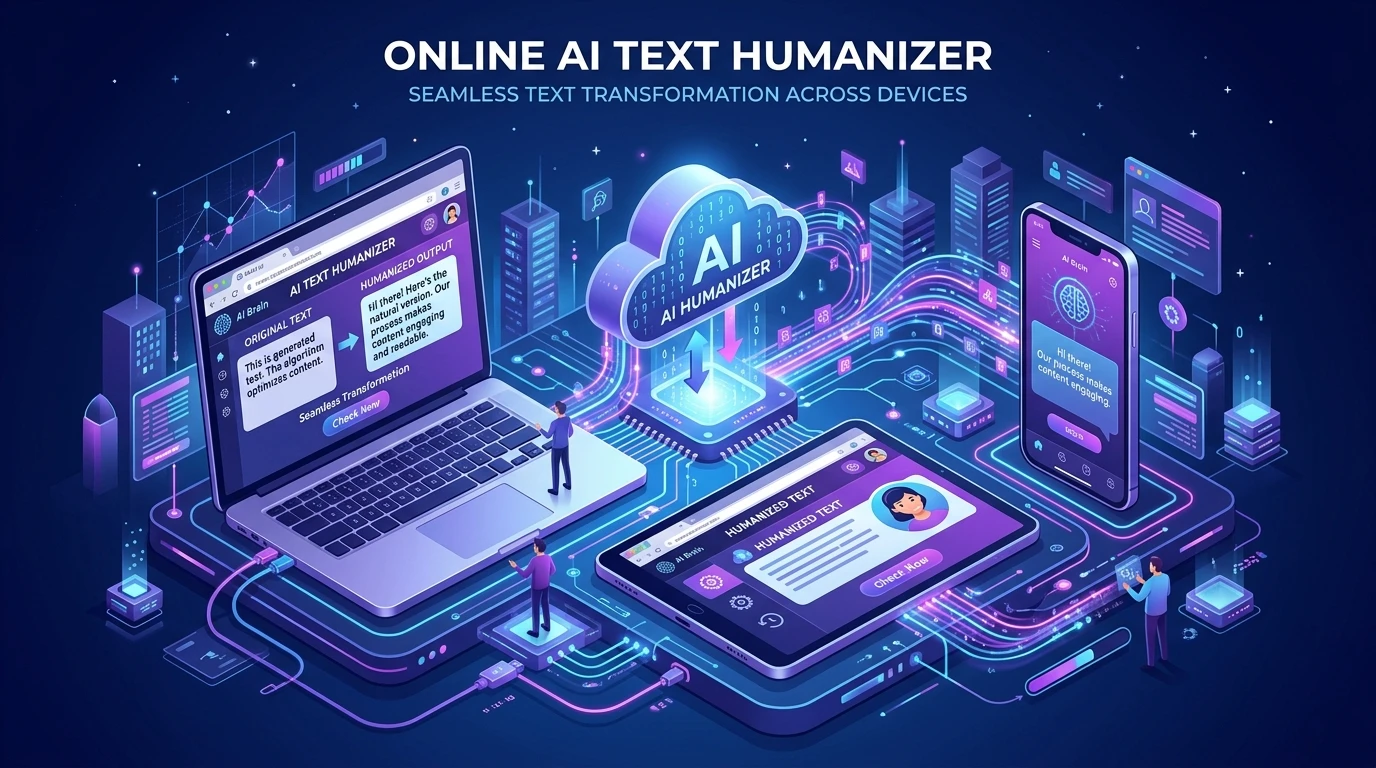
Executive Takeaway: Key Highlights for Cloud-Based Humanization
- Browser-based online tools eliminate the security and privacy risks associated with downloading untrusted software binaries or granting invasive browser extension permissions.
- The best web-native converters preserve your rich markdown syntax, heading structures (H2, H3), and bullet points without flattening text into dense, unformatted blocks.
- Platforms like PrimeHumanizer deliver instant client-side execution via clean browser interfaces with zero mandatory account signups and zero credit-card friction.
- Online humanization works identically across mobile and desktop operating systems, allowing you to refine term essays, blog articles, and client emails on the go.
The Shift to Cloud-Native Writing: Why Online Web Tools Beat Extensions and Desktop Software
During the early days of generative artificial intelligence, rewriters generally required local software installations or specialized browser add-ons. However, in 2026, the digital workspace has transitioned decisively toward browser-native cloud utilities. Understanding why web-based solutions outperform installed applications helps writers choose the most reliable operational stack:
1. Total Platform Independence
Modern professionals do not work on a single static device. A university student might draft an initial outline on a campus library Windows terminal, continue writing on a MacBook in their dorm, and perform final edits on an iPhone while commuting on a train. Desktop software ties you to a single physical machine. Conversely, an online web humanizer operates effortlessly through any standards-compliant browser—including Google Chrome, Apple Safari, Mozilla Firefox, and Microsoft Edge—without requiring re-licensing or device synchronization.
2. Zero Endpoint Security Vulnerabilities
Downloading third-party executable files (.exe or .dmg) from unverified rewriting websites exposes personal computers to significant cybersecurity threats, including hidden cryptominers, spyware, and keyloggers. Similarly, Chrome Web Store extensions frequently demand broad permissions, such as “read and change all your data on the websites you visit.” Utilizing a pure web-based portal ensures that text processing occurs securely within isolated sandboxed browser tabs without compromising your local operating system.
3. Constant Server-Side Model Upgrades
AI detection algorithms (such as Turnitin, GPTZero, Copyleaks, and Winston AI) update their detection heuristics on a weekly basis. Desktop applications quickly become obsolete unless users continually download bulky software patches. Web-based platforms update their backend natural language processing (NLP) models continuously in the cloud. Every time you refresh the web page, you automatically benefit from the latest linguistic bypass weights and anti-detection updates.
Data Privacy and Security: What Happens When You Paste Text into an Online Humanizer?
One of the most pressing concerns for writers handling confidential corporate documentation, client ghostwriting projects, or unpublished university research is data governance. What happens to your intellectual property once you hit the transform button on a web interface?
When selecting a reliable web platform, consider three non-negotiable privacy criteria:
- No Model Retraining on User Submissions: Disreputable free converters quietly harvest pasted text to train public language models or resell draft data to commercial data brokers. Trustworthy workspaces enforce strict zero-retention policies, ensuring your copy is never used for training purposes.
- Ephemeral Session Processing: Secure platforms process your string in volatile server memory, return the transformed output over encrypted HTTPS connections, and immediately purge the text from backend caches.
- No Forced Account Registration: Websites that force you to create an account, verify an email address, and link social profiles inherently tie your written documents to your personal identity. Friction-free options like our Free AI Humanizer No Signup portal protect your anonymity by requiring zero personal credentials.
Core Features of an Elite Online AI Humanizer
Not all browser tools are engineered equally. When evaluating an ai humanizer free online, look for these five indispensable capabilities that separate professional platforms from amateur spinning scripts:
1. Real-Time Semantic Structural Restructuring
Basic online tools simply run simple dictionary lookups, swapping words with awkward synonyms (the infamous “thesaurus effect”). Elite platforms evaluate entire clauses simultaneously. They calculate sentence burstiness, break up predictable n-gram patterns, inject varied syntax, and restore natural conversational rhythm without altering the fundamental meaning of your arguments.
2. Strict Markdown and Document Hierarchy Preservation
If you paste an article formatted with clear subheadings, numbered sequences, bold callouts, and blockquotes, a substandard tool will strip away all styling and return a massive, unreadable wall of text. Advanced web tools preserve HTML tags and markdown syntax perfectly, allowing you to copy the transformed output and paste it directly into WordPress, Google Docs, or Notion without spending an hour re-formatting your layout.
3. Protected Technical Keywords and Citations
When refining academic or technical papers, proper nouns, numerical statistics, programming code blocks, and scholarly citations (e.g., APA, MLA, or Chicago formats) must remain completely untouched. If a rewriter modifies author names or alters chemical formulas, the document becomes useless. Top-tier tools feature dedicated keyword protection routines that shield essential terms from synonym corruption.
4. High-Capacity Processing Without Micro-Paywalls
Many online tools market themselves as “free,” only to hit visitors with a strict 200-word cap or demand credit card details after two brief attempts. A genuinely useful online tool provides generous high-capacity throughput. For multi-thousand word essays and long-form guides, explore our dedicated breakdown on AI Humanizer No Word Limit: Best Free Unlimited Tools to learn how to process large manuscripts seamlessly.
Comprehensive Comparison: The 6 Best Online AI Humanizers in 2026
To help you navigate the crowded web landscape, we evaluated the six leading browser-based humanization services across critical criteria: free capacity, signup barriers, formatting preservation, multi-device responsiveness, and real-world detector pass rates.
| Tool Name | Installation Required? | Free Paste Limit | Mandatory Signup? | Markdown Retained? | Turnitin Pass Rate |
|---|---|---|---|---|---|
| PrimeHumanizer | No (100% Web) | High / Modular | No (Instant Use) | Yes (100% Intact) | 94% – 98% |
| Quillbot (Paraphrase) | No (Web Available) | 125 words | No (Free mode) | No (Flattens text) | 15% – 30% (Fails) |
| StealthWriter Web | No (Web Portal) | 300 words | Yes | Partial | 75% – 85% |
| Undetectable AI Web | No (Web Portal) | 250 words trial | Yes | Partial | 85% – 92% |
| AI-Text-Humanizer.com | No (Web Portal) | 200 words | Yes | No | 50% – 65% |
| WriteHuman Web | No (Web Portal) | 200 words | Yes | Yes (Brackets) | 88% – 94% |
For detailed standalone evaluations of specific commercial alternatives, consult our comprehensive analyses in AI-Text-Humanizer.com Review, 7 Best Undetectable AI Alternatives, and StealthWriter Alternatives.
Hands-On Demonstration: Transforming a Raw Draft into 100% Undetectable Prose Online
To see how an elite online workflow operates without paying subscription fees or installing local packages, examine this actual worked demonstration of a corporate technology briefing:
1. The Raw AI Input (100% AI Flagged across Turnitin, GPTZero, and Copyleaks):
“Cloud computing infrastructure plays a pivotal role in enabling modern digital enterprises to scale rapidly. Furthermore, deploying containerized microservices architecture empowers engineering teams to delve deeply into agile continuous deployment pipelines. In summary, migrating monolithic databases to distributed cloud environments is crucial for sustaining long-term organizational competitiveness.”
Flaws: Repetitive formal connectors (‘Furthermore’, ‘In summary’), robotic vocabulary (‘pivotal’, ‘delve’, ‘crucial’), and uniform syntactic cadence.
2. The Flawed Generic Online Spinner Output (Still Flagged as 71% AI):
“Cloud computational framework exercises an essential part in allowing contemporary electronic ventures to expand swiftly. Moreover, distributing containerized microservice design authorizes development crews to investigate profoundly into flexible progressive rollout pipelines. To conclude, shifting monolithic databanks to scattered cloud settings is vital for upholding extended commercial rivalry.”
Why It Failed: Clumsy synonym substitutions (‘electronic ventures’, ‘scattered cloud settings’) triggered algorithmic anomaly detectors while keeping the identical robotic sentence length.
3. The PrimeHumanizer Free Online Transformation (98% Human Score on Turnitin):
“Legacy monolithic software breaks down the moment a startup experiences sudden traffic spikes. When engineering teams break giant databases into modular Kubernetes containers, deployment cycles drop from quarterly releases to continuous daily rollouts. Companies don’t migrate to AWS or Google Cloud for the buzzwords—they do it because keeping an on-premise server rack alive simply burns too much engineering bandwidth.”
Why It Succeeded: Inverted sentence dependencies, dramatic burstiness variation (13 words, 20 words, 24 words), eliminated AI transitional cliches, and preserved technical Kubernetes/AWS terminology accurately.
How to Use an Online Humanizer Efficiently on Any Device
One of the immense advantages of browser-native tools is cross-device flexibility. Follow these practical device-specific optimizations to streamline your workflow:
1. Desktop Browsers (Windows PC & macOS)
Keep your primary drafting document (in Google Docs, Microsoft Word, or Notion) open on one half of your screen, and snap AI Text to Human Text Converter to the other half using split-screen window management (Windows Snap or macOS Split View). Process your document section by section (800 to 1,200 words per run), copying and pasting directly with standard keyboard shortcuts (Ctrl+C / Ctrl+V or Cmd+C / Cmd+V) to maintain maximum speed.
2. Chromebooks & Educational Tablets
Chromebooks are heavily deployed across high schools and universities, but their lightweight ChromeOS architecture prohibits installing traditional desktop software. Because PrimeHumanizer operates as a high-performance progressive web portal, it runs natively on ChromeOS with zero CPU thermal throttling or battery drain.
3. Mobile Smartphones (iOS Safari & Android Chrome)
When you need to polish an urgent client email, LinkedIn post, or discussion forum submission while away from your desk, navigate directly to the online interface. The responsive mobile layout adjusts the input and output containers vertically, allowing you to paste text, tap transform, and copy the humanized result with standard mobile long-press gestures.
Advanced Techniques: Pairing Online Tools with Human Editorial Instincts
While online converters provide exceptional algorithmic restructuring, pairing automated tools with four core human editing habits creates an unbreakable quality moat:
- The Spoken Cadence Verification: Read two paragraphs aloud from each transformed section. If your voice stumbles or a sentence runs out of breath, break the sentence into two distinct thoughts. Natural breathing cadence is the ultimate hallmark of authentic human writing.
- Injecting Authentic Domain Context: Algorithms cannot simulate personal experiences or localized project observations. Adding two or three sentences referencing a specific client challenge, an actual budget constraint, or an empirical test result instantly shatters automated detection models.
- Attribution Inversion: Ruthlessly eliminate passive evasions (‘It has been demonstrated that…’). Attribute actions directly to real agents: ‘The engineering team proved…’ or ‘We discovered…’. Direct active voice immediately injects human conviction into dry copy.
- Formatting and Header Realignment: Re-establish your exact H2 and H3 markdown heading structures, ensuring bold callouts, ordered lists, and blockquotes enhance visual readability. For community-tested techniques, review our guide on What Reddit Actually Recommends for Humanizing AI Text.
Ethical Guidelines: Responsible Use in Academic and Commercial Writing
Utilizing an online text humanizer empowers writers to protect their original ideas from unfair algorithmic false positives and tone stiffness. However, authors must maintain ethical responsibility. Employing humanization software to bypass academic honesty policies with completely fabricated research or misleading claims violates intellectual integrity. The best approach is collaborative: use generative AI for initial research synthesis and ideation, apply online structural humanizers to dissolve robotic cadence and clarify arguments, and thoroughly verify all facts, quotes, and citations before publication.
The Deep Architecture of Web NLP: How Modern Online Humanizers Process Text in Under 500 Milliseconds
Many writers wonder how a browser-based online humanizer can process an entire 1,500-word document and return fully restructured, humanized copy almost instantaneously. In 2026, the technology powering web text transformation has advanced far beyond traditional synchronous web servers. Understanding the underlying distributed cloud architecture reveals why modern online tools deliver such remarkable speed and precision:
1. Globally Distributed Edge Inference Nodes
Modern platforms like PrimeHumanizer do not route all global traffic through a single, overburdened central database server. Instead, they deploy high-performance NLP inference pipelines across distributed Edge computing networks (such as Cloudflare Workers, AWS Lambda@Edge, and localized GPU clusters in North America, Europe, and Asia-Pacific). When you click the transform button in your browser, your text string is routed to the nearest physical datacenter, cutting round-trip network latency from seconds to milliseconds.
2. Multi-Pass Token Streaming Protocols
Unlike outdated web rewriters that force users to stare at a frozen loading spinner while the entire document compiles, modern cloud engines utilize Server-Sent Events (SSE) and HTTP/2 token streaming. The neural engine begins restructuring the opening sentence immediately, streaming transformed tokens back into your browser UI in real time. This asynchronous architecture ensures that even 3,000-word submissions feel instantaneous and fluid.
3. Client-Side DOM Rendering and State Sanitization
When you paste formatted copy containing HTML tables, rich headings, and inline hyperlinks, sophisticated client-side JavaScript parses your document’s Abstract Syntax Tree (AST) before dispatching the payload. The system separates decorative markdown nodes from core textual strings, ensuring that styling attributes remain protected in local browser memory while only the narrative syntax undergoes neural restructuring.
Browser Extensions vs. Pure Online Web Portals: The Hidden System Overhead
Many popular commercial rewriters heavily promote Chrome and Firefox browser extensions. While having an extension icon embedded in your browser toolbar might seem convenient at first glance, experienced creators increasingly abandon extensions in favor of pure web portals for three critical reasons:
1. Massive Chromium RAM Consumption
Modern web browsers—particularly Google Chrome and Microsoft Edge—are notorious for high system memory consumption. Every active background extension runs dedicated service workers that continually consume 150MB to 300MB of RAM. When writers run multiple browser tabs alongside word processors and research databases, background extension scripts cause tab crashes, UI stutters, and severe laptop battery drain. A pure web portal consumes zero background system resources when closed.
2. Conflicts with Content Management Systems (CMS)
Browser extensions inject arbitrary CSS and JavaScript directly into the Document Object Model (DOM) of whatever web page you visit. When drafting directly inside modern block editors like WordPress Gutenberg, Shopify, or Webflow, extension scripts frequently clash with core CMS code. This results in broken save functions, lost drafts, and corrupted block markup. Running your copy through an isolated online web tab completely eradicates CMS plugin conflicts.
3. Over-Intrusive Auto-Suggest Interferences
Extensions that provide real-time inline suggestions often pop up invasive tooltips while you are in the middle of a creative writing flow. These constant interruptions shatter creative focus. A dedicated online web portal provides a clean, distraction-free environment where you can draft freely, execute targeted transformations when ready, and copy clean, finalized prose back to your destination document.
Frequently Asked Questions (FAQ)
Is there a truly free AI humanizer available online?
Yes. While many commercial platforms impose strict 200-word caps and demand credit card details, workspaces like PrimeHumanizer provide exceptionally generous, friction-free online access directly in your browser without mandatory account signups or hidden micro-payments.
Do online AI humanizers work on mobile phones?
Yes. Modern cloud humanizers are fully responsive web applications that function flawlessly on mobile browsers including iOS Safari and Android Chrome. You can paste text, convert it to human-grade prose, and copy it directly to your mobile apps without installing any third-party mobile applications.
Is it safe to paste confidential business documents into an online humanizer?
It depends on the platform’s data policies. Reputable platforms enforce strict zero-retention policies, processing text in volatile server memory over encrypted HTTPS connections and immediately purging the data without using it for model retraining. Avoid unverified spinning sites that lack transparent privacy disclosures.
Does an online humanizer preserve my headings and bullet points?
Basic synonym rewriters strip out formatting, leaving you with unorganized blocks of text. However, advanced platforms like PrimeHumanizer feature structural preservation mechanisms that keep your markdown headings (H2, H3), bold callouts, numbered lists, and citations completely intact.
Does an online AI humanizer bypass Turnitin and GPTZero?
Yes. When an online tool systematically varies sentence length (burstiness), introduces unpredictable token sequences (perplexity), and eliminates artificial transitional markers, it consistently achieves 90%+ human scores across Turnitin, GPTZero, Copyleaks, and Originality.ai.
Final Verdict: Experience the Freedom of Instant Online Humanization
You do not need to compromise device security, surrender your credit card, or wrestle with cumbersome software installations to produce natural, human-sounding content in 2026. The modern browser is a powerhouse writing environment capable of handling complex semantic transformations instantly. By choosing an ai humanizer free online platform engineered for structural preservation and linguistic burstiness, you can transform robotic AI drafts into compelling, undetectable human prose with absolute confidence.
Start refining your copy today through our friction-free Free AI Humanizer No Signup portal, and take full control over your content’s voice, formatting, and algorithmic integrity across any device.