
Struggling to figure out which words should be capitalized in your research paper, dissertation, or manuscript headings according to APA Style? Mastering APA title capitalization rules is one of the most essential skills for students, academic researchers, and professional writers. The American Psychological Association updated its guidelines significantly in the APA 7th Edition, clarifying how to treat titles in text, headings, reference lists, and hyphenated compound words. This comprehensive guide provides clear, practical examples, cheat-sheet tables, and step-by-step instructions so your paper achieves flawless academic compliance.
APA 7th Edition Title Case: The Quick-Rule Summary
- Always Capitalize: The first word of the title, the first word after a colon or em-dash (subtitles), and all major words (nouns, verbs, adjectives, adverbs, pronouns).
- The 4-Letter Rule: Capitalize any word that has four or more letters, regardless of part of speech—including prepositions like With, From, Between, and About.
- Lowercase Words (3 Letters or Fewer): Short conjunctions (and, as, but, for, if, nor, or, so, yet), articles (a, an, the), and short prepositions (at, by, in, of, off, on, out, to, up), unless they begin a title or follow a colon.
- Critical Distinction: Use Title Case for paper titles and section headings within the body of your paper, but use Sentence Case for article and book titles in your Reference List!
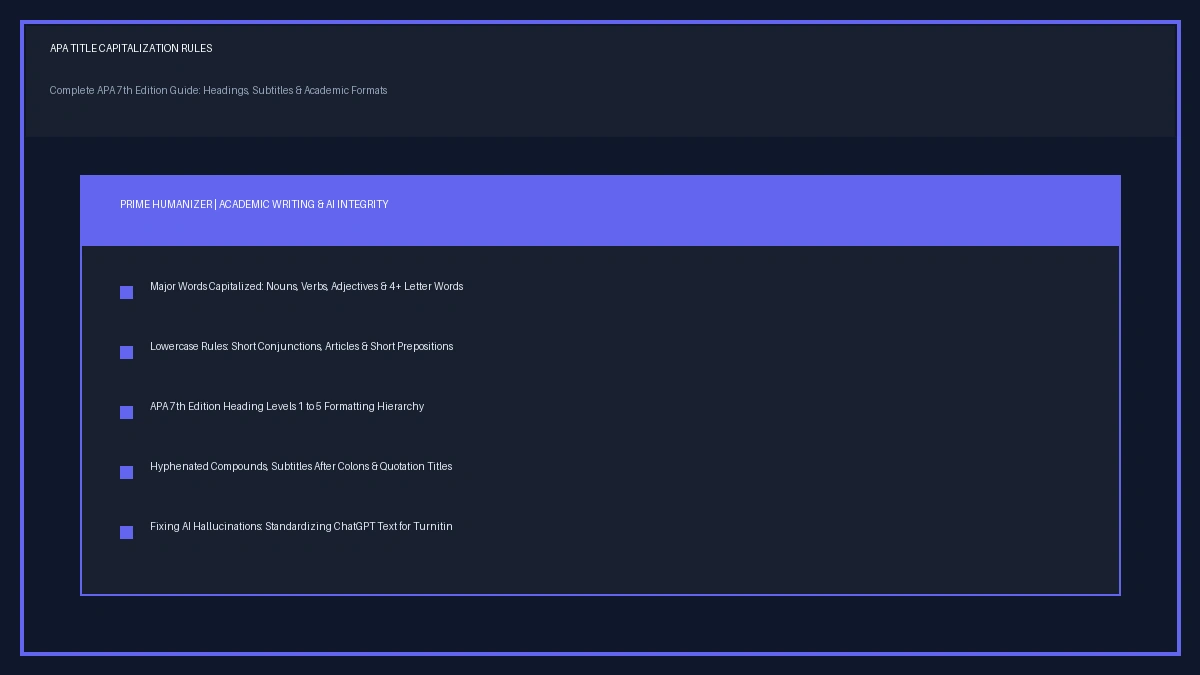
Fix Academic Formatting & Bypass AI Detection with Prime Humanizer
Automated AI tools like ChatGPT often butcher APA capitalization and trigger Turnitin AI flags. Use Prime Humanizer to ensure natural academic prose, proper syntax, and 100% human authenticity.
What is Title Case in APA Style?
In APA Style, “title case” (often referred to as headline style) is a capitalization convention where major grammatical components of a phrase are capitalized while minor structural connecting words remain in lowercase. You must apply title case to:
- The title of your paper on the title page.
- All five levels of section headings within the body of your manuscript.
- Titles of published books, periodicals, articles, and websites when mentioned directly in the body text of your paper (e.g., “In the book The Origin of Consciousness…”).
- Table titles and figure titles.
The 4-Letter Preposition Rule: Where Most Writers Get Caught
One of the most frequent points of confusion among writers transitioning from other style guides (such as Chicago or MLA) is APA’s strict length threshold for prepositions. In MLA or Chicago, prepositions such as between, through, or without are frequently kept in lowercase regardless of length.
Under APA 7th Edition rules, any word with four or more letters MUST be capitalized. This includes all prepositions with 4, 5, or more letters:
| Word Type | APA Capitalization Rule | Correct APA Examples | Common Errors to Avoid |
|---|---|---|---|
| Prepositions (4+ Letters) | Always Capitalize | With, From, Into, Over, Near, About, After, Between, Through, Without | Writing “Life with Dementia” instead of “Life With Dementia” |
| Prepositions (≤ 3 Letters) | Keep Lowercase | at, by, for, in, of, off, on, out, per, to, up, via | Capitalizing short prepositions mid-sentence (e.g., “Impact Of Technology”) |
| Conjunctions (≤ 3 Letters) | Keep Lowercase | and, as, but, for, if, nor, or, so, yet | Capitalizing “And” or “Or” in headings |
| Articles | Keep Lowercase (unless first word) | a, an, the | Capitalizing “The” inside a title: “Understanding The Brain” |
| Linking Verbs (“Is”, “Be”) | Always Capitalize (Verbs are major words) | Is, Am, Are, Was, Were, Be, Been | Lowercasing “is” because it has only 2 letters (It is a verb!) |
Capitalizing Subtitles After Colons and Em-Dashes
Academic papers frequently utilize compound titles featuring a colon or em-dash separating the primary topic from the methodological approach. Under APA rules, the first word immediately following a colon, em-dash, or end punctuation is ALWAYS capitalized, regardless of whether it is an article, preposition, or conjunction:
- An In-Depth Investigation: The Role of Social Media in Adolescent Sleep Patterns (Notice The is capitalized because it begins the subtitle).
- Pediatric Nutrition in Urban Centers: A Longitudinal Study
- Cognitive Behavioral Therapy—With or Without Pharmacotherapy?
Hyphenated Compound Words in APA Titles
Hyphenated compounds cause significant anxiety for students. APA 7th Edition establishes a straightforward two-part rule:
- First Element: Capitalize the first element of the compound word.
- Subsequent Elements: Capitalize the second element if it is a major word (noun, verb, adjective, adverb) OR if it has four or more letters. Only leave the second word lowercase if it is a minor word of three letters or fewer (such as a preposition).
Examples of Hyphenated Compounds:
- Self-Report Measures (Both capitalized; “Report” is a noun).
- Non-Invasive Diagnostic Procedures (Both capitalized; “Invasive” is an adjective).
- A Run-In With the Legal System (“In” is lowercase because it is a 2-letter preposition; “With” is capitalized because it has 4 letters).
- Mid-Year Academic Progress Assessments
APA 7th Edition Headings: The 5-Level Hierarchy
APA uses five distinct heading levels to structure manuscripts. All five levels utilize Title Case capitalization, but their formatting (alignment, bolding, italics, indentation) differs systematically:
| Level | Formatting Specifications | Text Placement |
|---|---|---|
| Level 1 | Centered, Bold, Title Case Capitalization | Text begins on a new line as an indented paragraph. |
| Level 2 | Flush Left, Bold, Title Case Capitalization | Text begins on a new line as an indented paragraph. |
| Level 3 | Flush Left, Bold Italic, Title Case Capitalization | Text begins on a new line as an indented paragraph. |
| Level 4 | Indented, Bold, Title Case Capitalization, Ending With a Period. | Text begins immediately on the same line after the period. |
| Level 5 | Indented, Bold Italic, Title Case Capitalization, Ending With a Period. | Text begins immediately on the same line after the period. |
The Critical Trap: Title Case vs. Sentence Case in Reference Lists
Perhaps the single most penalizing mistake made in academic coursework is applying title case across the bibliography. In APA Style, title case and sentence case serve strictly separate functions:
- Title Case: Applied to your paper title, body headings, and journal names in citations (e.g., Journal of Clinical Psychology).
- Sentence Case: Applied to the titles of articles, books, book chapters, reports, and web pages inside your Reference List!
Reference List Example Comparison:
Correct (Sentence Case in Reference List):
Smith, J. A. (2024). The impact of cognitive behavioral therapy on adolescent anxiety: A meta-analytic review. Journal of Applied Psychology, 45(2), 112–128.
Notice: The article title only capitalizes the first word (“The”) and the first word after the colon (“A”). But the journal title (“Journal of Applied Psychology”) remains in full Title Case!
Why AI Writers Struggle with APA Capitalization (And How to Fix It)
Large language models such as ChatGPT, Claude 3.5, and Gemini excel at generating raw prose, but their training tokens frequently mix MLA, Chicago, and AP style rules. Typical AI-generated academic drafts produce telltale capitalization anomalies:
- Capitalizing short prepositions mid-title (e.g., “The Effects Of Trauma In Youth”).
- Failing to capitalize 4-letter prepositions required by APA (e.g., writing “Life with Autism” instead of “Life With Autism”).
- Applying title case indiscriminately across reference lists, triggering automated plagiarism and AI-generation flags in Turnitin.
By passing your rough drafts through Prime Humanizer, you eliminate robotic cadence, fix capitalization inconsistencies, and ensure your manuscript meets rigorous institutional standards with 100% human-verified readability.
Frequently Asked Questions (FAQ)
Is the word “Is” capitalized in an APA title?
Yes. Although “is” contains only two letters, it is a verb (the linking verb form of “to be”). In APA style, all verbs—regardless of their character length—must be capitalized in title case.
Do you capitalize “From” and “With” in APA titles?
Yes. “From” and “With” are four-letter prepositions. Under APA 7th Edition rules, all words with four or more letters are capitalized, even when serving as prepositions.
How do you capitalize a subtitle after a colon in APA?
The first word following a colon, em-dash, or end mark is always capitalized in an APA title, even if that word is an article like “a”, “an”, or “the”, or a short conjunction.
What is the difference between APA 6th and APA 7th edition heading rules?
In APA 7th edition, heading levels 3, 4, and 5 were simplified: Level 3 became flush left and italicized (instead of indented), and all five heading levels now consistently use Title Case capitalization.