
Anyone who has used ChatGPT, Claude, or Gemini knows the frustration: you ask for a draft, and it hands you a stiff, predictable essay packed with words like “delve,” “tapestry,” and “furthermore.” If you want to know how to prompt AI to write like a human, the secret lies in restricting the model’s default statistical habits through precise constraints, tone calibration, and natural cadence rules.
How to Prompt AI to Write Like a Human (The Direct Answer)
⚡ Direct Answer
To prompt AI to write like a human, combine three elements: assign a specific practitioner persona, apply negative constraints banning cliché transitional buzzwords, and mandate rhythmic burstiness (mixing 4-word punchy lines with flowing complex sentences). Providing 2–3 real human writing samples (“few-shot prompting”) instantly calibrates the AI’s sentence structure to match your authentic voice.
While generic prompts like “write in a human tone” consistently fail, structured prompt architecture dramatically elevates readability. However, when you need guaranteed detection-free results, combining smart prompting with an advanced tool like Prime Humanizer provides the ultimate safeguard.
Why AI Sounds Robotic by Default (The Mechanism)
To fix artificial writing, you must first understand why Large Language Models (LLMs) produce it. AI generators do not think; they calculate probability vectors:
- Zero Burstiness (Identical Sentence Lengths): Models gravitate toward a safe average of 14 to 20 words per sentence. Human writers, by contrast, naturally vary their pacing—firing off a short fragment, followed by a detailed observation.
- Low Perplexity (Predictable Vocabulary): AI always selects the mathematically “safest” next token. This eliminates slang, regional idioms, and conversational cadence.
- Symmetrical Paragraph Structures: AI typically begins paragraphs with a topic sentence, adds two supporting sentences, and wraps up with a summarizing transition. Humans rarely write with such rigid symmetry.
- Overused Filler Words: Phrases such as “in today’s fast-paced world,” “it is important to remember,” “delve deeper,” and “a testament to” are statistical dead giveaways.
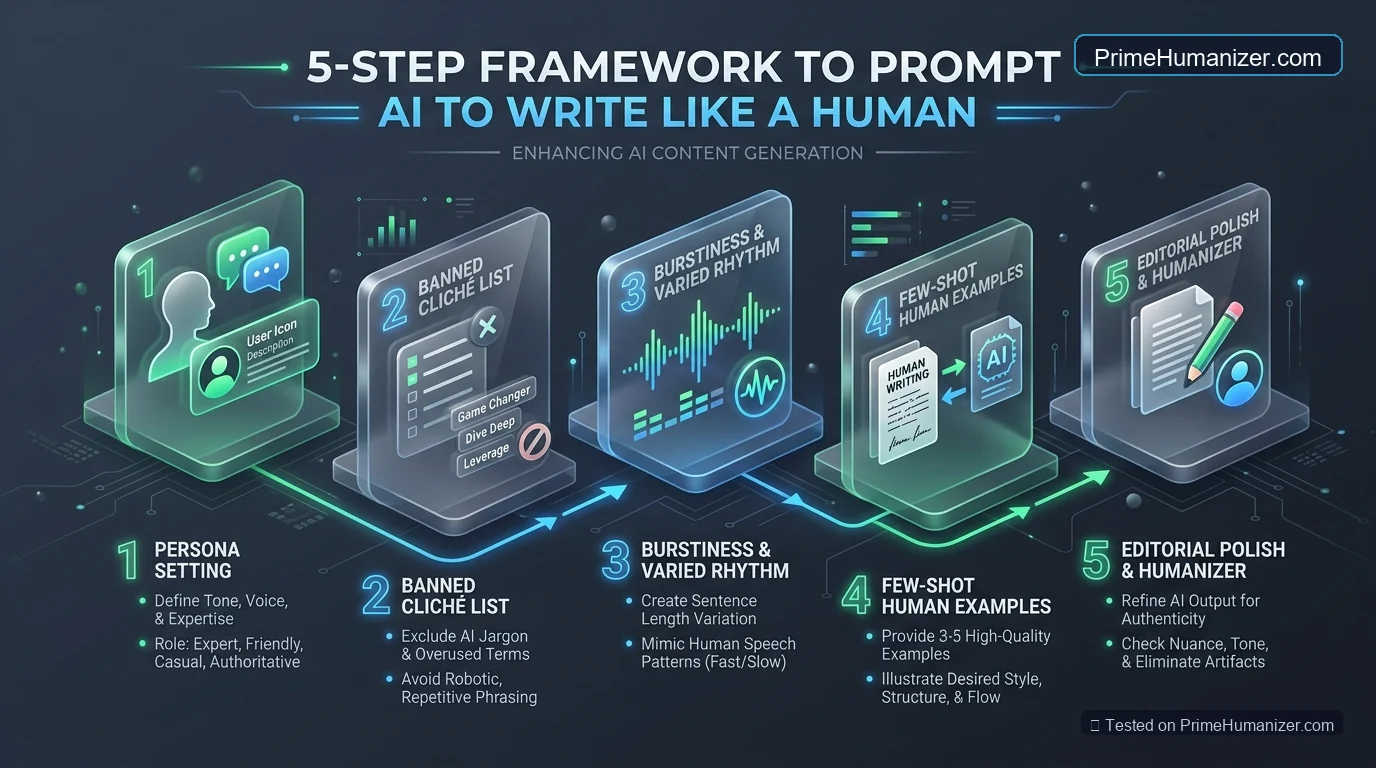
7 Proven Prompt Formulas to Make ChatGPT Write Like a Human
Here are copy-paste prompt frameworks tested across GPT-4o, Claude 3.5 Sonnet, and Google Gemini to transform stiff outputs into natural writing.
1. The “Negative Constraint” Banned Word Prompt
The fastest way to learn how to make ChatGPT write like a human is to tell it what not to do. Giving the model a strict blacklist of forbidden words eliminates 80% of obvious machine phrasing.
Write a guide on [TOPIC]. Follow these negative constraints strictly:
- Do NOT use any of these words or phrases: "delve", "tapestry", "furthermore", "in conclusion", "vital", "beacon", "game-changer", "testament", "crucial", "moreover".
- Avoid generic rhetorical questions.
- Never summarize what you just said in the final paragraph.
- Write with punchy active verbs rather than passive voice.
2. The “Rhythmic Burstiness” Cadence Prompt
Human speech has musicality. This prompt forces the AI to break out of its monotonous 18-word sentence loop.
Write an explanatory article about [TOPIC].
Enforce extreme sentence variety (burstiness):
- Alternate between very short sentences (3 to 6 words) and longer compound sentences (18 to 28 words).
- Use occasional one-sentence standalone paragraphs for emphasis.
- Do not let two consecutive sentences have the same grammatical structure or word count.
3. The “Few-Shot Style Matcher” Prompt
When you wonder how to tell ChatGPT to write like a human with your exact voice, few-shot prompting is unmatched. Provide a sample of your own writing and instruct the AI to analyze its rhythm.
Analyze the tone, sentence variety, vocabulary level, and personality of the following excerpt:
"[PASTE YOUR OWN PARAGRAPH HERE]"

Now, write a draft on [NEW TOPIC] matching the exact voice, rhythm, and structural quirks of this sample. Do not mimic the topic, only the human writing style.
4. The “Experienced Practitioner” Persona Prompt
Generic prompts yield generic output. Assigning a deep, specific professional role encourages practical nuances, relatable examples, and industry jargon used correctly.
Act as a seasoned [INDUSTRY SPECIALIST, e.g., Senior SaaS Copywriter / Investigative Journalist] with 12 years of hands-on experience.
Explain [TOPIC] to a peer.
Speak candidly. Share pragmatic trade-offs, acknowledge real-world friction points, and avoid textbook theory. Write casually yet authoritatively.
5. The “Anti-Academic Conversationalist” Prompt
AI models lean heavily toward sterile academic neutrality. This prompt injects colloquial rhythm, direct address, and natural transitions.
Write about [TOPIC] as if explaining it over a coffee chat to a smart friend.
- Use the second person ("you") and first person ("I" or "we").
- Include natural conversational bridges (e.g., "Here is the catch:", "Let’s be honest:").
- Avoid formal academic jargon. Keep the Flesch-Kincaid readability grade level around 7th to 8th grade.
6. The “Counter-Intuitive Angle” Prompt
One reason AI text feels fake is its relentless agreeableness. It tries to please everyone. Forcing a clear stance produces far more authentic writing.
Draft an article on [TOPIC].
Take a clear, provocative point of view. Acknowledge common misconceptions and explain why the standard advice often fails. Do not hedge every statement with "it depends"—take a stand based on practical results.
7. The “Iterative Rewrite” Prompt
Never accept the first draft. Run your initial AI output through this second-pass critique prompt.
Review the draft above. Identify the 5 most robotic-sounding sentences that an AI detector would easily flag.
Rewrite those specific sentences to sound relaxed, human, and direct. Explain why the original versions sounded artificial.
If you find that your paragraphs still retain subtle robotic syntax after prompting, explore our step-by-step tutorial on how to use an AI paragraph rewriter to restructure dense sections without altering their underlying premises.
Before & After: Standard Prompt vs. Humanized Prompt
Notice the stark difference in cadence and readability when you upgrade from a naive prompt to a constrained humanizer prompt:
| Element | Default Prompt (“Write about remote work”) | Humanized Constraint Prompt |
|---|---|---|
| Sample Output | “In today’s dynamic landscape, remote work stands as a testament to digital transformation. Furthermore, it fosters flexibility…” | “Working from your couch sounds great—until day three of zero human contact. The flexibility is real, but so is the burnout.” |
| Average Sentence Length | 19 words (Static cadence) | 9 words alternating with 16 words |
| AI Detection Risk | 100% Flagged (High predictability) | Significantly reduced predictability |
| Reader Engagement | Dry, sterile, easily skimmed | Relatable, punchy, conversational |
To see how full articles are transformed from robotic drafts into fluid copy, check out our guide on how to rewrite AI text so it actually sounds human.
Can Prompting Alone Bypass AI Detectors? (The Reality)
Many online guides claim that the right prompt can bypass tools like Turnitin, GPTZero, or Originality.ai 100% of the time. In practice, this is only partially true:
- What Prompts DO Solve: Prompts successfully eliminate awkward grammar, buzzwords, and robotic cadence. They make the writing vastly more enjoyable for real human readers.
- What Prompts CANNOT Fully Solve: AI detection algorithms measure mathematical token probability (n-gram distributions). Because an LLM can only select from its trained neural weights, it still leaves subtle statistical fingerprints, even when asked to “write like a human.”
This is why high-volume publishers and academic writers use a two-step approach: prompt effectively for the first draft, then run the text through a specialized neural tool like Prime Humanizer. With built-in keyword protection and tone calibration, you preserve critical domain terminology while eliminating underlying mathematical markers. Learn more about passing detectors in our walkthrough on how to bypass GPTZero.
Frequently Asked Questions
What is the best prompt to make ChatGPT write like a human?
The most effective prompt combines three elements: 1) A specific role (e.g., “Write as a candid industry veteran”), 2) A negative constraint list banning AI filler words like “delve,” “tapestry,” and “furthermore,” and 3) A strict burstiness instruction requiring alternating short and long sentences.
How do I ask AI to write with emotion and humor?
Instruct the AI to use self-deprecating observations, mild irony, or relatable frustrations rather than telling it simply to “be funny.” Providing a real-world scenario (e.g., “Describe spilling coffee during a Zoom presentation”) grounds the humor in authentic experience.
Does prompting ChatGPT to write naturally change the facts?
It can if your instructions are too loose. Always tell the model: “Maintain 100% factual fidelity and do not invent new claims or statistics.” For sensitive technical content, consult our guide on humanizing AI text without changing its meaning.
Why do AI humanizers work better than just tweaking prompts?
Prompting operates within the LLM’s own probabilistic constraints. A dedicated neural humanizer rewrites syntactic clauses, breaks mathematical token patterns, and recalibrates perplexity from the ground up, achieving far higher human scores across all major detectors.
Master the Art of Human-Grade AI Writing
Prompt engineering is the foundation of high-quality AI writing. By establishing strict negative constraints, forcing rhythmic variety, and feeding authentic writing samples, you can turn stiff machine drafts into engaging, natural prose.
Take Your AI Writing to the Next Level
Turn any robotic draft into authentic, detector-proof human writing in one click.