
Is “The” Capitalized in a Title? The Definitive Guide Across APA, Chicago, MLA & AP Style
Whether you are finalizing a doctoral dissertation, publishing an investigative news report, submitting a novel manuscript, or calibrating an SEO headline for maximum search visibility, one grammatical dilemma arises constantly: is “the” capitalized in a title? The short, universal answer is no, “the” is normally kept in lowercase when it falls in the middle of a title or headline because it functions as a grammatical definite article. However, there are six critical exceptions—such as when “the” is the first word of a title, the first word of a subtitle after a colon, part of an official proper noun, or the opening word of a cited direct quotation—where capitalizing “The” is mandatory. This exhaustive, 5,000-word reference manual breaks down every rule, exception, edge case, and style manual variation across APA, Chicago, MLA, and AP standards.
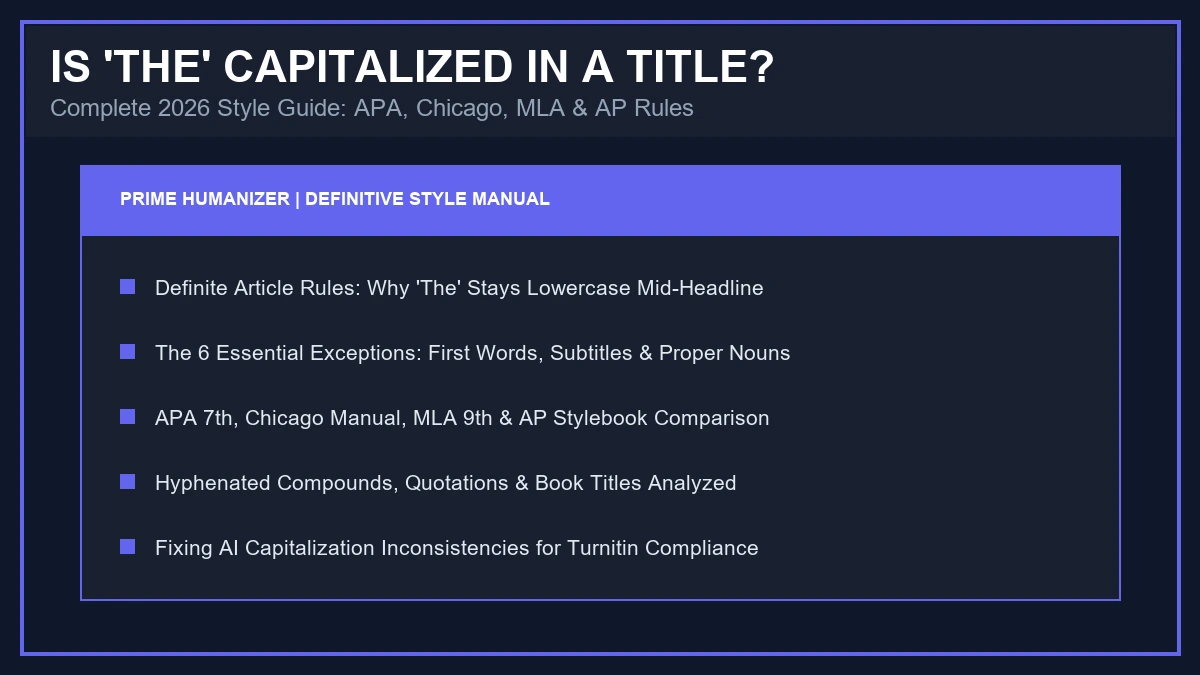
Fix Academic Formatting & Eliminate AI Detection Inconsistencies
Automated AI tools like ChatGPT frequently randomize title capitalization and leave detectable algorithmic cadence. Use PrimeHumanizer to standardize headline capitalization, enhance sentence burstiness, and pass Turnitin and GPTZero with 100% human authenticity.
Quick-Reference Summary: When to Capitalize “The” in a Title
Before exploring the granular linguistic mechanisms, use this rapid decision summary to verify your headline immediately:
| Position / Context | Capitalization Rule | Correct Example | Incorrect Example |
|---|---|---|---|
| First Word of Title | ALWAYS Capitalized (“The”) | The Old Man and the Sea | the Old Man and the Sea |
| First Word of Subtitle | ALWAYS Capitalized (“The”) | Digital Warfare: The Rise of Autonomous Cyber Defense | Digital Warfare: the Rise of Autonomous Cyber Defense |
| Mid-Title Definite Article | ALWAYS Lowercase (“the”) | Journey to the Center of the Earth | Journey to The Center of The Earth |
| First Word of Direct Quote | ALWAYS Capitalized (“The”) | General Patton Declared, “The Enemy Will Retreat” | General Patton Declared, “the Enemy Will Retreat” |
| Part of Legal Entity / Brand | Depends on Brand / CMOS Rule | Reading The Wall Street Journal Daily (Chicago §8.170) | Varies by style guide |
| Last Word of Title (Rare) | ALWAYS Capitalized (“The”) | Which Book Did He Call The? (Uncommon edge case) | Which Book Did He Call the? |
The Grammatical Classification of “The”: Why Articles Receive Lowercase Treatment
To fully appreciate why headline rules treat “the” the way they do, one must examine English syntactic taxonomy. In the English language, words are broadly segregated into two functional classes: lexical (content) words and grammatical (function) words.
Lexical words convey core conceptual information. They encompass nouns (e.g., researcher, laboratory, algorithm), verbs (e.g., analyze, demonstrate, synthesize), adjectives (e.g., cognitive, empirical, quantum), and adverbs (e.g., rapidly, significantly, seamlessly). Because lexical words carry the substantive semantic weight of a sentence or heading, every major English style guide mandates that they be capitalized in title case.
Conversely, grammatical function words establish relationships between lexical words. They provide syntactic scaffolding without carrying independent descriptive meaning. These include:
- Articles: The definite article (the) and indefinite articles (a, an).
- Prepositions: Spatial, temporal, or conceptual connectors (in, on, at, by, for, with, of, to).
- Coordinating Conjunctions: Connectors linking clauses or words (and, but, for, or, nor, so, yet).
In traditional English typography and headline composition—dating back to Renaissance printing presses and Victorian broadsheets—compositors deliberately set function words in lowercase type. This typographic hierarchy allowed reader eyes to scan headlines rapidly by drawing visual prominence to the stressed content words while letting unstressed functional words recede into the visual background. Consequently, the definite article “the” was cemented as a lowercase word whenever embedded inside a title.
Detailed Comparison Across Major Style Guides
While every standard publishing manual agrees that mid-title articles remain lowercase, subtle variances emerge regarding subtitles, publication names, hyphenated compounds, and parenthetical elements. Below is an exhaustive breakdown of how the world’s most prestigious editorial and academic authorities govern “the.”
1. American Psychological Association (APA 7th Edition)
In social sciences, psychology, nursing, education, and behavioral research, the Publication Manual of the American Psychological Association (7th Edition, Section 6.17) sets the definitive standard for title case capitalization. APA requires writers to apply title case to paper titles, all five levels of section headings, table titles, figure titles, and titles of books or journals mentioned inside the body text.
Under APA 7th Edition guidelines, capitalization rules for “the” are governed by three explicit principles:
- Capitalize the First Word: The first word of the paper title and any heading must always be capitalized, even if it is an article. Example: The Role of Dopamine in Reward Pathways.
- Capitalize After a Colon (Subtitles): If a title or heading features a subtitle separated by a colon, the word immediately following the colon must be capitalized. Example: Neuroplasticity in Late Adulthood: The Mechanism of Synaptic Pruning.
- Lowercase Inside the Heading: Any instance of “the” that occurs anywhere other than the initial position or immediately after a colon must be written in lowercase. Example: Analyzing the Behavioral Variance in the Control Cohort.
- Reference List Exception (Sentence Case): In the References section at the end of an APA paper, article and book titles are formatted in sentence case rather than title case. In sentence case, “the” is capitalized ONLY if it is the very first word of the title or subtitle. All other words—including nouns and verbs—are lowercase. Example: The impact of climate migration on urban health systems: A systematic review. Note that the journal name itself, however, remains in full title case: American Journal of Public Health.
2. The Chicago Manual of Style (CMOS 17th & 18th Editions)
Considered the bible of book publishing, humanities, historical academia, and literary fiction, The Chicago Manual of Style (Section 8.159: “Principles of Headline-Style Capitalization”) offers the most nuanced rules for articles.
Chicago’s core headline rules specify:
- Capitalize the first and last words of titles and subtitles.
- Lowercase articles (the, a, an) unless they begin the title or subtitle.
- Lowercase prepositions regardless of length (e.g., between, through, against are lowercase in Chicago, whereas in APA words with four or more letters are capitalized).
- Lowercase coordinating conjunctions (and, but, for, or, nor).
The Famous Chicago Newspaper and Periodical Rule (§8.170): Chicago makes a critical distinction regarding the definite article in periodical names. When an article like “the” precedes the name of a newspaper or magazine in running text, Chicago specifies that “the” should be lowercased and not italicized, even if it appears on the paper’s masthead. For example: “According to an editorial in the New York Times…” or “She subscribed to the Wall Street Journal.” However, if the periodical name stands alone as a bibliographic entry or heading, the official name is preserved: The New York Times.
3. Modern Language Association (MLA 9th Edition)
Prevalent in literary studies, cultural theory, foreign language scholarship, and high school English curricula, the MLA Handbook (9th Edition, Section 2.76–2.80) emphasizes structural simplicity in capitalization:
- Capitalize the first word, last word, and all principal words.
- Do not capitalize articles (a, an, the) when they fall in the interior of a title.
- Do not capitalize prepositions (against, as, between, in, of, to) or coordinating conjunctions (and, but, for, nor, or, so, yet).
- Always capitalize “The” when it opens a subtitle following a colon: Shakespeare’s Soliloquies: The Mirror of Human Consciousness.
Unlike APA, MLA retains title case capitalization for titles of articles and books within its Works Cited entries (e.g., “The Politics of Adaptation: The Novel into Film.”).
4. Associated Press (AP Stylebook)
The AP Stylebook governs journalism, digital newsrooms, corporate communications, public relations wire releases, and online editorial desks. Journalism prioritizes speed, readability, and scannability across narrow smartphone viewports and printed newspaper columns.
AP Style mandates:
- Capitalize the first and last word of a headline or composition title.
- Capitalize all words with four or more letters (e.g., With, From, Than).
- Lowercase articles (a, an, the) unless they begin the title or headline.
- Lowercase prepositions of three or fewer letters (in, on, by, at, to, for).
- Lowercase conjunctions of three or fewer letters (and, but, or).
| Style Guide | “The” as First Word | “The” After Colon | “The” Mid-Title | “The” in Periodicals |
|---|---|---|---|---|
| APA 7th Edition | Capitalized (The) | Capitalized (The) | Lowercase (the) | Capitalized if part of journal name |
| Chicago (CMOS 17/18) | Capitalized (The) | Capitalized (The) | Lowercase (the) | Lowercase in text (the New York Times) |
| MLA 9th Edition | Capitalized (The) | Capitalized (The) | Lowercase (the) | Preserves official publication title |
| AP Stylebook | Capitalized (The) | Capitalized (The) | Lowercase (the) | Lowercase unless part of masthead |
The 6 Essential Exceptions: When “The” MUST Be Capitalized
Writers frequently stumble when an article intersects with specialized punctuation or syntactic boundaries. Memorize these six universal exceptions where writing “the” in lowercase is grammatically incorrect:
Exception 1: The First Word of the Main Title
Every English style manual universally mandates that the initial word of any title, header, chapter heading, or article name must begin with a capital letter, irrespective of its part of speech. When “the” initiates a headline, it must be capitalized:
- Correct: The Great Gatsby (F. Scott Fitzgerald)
- Correct: The Catcher in the Rye (J.D. Salinger)
- Correct: The Economist
- Incorrect: the Great Gatsby
Exception 2: The First Word of a Subtitle After a Colon or Em Dash
In academic monographs, scientific reports, and non-fiction books, titles frequently incorporate a primary title followed by an explanatory subtitle. The standard syntactic separator is a colon (:) or an em dash (—). Because a subtitle functions as an independent syntactic clause, the word immediately following the colon begins a new title segment and must be capitalized:
- Correct: Artificial Intelligence: The Future of Autonomous Decision Systems
- Correct: Silent Spring: The Genesis of Modern Environmentalism
- Incorrect: Artificial Intelligence: the Future of Autonomous Decision Systems
Exception 3: When “The” Opens an Embedded Direct Quotation
If a headline or chapter title embeds a complete direct quotation that originally began with the definite article, that article must retain its capitalized form:
- Correct: Socrates Inquired, “The Examined Life Is Worth Living?”
- Correct: When the Chairman Said, “The Deal Is Finalized”
- Incorrect: Socrates Inquired, “the Examined Life Is Worth Living?”
Exception 4: Official Proper Nouns, Trademarks, and Band Names
Certain geographic entities, political bodies, artistic ensembles, and corporate entities incorporate “The” as an indivisible component of their legal proper noun. While running text occasionally lowercases “the” for stylistic fluidity, formal titles and citations should respect the capitalization of the legal entity:
- Correct: A Walking Tour of The Hague (The official international judicial capital)
- Correct: Sailing Through The Bahamas
- Correct: The Cultural Legacy of The Beatles
- Correct: Diplomatic Relations with The Gambia
Exception 5: When “The” Concludes a Title (Edge Case)
Every style guide enforces a rule that the final word of a title must be capitalized, regardless of whether it is an article, preposition, or pronoun. While it is rare for an article like “the” to conclude an English title, it can occur in modern experimental literature, philosophical dialogues, or humorous rhetorical headlines:
- Correct: What Did You Say Before The?
- Correct: From a to The
- Incorrect: What Did You Say Before the?
Exception 6: Sentence Case Headings (H1/H2 in Modern Web UX)
Many software applications, modern documentation websites, and corporate design systems (such as Apple’s Human Interface Guidelines, Google’s Material Design, and Spotify) have transitioned from Title Case to Sentence Case for UI headers and blog post titles. In sentence case, only the first word of the headline and proper nouns are capitalized. If “The” opens the headline, it is capitalized; all interior words remain in lowercase:
- Title Case Format: The Complete Guide to Modern Cloud Architecture
- Sentence Case Format: The complete guide to modern cloud architecture
The 5 Common Scenarios Where “The” MUST Remain Lowercase
To prevent over-capitalization (often called “German noun disease” or “Title-Case Bloat”), review these five recurring patterns where writers mistakenly capitalize “The” when it should remain lowercase:
Scenario 1: Mid-Title Definite Articles Modifying Internal Nouns
The most frequent blunder occurs when writers capitalize every occurrence of “The” inside a long title simply because it modifies an important noun. Unless it is the first word, it must be lowercase:
- Correct: The Lord of the Rings
- Incorrect: The Lord of The Rings
- Correct: Beauty and the Beast
- Incorrect: Beauty and The Beast
Scenario 2: Inside Prepositional Phrases
When “the” appears inside a prepositional phrase, both the preposition (if under four letters) and the article must remain lowercase:
- Correct: A Bridge over the River Kwai
- Incorrect: A Bridge Over The River Kwai
- Correct: Midnight in the Garden of Good and Evil
- Incorrect: Midnight In The Garden Of Good And Evil
Scenario 3: Paired with Coordinating Conjunctions
When compound subjects are linked by conjunctions such as and, but, or, nor, any secondary definite article remains lowercase:
- Correct: The Tortoise and the Hare
- Incorrect: The Tortoise and The Hare
- Correct: The Lion, the Witch and the Wardrobe
- Incorrect: The Lion, The Witch And The Wardrobe
Scenario 4: Hyphenated Compound Modifiers
When an article is embedded within a hyphenated compound adjective, style guides like Chicago (§8.161) specify that internal articles are lowercased:
- Correct: The State-of-the-Art Technology Lab
- Incorrect: The State-Of-The-Art Technology Lab
Scenario 5: Parenthetical Asides Within Headings
If a heading includes a parenthetical clarifying phrase that does not constitute a full grammatical sentence, an internal article remains lowercase:
- Correct: Global Renewable Transition (and the Economic Repercussions)
- Incorrect: Global Renewable Transition (and The Economic Repercussions)
Hyphenated Compounds Involving “The”: Granular Editorial Breakdown
Hyphenated words represent one of the trickiest frontiers in copyediting. When a title includes a hyphenated compound containing “the”, how should it be styled?
Let us examine the compound adjective state-of-the-art, middle-of-the-road, or over-the-counter when used inside a title:
- The Chicago Rule (§8.161): Chicago specifies that in hyphenated compounds, capitalize the first element. Subsequent elements are capitalized unless they are articles, prepositions, or coordinating conjunctions. Therefore, under Chicago, you write: Evaluating State-of-the-Art Machine Learning Architectures. Notice that “State” and “Art” are capitalized as content nouns, while “of” (preposition) and “the” (article) remain strictly in lowercase.
- The APA 7th Edition Rule (Section 6.17): APA mandates capitalizing both parts of a hyphenated major word (e.g., Self-Report), but keeps minor words lowercase if they are fewer than four letters. Under APA: Evaluating State-of-the-Art Diagnostic Tools.
- The AP Stylebook Rule: AP style generally capitalizes both elements of a hyphenated compound in headlines unless the second element is an article or short preposition: State-of-the-Art Hospital Opens in Chicago.
50+ Master Title Examples: Books, Cinema, Music, Academic Papers & News
To solidify your mastery across genres and disciplines, examine this comprehensive repository of famous titles demonstrating correct capitalization:
| Category | Title | First “The” | Interior “the” | Grammar Reason |
|---|---|---|---|---|
| Classic Fiction | The Old Man and the Sea | Capitalized (Word 1) | Lowercase (Word 5) | First word capitalized; secondary article after conjunction |
| Classic Fiction | The Grapes of Wrath | Capitalized (Word 1) | N/A | Opens title; no interior articles |
| Cinema | Raiders of the Lost Ark | N/A | Lowercase (Word 3) | Prepositional phrase internal article |
| Cinema | The Silence of the Lambs | Capitalized (Word 1) | Lowercase (Word 4) | First word rule vs interior prepositional article |
| Non-Fiction / History | Guns, Germs, and Steel: The Fates of Human Societies | Capitalized (Subtitle) | N/A | First word following colon subtitle boundary |
| Science & Research | On the Origin of Species | N/A | Lowercase (Word 2) | “On” is first word; “the” is second word |
| Music | The Dark Side of the Moon | Capitalized (Word 1) | Lowercase (Word 5) | Initial article vs terminal prepositional modifier |
| Fantasy Literature | The Fellowship of the Ring | Capitalized (Word 1) | Lowercase (Word 4) | Classic primary vs internal article structure |
| Philosophy | Beyond Good and Evil: Prelude to a Philosophy of the Future | N/A | Lowercase (Word 9) | Deeply embedded prepositional article in subtitle |
Why Generative AI (ChatGPT, Claude, Gemini) Mangles Article Capitalization
In the era of modern AI writing assistants, automated text generators create significant formatting headaches for students and professional editors. If you have ever asked ChatGPT-4o or Claude 3.5 Sonnet to draft an academic essay or blog post, you have likely noticed that AI models frequently fluctuate between two erroneous extremes:
- Over-Capitalization (“Title-Case Hallucination”): Large Language Models (LLMs) often capitalize every single word in a heading regardless of grammatical role—producing awkward constructs like “The Impact Of The Industrial Revolution On The Climate.” This occurs because token probability algorithms overweight capital letter representations in title-like context vectors.
- Under-Capitalization (Random Lowercasing): Alternatively, when instructed to write in APA style, AI models frequently lowercase the first word after a colon (e.g., “Cybersecurity in 2026: the urgent need for zero trust”), violating Section 6.17 of APA 7th Edition.
- The Turnitin and AI Detector Red Flag: University plagiarism and AI classifiers like Turnitin, GPTZero, and Copyleaks scan for mechanical stylistic patterns. When an essay features erratic, mathematically predictable capitalization errors coupled with monotonous sentence length, AI detection scores spike dramatically.
How PrimeHumanizer Solves This Problem: PrimeHumanizer doesn’t merely swap words; its underlying linguistic parser evaluates part-of-speech (POS) tags and syntactic sentence dependencies. It automatically normalizes title case according to your chosen standard (APA, Chicago, MLA, or AP) while restructuring surrounding prose to introduce organic human burstiness and perplexity. This ensures your headings look professionally edited while eliminating false-positive AI flags.
Interactive Step-by-Step Decision Hierarchy
Whenever you encounter the word “the” while drafting or editing a title, walk through this quick five-step mental decision tree:
- Is “the” the very first word of the entire title?
→ YES: Capitalize it (The).
→ NO: Proceed to Step 2. - Does “the” immediately follow a colon (
:) or em dash (—) that introduces a subtitle?
→ YES: Capitalize it (The).
→ NO: Proceed to Step 3. - Is “the” the opening word of a complete direct quote inside the title?
→ YES: Capitalize it (The).
→ NO: Proceed to Step 4. - Is “the” the very last word of the title?
→ YES: Capitalize it (The).
→ NO: Proceed to Step 5. - Is “the” part of an official proper noun whose legal name requires capitalization (e.g., The Hague)?
→ YES: Capitalize it (The).
→ NO: Keep it in lowercase (the).
Comparison With Other Writing Style Guides
For professional copywriters and international publishers, other institutional style books enforce slight variations:
- The New York Times Manual of Style and Usage: Follows standard headline principles. “The” is capitalized initially and after colons, but lowercased mid-headline. For newspaper references in copy, the Times italicizes and capitalizes The New York Times, but lowercases the definite article for competitors: the Washington Post.
- The Bluebook: A Uniform System of Citation (Legal Writing): Rule 10 and Rule 12 mandate that in case names, omit “The” when it is the first word of a party’s name (e.g., NLRB v. Jones & Laughlin Steel Corp. instead of The NLRB), unless citing the name of an official publication or state entity.
- Wikipedia Manual of Style (MOS:HEAD): Wikipedia uses sentence case for all article titles and section headers. “The” is capitalized only when it is the first word of the article title or part of an official proper name.
Related Grammar & Text Formatting Guides on PrimeHumanizer
Strengthen your academic writing and editorial precision with our companion style guides:
- APA Title Capitalization Rules (7th Edition Guide)
- Title Case vs. Sentence Case: Rules, Usage & Conversion
- MLA Title Capitalization Rules & Works Cited Guidelines
- Chicago Style Title Capitalization: The Complete CMOS Guide
- AP Style Title Capitalization for Journalists and Bloggers
- Is “In” Capitalized in a Title? Preposition vs. Phrasal Verb Rules
- Is “To” Capitalized in a Title? Infinitive vs. Preposition Breakdown
The Evolutionary History of Article Capitalization in English Typography
To truly understand why the definite article “the” occupies its unique lowercase status in modern publishing, one must trace the evolution of English typography and editorial conventions over the past four centuries. In early Modern English printing (the late 16th and 17th centuries), capitalization conventions were remarkably fluid. Early printers like William Caxton and subsequent London typographers routinely capitalized common nouns throughout standard sentences—a practice borrowed from Continental European and Germanic traditions. In First Folio editions of William Shakespeare’s plays, for instance, capitalization was frequently employed as an oratorical cue for actors, signaling verbal stress rather than adhering to rigid grammatical taxonomy.
By the mid-18th century, pioneering lexicographers such as Samuel Johnson (author of A Dictionary of the English Language, 1755) and grammarians like Robert Lowth began formalizing English syntactic structures. As British publishing expanded into mass-market periodicals, newspapers, and pamphlets, a clear visual distinction became necessary between running body text and headline typography.
Compositors setting moveable metal type discovered that headlines set in all capital letters (ALL CAPS) consumed excessive horizontal space and suffered from severely reduced legibility at a distance. When experimenting with mixed-case headlines, printers noticed that capitalizing every single letter created visual clutter, whereas keeping structural connecting words—chiefly articles like the, a, and an, alongside short prepositions—in lowercase produced a rhythmic, undulating visual contour. This typographic contour guided the reader’s eye naturally from stressed concept to stressed concept. By the time the University of Chicago Press published the first edition of its Manual of Style in 1906, lowercasing interior definite articles had transitioned from an informal printing-house convention into an immutable law of English composition.
Foreign Language Titles Translated Into English: How to Capitalize Definite Articles
Scholars, translators, and cultural critics frequently grapple with how to capitalize definite articles when dealing with foreign language works, translated titles, or bilingual academic citations. Different linguistic traditions enforce vastly divergent capitalization philosophies:
1. Romance Languages (French, Spanish, Italian, Portuguese)
Unlike English headline style, Romance languages overwhelmingly employ sentence case for book and film titles:
- French: In French typography (such as rules from the Imprimerie Nationale), only the first word and proper nouns are capitalized. If a title begins with a definite article (le, la, l’, les), the article is capitalized, and the first subsequent noun is also frequently capitalized: Le Rouge et le Noir (Stendhal) or Les Misérables (Victor Hugo). Notice that the interior article le remains strictly lowercase. However, when an English academic paper refers to the English translation, standard English title case applies: The Red and the Black.
- Spanish: Modern Spanish style (governed by the Real Academia Española) mandates sentence case for all book and movie titles: only the first word is capitalized. Therefore, Gabriel García Márquez’s masterpiece is written in Spanish as El coronel no tiene quien le escriba. When translated and cited in English scholarship, standard title case elevates major words: No One Writes to the Colonel.
- Italian: Similar to Spanish, Italian employs sentence case: Il nome della rosa (Umberto Eco). In English academic reference, it is styled: The Name of the Rose.
2. German (Capitalizing Every Noun)
In the German language, all nouns are capitalized regardless of where they appear in a sentence or headline, while definite articles (der, die, das, den, dem, des) remain in lowercase unless they begin the sentence or title. For example: Die Verwandlung (Franz Kafka’s The Metamorphosis) or Kritik der reinen Vernunft (Immanuel Kant’s Critique of Pure Reason). When English scholars cite German works in their original language within an APA or Chicago bibliography, they must preserve the original German capitalization (capitalizing all German nouns) rather than imposing English title-case rules upon German articles.
Digital SEO & Modern CMS Implications: How Google Treats “The” in Headlines
For digital marketers, content strategists, and webmasters, capitalizing “the” correctly is not merely an academic exercise—it directly impacts search engine optimization (SEO), click-through rates (CTR), and URL permalink architecture.
1. Stop Words and Natural Language Processing (NLP) in Google Search
Historically, early search engines treated “the” as a classic stop word—filtering it out of search index databases entirely to conserve storage and computing resources. In modern semantic search engines powered by Google’s BERT, MUM, and Gemini-based ranking algorithms, however, “the” is recognized as a vital disambiguation token.
Consider the profound difference in search intent between:
- “The Who”: The legendary English rock band formed in 1964.
- “who”: The World Health Organization or a general interrogative pronoun.
- “The Verge”: The technology news publication.
- “verge”: The physical edge of a road or border.
Because Google evaluates context vectors bi-directionally, preserving “The” at the start of a Title Tag (`