
How Many Sentences in a Paragraph? Academic Rules by Grade & Essay Type (2026)
Whether you are drafting an elementary school book report, a high school persuasive essay, or a peer-reviewed university dissertation, paragraph length is one of the most fundamental structural requirements. Below is the definitive rule guide across academic levels, writing styles, and word counts.
Quick Answer: How Many Sentences Are in a Paragraph?
A standard academic paragraph contains 3 to 8 sentences (typically 100 to 200 words). However, sentence count depends strictly on academic level and writing intent:
- Elementary & Middle School: 3 to 5 sentences (Topic sentence, 2–3 supporting details, concluding sentence).
- High School Standard: 5 to 7 sentences (Claim, context, quoted evidence, analysis, and transition).
- College / University Level: 5 to 8+ sentences (150–250 words) focused on deep textual evidence, synthesis, and counter-argument analysis.
- Digital / Web Articles: 1 to 3 sentences (short, scannable bursts optimized for mobile screens).
The Golden Rule: A paragraph should develop exactly one central idea. When your argument shifts to a new concept or piece of evidence, begin a new paragraph.
Every student has heard conflicting instructions from English teachers. One instructor insists that a paragraph must have at least five sentences, while another praises a short two-sentence transition. In digital journalism, single-sentence paragraphs win awards, while in academic research journals, a single paragraph can easily span half a page.
The truth is that while there is no rigid universal sentence quota in English grammar, academic institutions, standardized testing boards (SAT, ACT, AP exams), and university writing centers adhere to strict structural benchmarks.
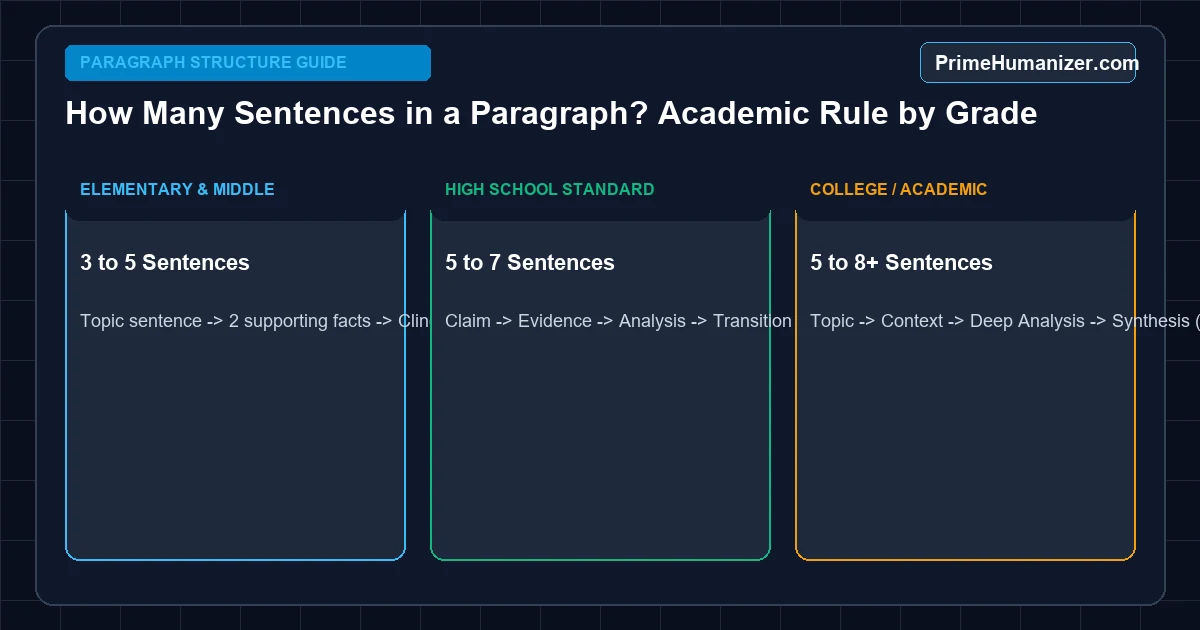
Figure 1: Paragraph sentence count guidelines across academic grade levels and professional formats.
The Anatomy of a Standard Academic Paragraph
In formal academic writing (APA, MLA, and Chicago styles), paragraphs follow a structured rhetorical rhythm often referred to as the MEAL plan (Main idea, Evidence, Analysis, Link):
- Sentence 1 (Topic Sentence): States the primary claim or assertion of the paragraph.
- Sentence 2 (Background & Context): Introduces the framework or source being discussed.
- Sentences 3–4 (Evidence / Data): Quotes a scholarly source, presents statistical data, or details empirical findings.
- Sentences 5–6 (Critical Analysis): Explains why the evidence supports the topic sentence and connects to your thesis statement.
- Sentence 7–8 (Clincher & Transition): Summarizes the takeaway and creates a smooth rhetorical bridge to the next paragraph.
Paragraph Sentence Count Matrix by Essay Type
| Essay Section / Type | Average Sentence Count | Typical Word Count | Primary Purpose |
|---|---|---|---|
| Introductory Paragraph | 3 to 5 sentences | 75 – 125 words | Hook, background context, and clear thesis statement. |
| Standard Body Paragraph | 5 to 8 sentences | 150 – 250 words | In-depth evidence, empirical analysis, and theoretical synthesis. |
| Concluding Paragraph | 3 to 5 sentences | 75 – 125 words | Restated thesis, synthesis of main points, and final clincher. |
| Transition Paragraph | 1 to 3 sentences | 30 – 60 words | Pivoting between two major thematic sections in a long paper. |
Common Mistakes: When Is a Paragraph Too Long or Too Short?
- The One-Sentence Academic Paragraph: Unless deliberately used as a transitional pivot in creative nonfiction, single-sentence paragraphs in academic papers are flagged by professors as undeveloped thoughts.
- The “Wall of Text” (Over 10 Sentences): Paragraphs extending past 300 words cause cognitive fatigue. Readers lose track of the topic sentence. If your paragraph exceeds 9 sentences, find the natural inflection point and split it into two distinct paragraphs.
- Uniform Sentence Length Monotony: Even if your paragraph has 6 sentences, if every sentence is exactly 18 words long, your writing will sound robotic and trigger AI detectors. Vary your sentence lengths between 5 and 35 words. (Explore our guide on how many sentences are in an essay).
Frequently Asked Questions
Can a paragraph have only 3 sentences?
Yes. In academic writing, a three-sentence paragraph is acceptable for introductory remarks, conclusions, or short transitions. As long as it contains a topic sentence, evidence, and conclusion, it is structurally complete.
What is the minimum number of sentences in an academic paragraph?
Most university writing centers recommend a minimum of 3 sentences. Anything shorter usually indicates that the claim lacks sufficient evidence or analysis.
How does PrimeHumanizer help refine paragraph structure?
If your paragraphs feel repetitive, choppy, or overly robotic after drafting, running them through the PrimeHumanizer AI rewriter tool balances sentence burstiness, optimizes cadence, and ensures natural transitions while preserving your original ideas.