
When preparing an academic essay, students are frequently given strict word count limits, but rarely receive guidance on sentence structure and volume. Understanding exactly how many sentences belong in an essay—and how those sentences should be distributed across your introduction, body paragraphs, and conclusion—is essential for crafting compelling, well-paced arguments. Whether you are writing a standard 5-paragraph high school paper or a comprehensive university research paper, knowing your target sentence count eliminates fluff and ensures academic excellence.
Direct Answer: How Many Sentences Are in an Essay?
⚡ Direct Answer & Sentence Count Blueprint
A standard 5-paragraph academic essay contains between 25 and 40 sentences (averaging ~32 sentences for a 500 to 650-word paper). Across longer academic assignments, essays average 50 to 70 sentences per 1,000 words. Each body paragraph requires 5 to 8 sentences to develop a complete argument, while introduction and conclusion paragraphs require 3 to 5 sentences.
In modern academic writing, the rhythm and length variation of your sentences (known as burstiness) is just as important as the raw count. Automated grading systems and institutional AI scanners actively analyze sentence cadence. You can test your draft’s flow on Prime Humanizer to ensure your sentence structure reads naturally and clears all detection algorithms.
Table of Contents
- Direct Answer: How Many Sentences Are in an Essay?
- Master Sentence Count Breakdown by Essay Length (500 to 3,000 Words)
- The 5-Paragraph Essay Blueprint: Sentences per Section
- Paragraph-by-Paragraph Sentence Anatomy (Intro, Body, Conclusion)
- Sentence Length vs. Sentence Count: The 15–20 Word Rule
- Sentence Cadence & AI Detection: Why “Burstiness” Matters in 2026
- How to Vary Your Sentence Rhythm (Step-by-Step)
- Frequently Asked Questions (FAQ)
- Conclusion & Writing Checklist
Master Sentence Count Breakdown by Essay Length (500 to 3,000 Words)
Because academic sentences average between 15 and 20 words, total sentence volume scales predictably with your overall word count target. Here is the exact mathematical distribution for standard academic papers:

| Target Word Count | Estimated Paragraphs | Total Sentence Range | Average Sentences Per Paragraph | Common Academic Format |
|---|---|---|---|---|
| 500 Words | 5 Paragraphs | 25 – 35 Sentences | 5 – 7 Sentences | Standard 5-paragraph essay, admissions prompt |
| 750 Words | 5 – 6 Paragraphs | 38 – 52 Sentences | 6 – 8 Sentences | College discussion response, short argumentative paper |
| 1,000 Words | 6 – 8 Paragraphs | 50 – 70 Sentences | 6 – 8 Sentences | Standard undergraduate term paper, midterm essay |
| 1,500 Words | 8 – 10 Paragraphs | 75 – 105 Sentences | 7 – 9 Sentences | Comprehensive research paper, literary analysis |
| 2,000 Words | 10 – 14 Paragraphs | 100 – 140 Sentences | 7 – 9 Sentences | Upper-level seminar paper, capstone draft |
| 3,000 Words | 15 – 20 Paragraphs | 150 – 210 Sentences | 7 – 10 Sentences | Undergraduate thesis chapter, major research project |
If your assignment is measured in pages rather than words or sentences, consult our companion conversion guide on how many pages is 10,000 words across line spacing and fonts.
The 5-Paragraph Essay Blueprint: Sentences per Section
The 5-paragraph essay remains the foundational model for persuasive and expository writing. Here is how expert writers allocate their sentences across the five sections to guarantee a balanced, cohesive structure:
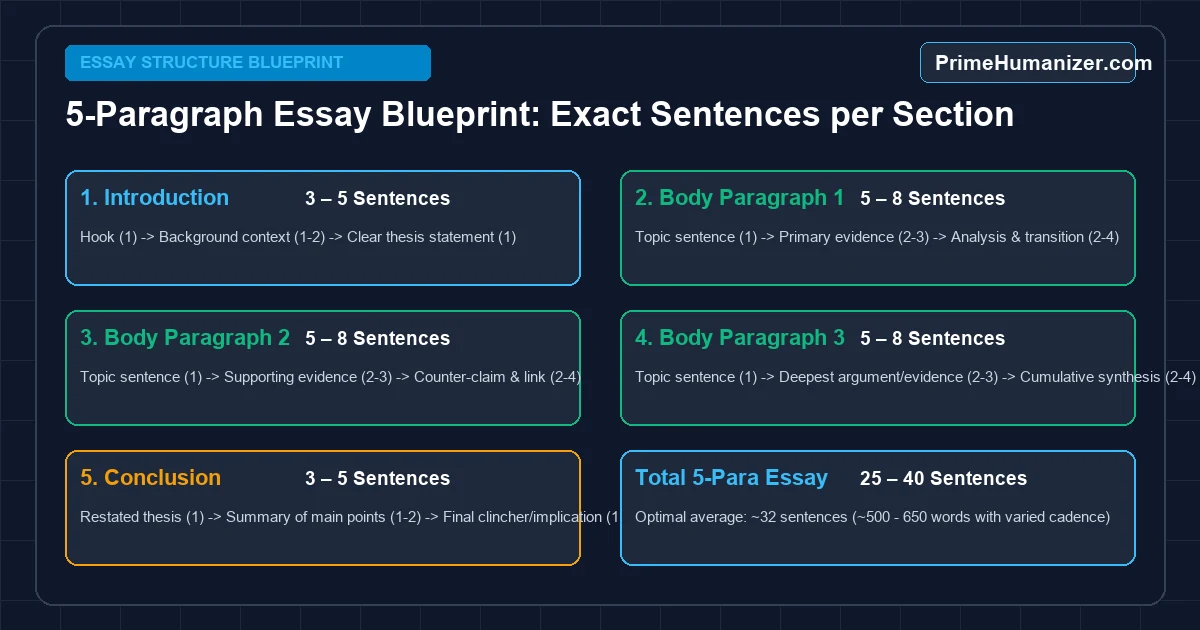
- Introduction (3 – 5 Sentences): Hooks reader interest, defines context, and states a defensible thesis.
- Body Paragraph 1 (5 – 8 Sentences): Presents your strongest evidentiary point with supporting citations.
- Body Paragraph 2 (5 – 8 Sentences): Develops your secondary argument or addresses a key counter-claim.
- Body Paragraph 3 (5 – 8 Sentences): Delivers your third supporting point with deep analytical synthesis.
- Conclusion (3 – 5 Sentences): Restates the thesis in a fresh way, summarizes main proofs, and ends with a memorable takeaway.
- Total 5-Paragraph Count: 25 to 40 Sentences (~500 to 650 words).
Paragraph-by-Paragraph Sentence Anatomy (Intro, Body, Conclusion)
To avoid generic filler, every sentence in an academic paragraph must serve a distinct functional purpose. Here is the anatomical sentence breakdown for each paragraph type:
1. The Introduction Paragraph (3 – 5 Sentences)
Your opening paragraph must move from broad relevance to narrow specificity:
- Sentence 1 (The Hook): Captures the reader’s attention with a compelling fact, rhetorical question, or surprising observation.
- Sentences 2–3 (Background & Scope): Introduces the core debate, key terminology, and author/text being analyzed.
- Sentence 4 (The Thesis Statement): The central argumentative claim that the entire essay proves.
- Sentence 5 (Optional Roadmap): Briefly previews the three supporting points explored in the body.
2. Body Paragraphs (5 – 8 Sentences Each)
A rigorous academic body paragraph follows the TEEL formula (Topic, Evidence, Explanation, Link):
- Sentence 1 (Topic Sentence): Clearly asserts the single main claim of the paragraph.
- Sentence 2 (Context / Framing): Introduces the source material, experiment, or historical event.
- Sentences 3–4 (Evidence / Direct Quote): Presents empirical data, textual evidence, or scholarly citations.
- Sentences 5–6 (Critical Analysis): Explains why this evidence validates your topic sentence and thesis.
- Sentence 7 (Counter-Perspective or Nuance): Acknowledges limitations or refines the scope of the claim.
- Sentence 8 (Transition / Link): Ties the insight back to the thesis and bridges logically into the next paragraph.
3. The Conclusion Paragraph (3 – 5 Sentences)
Your conclusion must never merely repeat prior paragraphs verbatim:
- Sentence 1 (Restated Thesis): Re-articulates your core argument using sophisticated new vocabulary.
- Sentences 2–3 (Synthesis of Findings): Demonstrates how your body paragraphs unite to answer the overarching question.
- Sentence 4 (Broader Significance): Explains why this topic matters to the field or society.
- Sentence 5 (The Clincher): A memorable final thought that resonates with the reader.
Sentence Length vs. Sentence Count: The 15–20 Word Rule
Focusing purely on counting sentences without monitoring sentence length leads to severe readability problems:
- The Choppy Draft (Average 8–10 Words): Writing only short sentences makes your prose sound infantile and disjointed: “The test failed. The scientists were shocked. They tried again. The results improved.”
- The Run-on Draft (Average 30+ Words): Packing multiple independent clauses together exhausts the reader and obscures your logic.
- The Sweet Spot (Average 16–18 Words): Experienced academic writers aim for an average sentence length of 16 to 18 words, achieved by mixing short, punchy statements with longer compound-complex analyses.
For guidelines on proper capitalization and grammar within academic essays, review our guide on is high school capitalized across APA, MLA, and Chicago styles.
Sentence Cadence & AI Detection: Why “Burstiness” Matters in 2026
If you use AI writing assistants like ChatGPT or Claude for brainstorming or drafting assistance, paying attention to sentence count is no longer optional—it is critical for academic survival. Institutional AI detectors (including Turnitin, Canvas, and GPTZero) evaluate documents using two statistical metrics:
- Perplexity: A measure of vocabulary unpredictability. Machine text uses high-probability word sequences, whereas humans use unexpected metaphors and diverse synonyms.
- Burstiness: The variation in sentence structure and sentence length. Raw AI text has nearly zero burstiness. Large language models write with a monotonous, metronomic cadence where almost every sentence hovers between 16 and 21 words.
When an essay is uploaded to an institutional portal, detectors analyze sentence distributions. If all 30 sentences in your essay have identical lengths and rigid transitional markers (e.g., “Furthermore,” “Moreover,” “In conclusion”), your paper triggers an automatic AI alert. Review our forensic investigation on what percentage of AI is acceptable on Turnitin to see how professors evaluate these reports.
To eliminate robotic cadence and protect your academic integrity, run your drafts through Prime Humanizer. The platform automatically reconstructs sentence architectures, injecting natural human burstiness—combining punchy 6-word assertions with 26-word explanatory clauses—ensuring your paper passes detectors with a clean 0% score.
How to Vary Your Sentence Rhythm (Step-by-Step)
To ensure your essay demonstrates authentic human rhythm, apply these three structural techniques during editing:
- The “Short-Long-Medium” Sequence: Follow an expansive 25-word analytical sentence with a crisp 6-word takeaway: “While empirical observations substantiate the initial hypothesis regarding market volatility, unexpected regulatory interventions altered investor behavior. The market froze.”
- Vary Your Sentence Openers: Avoid beginning consecutive sentences with the subject or pronouns (“He,” “The study,” “This”). Begin sentences with prepositional phrases, participial clauses, or transitional adverbs.
- The Vocalized Read-Aloud Test: Read your paragraph out loud at normal speaking cadence. If you run out of breath before reaching a period, split the sentence. If you sound like a robot reading a dictionary, combine adjacent thoughts.
For more insights into learning management tracking, read our breakdown on can Canvas detect ChatGPT and screen tracking.
Frequently Asked Questions (FAQ)
Can an essay paragraph have only 3 sentences?
In introduction and conclusion paragraphs, 3 sentences is completely acceptable (Hook, Context, Thesis). However, in body paragraphs, 3 sentences is usually too brief to adequately introduce a claim, cite evidence, and provide critical analysis.
What is the minimum number of sentences in an essay?
For a standard academic essay, the absolute bare minimum is 15 sentences (3 sentences across 5 paragraphs). However, a 15-sentence essay will rarely exceed 250 words and lacks academic depth. The standard target is 25 to 40 sentences.
How many sentences are in a 1,000-word essay?
A 1,000-word essay contains between 50 and 70 sentences, distributed across 6 to 8 paragraphs averaging 7 to 9 sentences each.
Do professors count sentences when grading?
Professors almost never manually count individual sentences; they grade based on word count, logical flow, evidence quality, and paragraph coherence. However, adhering to sentence target ranges ensures your paragraphs are structurally complete.
Conclusion & Writing Checklist
Sentence count is the architectural framework that gives academic essays their momentum, clarity, and authority. By targeting 25 to 40 sentences for a 5-paragraph essay (and 50 to 70 sentences per 1,000 words), varying your sentence lengths, and refining your drafts with Prime Humanizer, you can submit essays that captivate human readers and pass automated institutional checks effortlessly.
Perfect Your Essay’s Sentence Rhythm & Cadence
Inject natural human burstiness, eliminate repetitive AI transitions, and achieve 0% detection across Turnitin and Canvas.