Whether you are drafting a college admissions essay, updating your LinkedIn profile, or polishing your professional resume, improper capitalization can undermine your credibility. One of the most frequent grammar queries students, educators, and job applicants search for is whether the term “high school” should be capitalized. Because English rules governing academic terms, degrees, and institutions can feel arbitrary, writers frequently make mistakes that stand out to admissions officers and hiring managers.
Direct Answer: Is “High School” Capitalized?
⚡ Direct Answer & Core Capitalization Rule
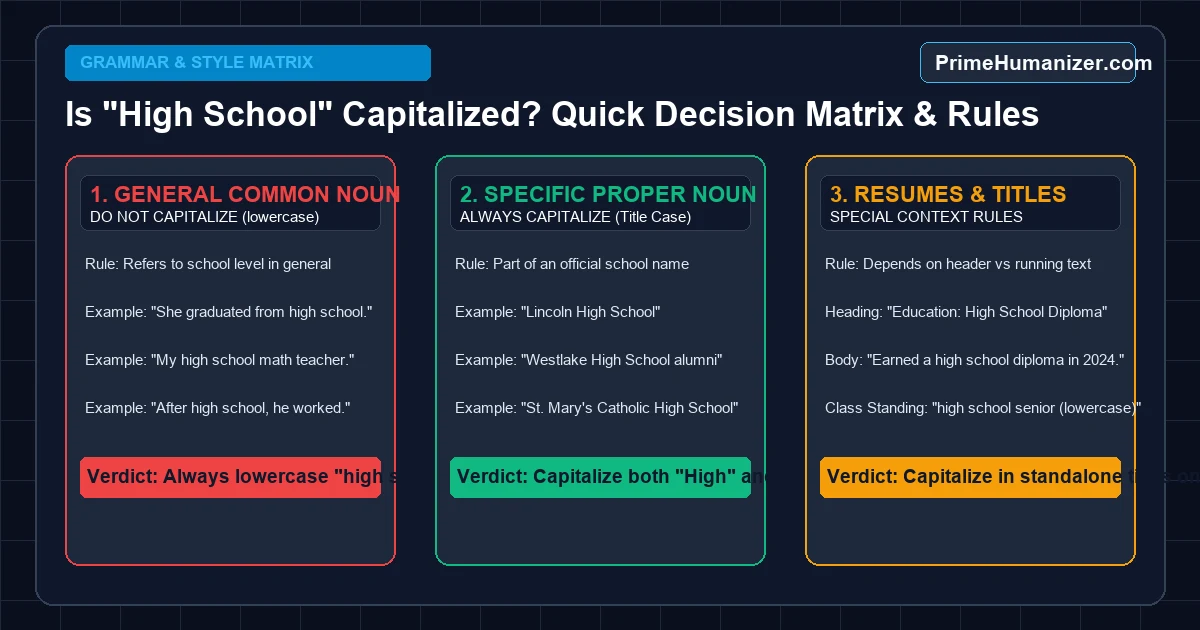
In standard English grammar, “high school” is NOT capitalized when used as a general common noun (e.g., “I attended high school in California”). It is ONLY capitalized when it forms part of a specific proper noun (e.g., “Lincoln High School”), appears as a standalone title or heading on a resume, or begins a sentence.
If you are writing an academic essay or personal statement, maintaining natural sentence rhythm and correct punctuation ensures your paper passes both human editorial review and automated checks. You can check your writing on Prime Humanizer to ensure your prose flows naturally and clears academic integrity screenings.
Table of Contents
- Direct Answer: Is “High School” Capitalized?
- The Core Grammar Principle: Common Noun vs. Proper Noun
- Quick Decision Matrix: When to Capitalize
- Capitalizing “High School” on Resumes, Diplomas, and CVs
- Academic Subjects & Grade Levels (Freshman, Senior, AP)
- Style Guide Rules: APA, MLA, Chicago, and AP Style
- Master Comparison Table: Correct vs. Incorrect Usage
- Common Mistakes to Avoid (One Word vs. Two Words)
- Why AI Writers Over-Capitalize Nouns & How to Fix It
- Frequently Asked Questions (FAQ)
- Conclusion & Key Takeaways
The Core Grammar Principle: Common Noun vs. Proper Noun
English capitalization hinges on whether a word refers to a broad, non-specific category (a common noun) or a distinct, named entity (a proper noun):
1. General Category (Lowercase: “high school”)
When you refer to secondary education in general, “high school” functions as a standard common noun. It must remain entirely lowercase:
- ✅ “She participated in varsity track throughout high school.”
- ❌ “She participated in varsity track throughout High School.”
- ✅ “Most high school students begin preparing for college in their sophomore year.”
- ❌ “Most High School students begin preparing for college in their sophomore year.”
2. Specific Named Institution (Capitalized: “High School”)
When “high school” is part of the official legal name of a school, both words become proper nouns and must be capitalized:
- ✅ “He graduated with honors from Oakridge High School.”
- ❌ “He graduated with honors from Oakridge high school.”
- ✅ “The state debate tournament was held at St. Jude Catholic High School.”
Capitalizing “High School” on Resumes, Diplomas, and CVs
Job applicants frequently stumble over capitalization when listing their educational credentials. How you format “high school” depends on whether it appears in a bulleted header or within a running descriptive sentence:
- Resume Section Headers (Title Case Permitted): If you are creating a standalone heading in the education section of your resume, title case is standard practice:
High School Diploma | Westview High School, Austin, TX (Graduated 2024) - Running Sentence in Cover Letters / Summaries (Lowercase): If you mention your diploma in a full sentence, write it in lowercase:
“I earned my high school diploma in 2023 before completing an administrative internship.” - Should You Even Include High School on a Resume? If you have earned an Associate, Bachelor’s, or higher degree, professional resume etiquette recommends omitting high school entirely. Only include your high school credential if you are a current college student or recent graduate entering the workforce.
Academic Subjects & Grade Levels (Freshman, Senior, AP)
Another related area of confusion involves grade levels and school subjects:
- Class Standings (Freshman, Sophomore, Junior, Senior): Class standings are common nouns and should be lowercase unless starting a sentence:
✅ “During her high school junior year, she volunteered at the local clinic.”
❌ “During her High School Junior Year, she volunteered at the local clinic.” - General School Subjects: Broad academic subjects (math, history, chemistry, biology) are lowercase unless they include a language or proper noun:
✅ “He excelled in high school chemistry and Spanish.” (Spanish is capitalized because it is a language; chemistry is lowercase). - Specific Course Titles: Capitalize exact, numbered course catalog titles:
✅ “She completed AP Biology, Introduction to Psychology, and high school algebra.”
Style Guide Rules: APA, MLA, Chicago, and AP Style
Major academic and journalistic style manuals maintain strict consensus regarding secondary school terminology:
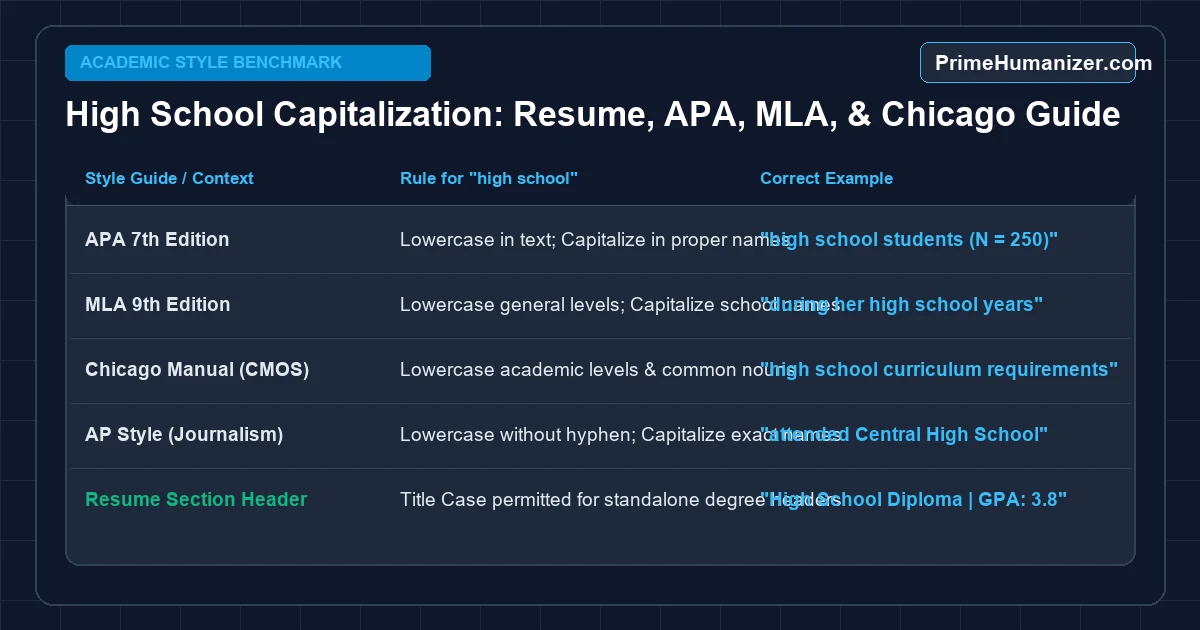
| Style Manual | Standard Rule | Official Example |
|---|---|---|
| APA 7th Edition | Lowercase in running text; Capitalize in official school names. | “The study sampled 300 high school seniors across three districts.” |
| MLA 9th Edition | Lowercase for generic academic levels and degree types. | “During her high school years, the author developed her lyrical style.” |
| Chicago Manual of Style (CMOS) | Strictly lowercase common institutional designations. | “A high school education remains fundamental for vocational training.” |
| Associated Press (AP Style) | Lowercase; do not hyphenate “high school student.” | “The mayor visited Franklin High School to address students.” |
For more insights into formatting academic coursework to clear institutional checks, explore our guide on how Canvas LMS tracks student submissions and formatting.
Master Comparison Table: Correct vs. Incorrect Usage
| Writing Context | Incorrect Formatting ❌ | Correct Formatting ✅ |
|---|---|---|
| General Education | “I finished High School in 2022.” | “I finished high school in 2022.” |
| Official Name | “She attends Roosevelt high school.” | “She attends Roosevelt High School.” |
| Diploma Credential | “Requires a High School Diploma.” | “Requires a high school diploma.” |
| Resume Header | “high school diploma | 2024” | “High School Diploma | 2024″ (Title Case) |
| Class Year | “A High School Sophomore.” | “A high school sophomore.” |
| Beginning of Sentence | “high school was memorable.” | “High school was memorable.” |
Common Mistakes to Avoid (One Word vs. Two Words)
Beyond capitalization, writers frequently make spelling and hyphenation errors:
- Is “Highschool” Ever One Word? No. In modern English, “high school” is strictly two separate words. Writing “highschool” as a single compound word is grammatically incorrect in both American and British English.
- Should “High School” Be Hyphenated? When “high school” functions as a compound adjective modifying a noun (e.g., high school teacher, high school campus), it is never hyphenated. Because “high school” is an established compound noun that is universally understood, adding a hyphen (“high-school teacher”) is unnecessary under AP and Chicago style guidelines.
Why AI Writers Over-Capitalize Nouns & How to Fix It
If you utilize artificial intelligence tools like ChatGPT or Claude for preliminary research or drafting, you have likely noticed that AI language models suffer from “Title Case Syndrome.” Raw AI text frequently over-capitalizes common nouns (e.g., writing “High School Curriculum,” “University Degree,” or “Marketing Strategy” in the middle of sentences).
This artificial capitalization pattern is one of the subtle markers institutional classifiers look for. When combined with uniform sentence lengths, it increases detection scores on systems like Turnitin and GPTZero. Read our research on what percentage of AI is acceptable on Turnitin to see how formatting impacts institutional evaluations.
To eliminate these robotic formatting quirks, run your drafts through Prime Humanizer. The engine corrects awkward capitalization, optimizes sentence burstiness, and delivers clean, natural prose ready for academic or professional submission.
Frequently Asked Questions (FAQ)
Do you capitalize “high school” when referring to yourself?
No. When describing your personal background, write it in lowercase: “When I was in high school, I developed an interest in computer science.”
Should “high school diploma” be capitalized on LinkedIn?
In the structured “Education” fields of LinkedIn, using Title Case (“High School Diploma”) is standard. In your “About” summary paragraph, keep it lowercase: “After earning my high school diploma in 2021…”
Is “Middle School” or “Elementary School” capitalized?
The exact same rule applies: lowercase when referring to the general institution level (“elementary school,” “middle school”), and capitalized only when naming a specific school (“Westview Middle School”).
Conclusion & Key Takeaways
Mastering the capitalization of “high school” boils down to a simple question: Are you naming a specific school, or referring to the general educational stage? Keep it lowercase for general references, diplomas, and grade levels in running text, and capitalize it only when it forms part of an official institution’s name or a standalone resume heading.
Polish Your Essays and Resumes to Perfection
Eliminate awkward AI formatting, correct over-capitalization, and pass academic integrity checks with Prime Humanizer.