
Submitting an academic essay and seeing an unexpected AI detection percentage on Turnitin is every student’s worst nightmare. Whether you used an AI assistant to brainstorm ideas, refined your grammar with automated proofreading tools, or wrote every single word yourself from scratch, seeing a highlighted AI percentage triggers immediate anxiety: Will my professor fail my paper? Does a 15% score count as academic misconduct? What percentage of AI is actually acceptable on Turnitin in 2026?
Direct Answer: What Percentage of AI is Acceptable on Turnitin?
⚡ Direct Answer & 2026 Policy Thresholds
Turnitin does not set an official universal cutoff, but across most US, UK, Canadian, and Australian universities, an AI score between 0% and 10% is generally acceptable and considered normal false-positive noise. An AI score of 11% to 20% falls into an amber caution zone requiring manual instructor review, while any score exceeding 20% typically triggers formal academic integrity investigations or mandatory grade deductions.
To eliminate the risk of false-positive penalties before turning in your assignments, you can run your text through Prime Humanizer to ensure your writing clears institutional scanners with a clean 0% AI detection rating.
Table of Contents
- Direct Answer: Acceptable AI Percentage Thresholds
- The 3 Turnitin AI Percentage Zones Explained (Green, Amber, Red)
- Master University Policy Benchmark (US, UK, & Global Standards)
- Turnitin’s Official Accuracy Disclaimer & False-Positive Rates
- What Instructors Actually See in Turnitin AI Reports
- Why 100% Original Student Writing Gets Flagged
- How to Appeal an Unfair AI Flag (Step-by-Step Defense Guide)
- How to Reduce Your AI Score to 0% Before Submitting
- Frequently Asked Questions (FAQ)
- Conclusion & Final Checklist
The 3 Turnitin AI Percentage Zones Explained (Green, Amber, Red)
Because automated classifiers cannot verify intent, academic institutions categorize Turnitin scores into three operational decision tiers:
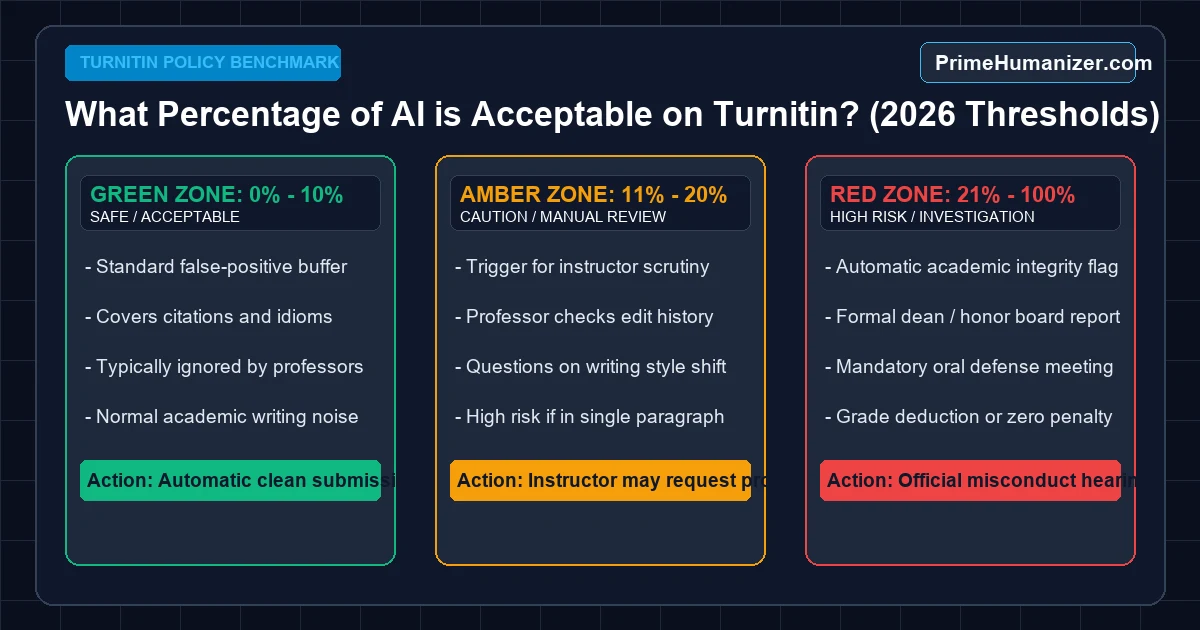
1. The Green Zone: 0% – 10% (Safe / Acceptable)
Scores below 10% are overwhelmingly viewed as standard statistical noise. Turnitin’s neural classifier frequently flags generic transitional phrases (e.g., “In conclusion, the data demonstrates…”), APA bibliography citations, and widely accepted definitions. Unless an instructor enforces a zero-tolerance policy, papers in this range are graded normally without questions.
2. The Amber Zone: 11% – 20% (Caution / Manual Inspection)
Scores in the 11% to 20% range rarely lead to immediate disciplinary penalties, but they act as a red flag prompting the instructor to look closer. Professors will examine where the AI flags occur. If isolated introductory sentences are highlighted, it is usually dismissed. However, if an entire body paragraph or methodology section is highlighted in solid blue, professors may request editing logs or draft histories.
3. The Red Zone: 21% – 100% (High Risk / Investigation)
Scores above 20% represent the standard threshold where university academic integrity boards mandate formal action. At 25% or higher, Turnitin’s confidence metric is considered legally defensible under institutional bylaws. Students in this tier often face grade deductions, mandatory zero grades on assignments, or formal academic hearings.
Master University Policy Benchmark (US, UK, & Global Standards)
Different academic systems apply different guidelines regarding AI detection reports. Here is how leading institutional categories approach Turnitin AI scores:
| Institution Type | Acceptable AI % Buffer | Investigation Trigger | Standard Institutional Penalty |
|---|---|---|---|
| Ivy League / Elite US Universities | 0% – 5% | 10%+ | Formal Honor Code Hearing; Zero on Course |
| Major US State Universities | 0% – 15% | 20%+ | Professor viva / Oral defense; Assignment zero |
| UK Russell Group Universities | 0% – 10% | 15%+ | Academic Misconduct Panel; Cap at pass mark |
| Australian / Go8 Universities | 0% – 10% | 20%+ | Investigation of Google Docs version history |
| Community / Online Colleges | 0% – 20% | 25%+ | Mandatory rewrite or grade penalty |
Turnitin’s Official Accuracy Disclaimer & False-Positive Rates
Crucially, Turnitin itself explicitly cautions educators against using their AI detection score as a sole basis for accusing students of cheating. According to official documentation published by Turnitin:
- Document-Level False Positive Rate: Approximately 1% for full essays with high word counts.
- Sentence-Level False Positive Rate: Up to 4% when analyzing short passages under 500 words.
- Official Recommendation: Turnitin instructs professors to treat the score as an “investigative indicator” rather than definitive proof of academic dishonesty.
For more forensic insights into how modern LMS platforms integrate these scans, check our detailed report on what Canvas LMS can and cannot track during assignments.
What Instructors Actually See in Turnitin AI Reports
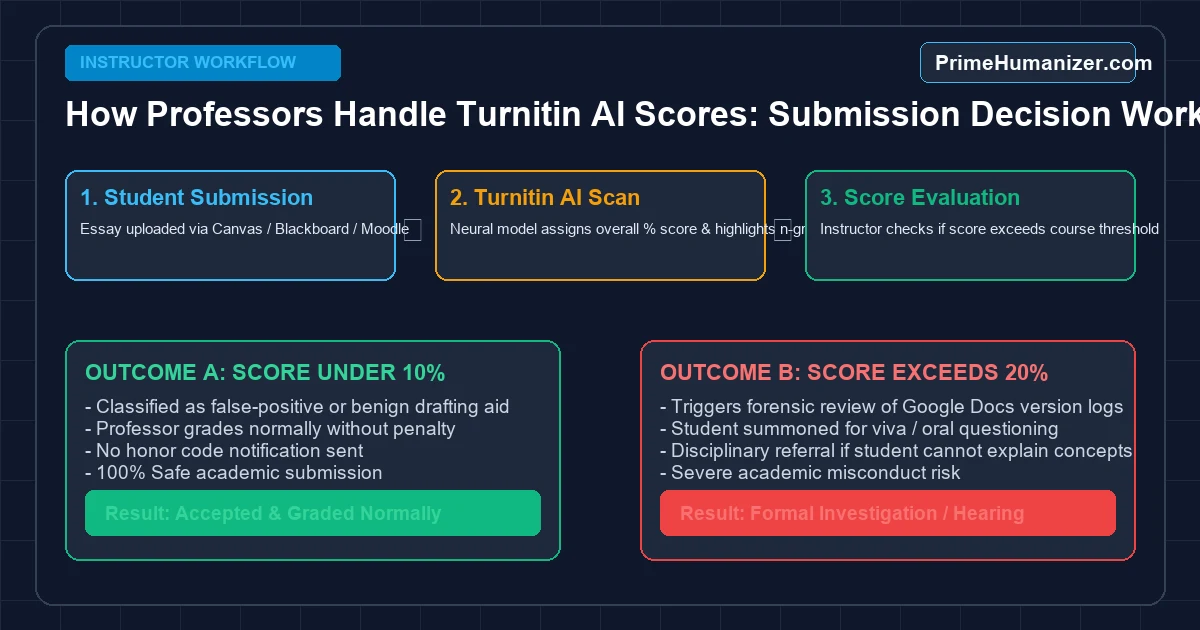
When a professor opens your submission inside Canvas, Blackboard, or Moodle, they see two completely distinct metrics:
- Similarity Index (Red/Orange/Green): Measures traditional plagiarism against published papers, websites, and student databases.
- AI Writing Indicator (Blue Percentage Badge): Shows the estimated percentage of sentences generated by large language models (ChatGPT, Claude, Gemini).
Clicking the blue AI badge opens an interactive document viewer where suspicious sentences are highlighted in blue. Professors do not just look at the raw number; they evaluate whether the highlighted portions form coherent, formulaic paragraphs or scattered phrases. If you want to see which tools consistently clear these reports, see our benchmark of the top AI humanizers for Turnitin.
Why 100% Original Student Writing Gets Flagged
Thousands of honest students receive false-positive Turnitin flags every semester. Here is why the algorithm makes mistakes:
- Low Perplexity Writing: Clear, grammatically precise academic prose naturally uses common transitional phrasing. Turnitin mistakes high clarity for low perplexity machine output.
- Non-Native English Speakers (ESL): Studies from Stanford University revealed that AI detectors are significantly biased against international students, who tend to use less diverse vocabulary and more structured syntax.
- Heavy Automated Grammar Checking: Overusing Grammarly’s sentence restructuring suggestions can unintentionally format your sentences into patterns Turnitin flags as machine-assisted.
- Standardized Technical Jargon: Fields like chemistry, legal studies, and computer science require rigid terminology that cannot be paraphrased, increasing detection probability.
Many students attempt to fix these flags using basic paraphrasers, only to make the problem worse. Read our experimental investigation on why QuillBot gets flagged by Turnitin.
How to Appeal an Unfair AI Flag (Step-by-Step Defense Guide)
If your professor confronts you with a high AI percentage on a paper you wrote authentically, follow this proven defense protocol:
- Remain Calm and Professional: Do not react defensively. Request an in-person or Zoom meeting to review the submission together.
- Present Version History Logs: Open Google Docs or Word Online and show your version history. A document created in 10 seconds via copy-paste looks suspicious, but a document showing hours of sequential edits, deletions, and typing timestamps is undeniable proof of human authorship.
- Offer an Oral Defense (Viva): Offer to explain your thesis, methodology, and primary sources without notes. Professors know that someone who generated an essay with AI cannot discuss nuanced arguments in real-time.
- Cite Turnitin’s False-Positive Disclaimers: Respectfully point out Turnitin’s documented false-positive margins and Stanford’s studies on linguistic bias.
How to Reduce Your AI Score to 0% Before Submitting
The smartest way to avoid academic integrity headaches is to ensure your submission registers 0% AI before hitting the submit button. When using AI for preliminary research or drafting assistance, follow these rules:
- Vary Your Sentence Pacing (Burstiness): Break up monotonous 20-word sentences. Pair a short 6-word assertion with a 28-word analytical explanation.
- Inject Authentic Personal Experience: Reference specific lecture notes, class discussions, and regional examples that no generic LLM could anticipate.
- Use a Dedicated Neural Humanizer: Instead of crude word spinners, run your text through Prime Humanizer. It re-engineers sentence perplexity, preserves your APA citations, and delivers a guaranteed clean pass across Turnitin and GPTZero.
To understand the full spectrum of tools available, explore our rankings of the best AI humanizer tools in 2026.
Frequently Asked Questions (FAQ)
Is a 15% AI score on Turnitin bad?
A 15% AI score falls into the amber caution range. Most professors will not penalize you immediately, but they may manually inspect the highlighted sections. If the flagged sentences are scattered definitions or citations, it is usually dismissed. If an entire section is flagged, you may be asked to explain your draft process.
Can Turnitin detect text that has been humanized?
Basic paraphrasers like QuillBot are easily detected because they merely swap synonyms. However, advanced neural humanizers like Prime Humanizer mathematically restructure perplexity and burstiness, consistently scoring 0% AI on Turnitin.
Does Turnitin store my paper in its database?
If your professor enables the standard “Standard Paper Repository” setting, your paper is stored to check against future student submissions. However, draft check portals often allow submissions without storing them in the permanent repository.
Can I check my own Turnitin score before submitting?
Turnitin does not offer direct individual accounts to students; access is only provided through university LMS portals. However, you can test your draft against third-party neural detectors and humanize your content through Prime Humanizer prior to final submission.
What is the difference between similarity score and AI score?
Similarity measures traditional plagiarism—matching text against websites, journals, and previous submissions. AI score measures statistical likelihood that text was generated by an LLM, even if the content is 100% unique and unplagiarized.
Conclusion: Aim for a Clean 0% for Total Peace of Mind
While an AI score under 10% is technically tolerated by many universities, academic policies vary wildly between professors and departments. The only way to ensure 100% peace of mind, avoid stressful hearings, and protect your academic standing is to ensure your final submission reads authentically and registers a clean 0% AI detection score.
Submit Your Assignments with 100% Confidence
Eliminate false-positive AI flags on Turnitin, Canvas, and Blackboard with Prime Humanizer’s citation-safe rewriting engine.