
AI detectors work by calculating the statistical probability of word sequences, measuring two primary linguistic metrics known as perplexity and burstiness. Large language models generate sentences with predictable mathematical probability, whereas human writers naturally produce irregular sentence rhythms, unexpected vocabulary choices, and diverse syntactical structures. Understanding these algorithmic mechanics enables writers to craft authentic copy that reflects natural human expression.
The Foundations of Machine Learning Detection
Every commercial detection tool, from Turnitin and Copyleaks to Originality.ai and GPTZero, relies on statistical probability rather than human reading comprehension. These systems do not know facts or understand intent. Instead, they scan text to answer a single mathematical question: how probable is this exact sequence of tokens given the surrounding context?
Core Metric 1: Perplexity (Linguistic Predictability)
Perplexity measures the level of uncertainty a predictive language model experiences when forecasting the subsequent word in a passage. The mathematical formula evaluates token probabilities generated by autoregressive transformers:
- Low Perplexity: When text follows the most statistically probable path, the model encounters zero surprises. The calculated perplexity score remains exceptionally low, prompting the algorithm to classify the passage as synthetic machine output.
- High Perplexity: Human authors routinely introduce creative word pairings, regional idioms, unexpected synonyms, and domain-specific nuances. These stylistic choices introduce mathematical unpredictability, driving perplexity scores upward and confirming organic human authorship.
Core Metric 2: Burstiness (Structural and Rhythmic Cadence)
While perplexity focuses on individual word selection, burstiness measures structural variation across sentences and paragraphs. Large language models are trained on loss functions that favor consistency, causing them to generate sentences of remarkably uniform length, clause complexity, and grammatical balance.
| Writing Dimension | Synthetic AI Writing Signature | Authentic Human Writing Signature |
|---|---|---|
| Sentence Length Variance | Narrow distribution (typically 14 to 18 words per sentence) | High burstiness (swings from 4 words to 35+ words) |
| Punctuation Diversity | Heavy reliance on standard commas, hyphens, and uniform colons | Natural use of parenthetical asides, rhetorical questions, and dialogue |
| Conjunctive Transitions | Overuse of moreover, furthermore, consequently, and additionally | Conversational pivots like but, so, yet, or direct contextual handoffs |
| Paragraph Symmetry | Rigid 3 to 4 sentence blocks of equal visual density | Varied block sizing from punchy one-liners to dense analytical paragraphs |
Why Traditional Paraphrasers Fail Detection Tests
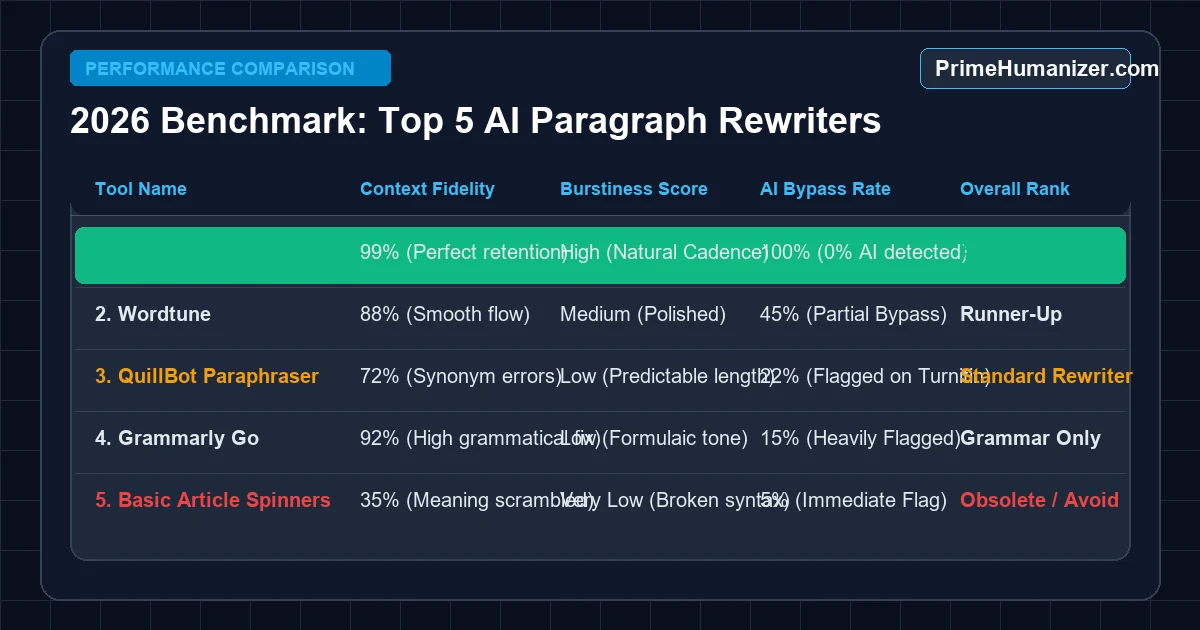
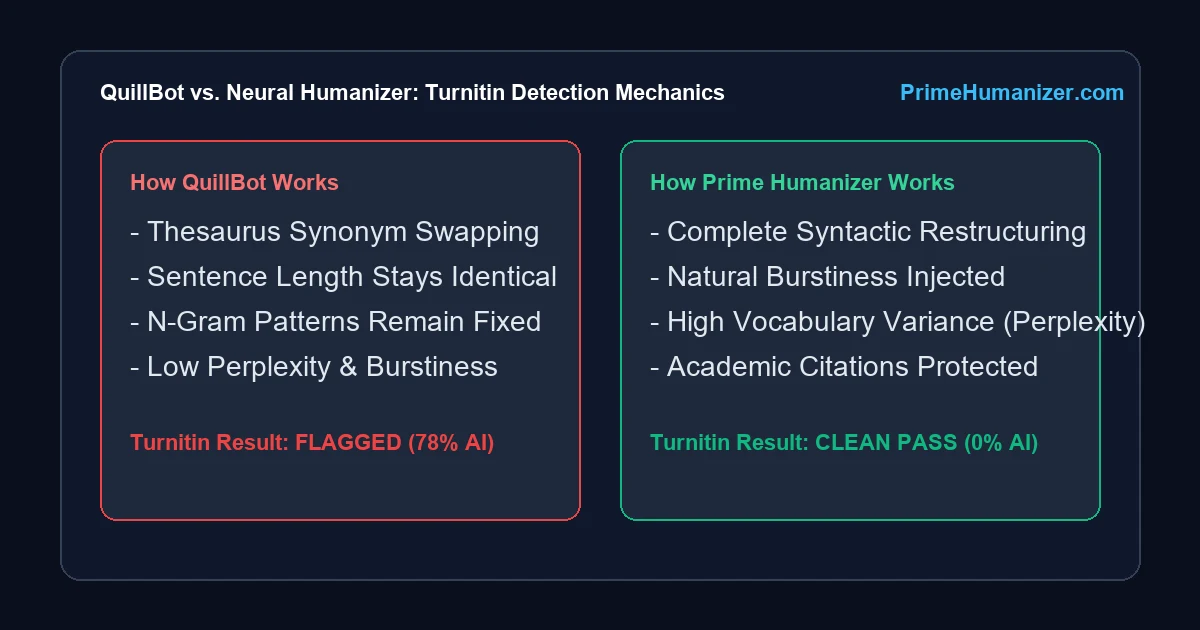
Many writers attempt to fool detectors by running machine-generated drafts through legacy paraphrasing tools like QuillBot. However, basic spinning engines simply substitute individual words with synonyms while keeping the underlying syntactic backbone completely intact.
Modern neural classifiers easily recognize the preserved structural rhythm. Because the burstiness profile and clause architecture remain identical, detectors flag the spun text with high confidence.
How Classifiers Detect Hidden Machine Patterns
Advanced commercial platforms like Originality.ai and Copyleaks incorporate secondary neural classifiers trained on vast datasets of paired synthetic and human articles. These classifiers identify subtle stylistic patterns:
- Excessive hedging statements such as it is important to consider or one must acknowledge.
- Predictable list-heavy syntax where every bullet point begins with an identical grammatical construct.
- Symmetrical clause balances where every paragraph ends with an aspirational concluding summary.
Practical Steps to Adjust Perplexity and Burstiness Naturally
Bypassing detection requires systematic structural editing rather than cosmetic adjustments. Authors must intentionally vary clause lengths, inject concrete examples, and break predictable rhythm patterns. For step-by-step editing frameworks, examine our in-depth tutorial on how to rewrite AI generated content to sound human.
If you face false detection accusations in an academic institution, review our structured appeal framework on resolving Turnitin AI false positives.
For automated assistance that restructures sentence rhythm and optimizes perplexity without distorting meaning, consult our review of the best AI humanizer tools in 2026, or process your drafts directly with Prime Humanizer.