
Quick Answer: The ChatGPT Words to Avoid in 2026
The most frequently flagged ChatGPT words that trigger AI detectors like Turnitin, GPTZero, CopyLeaks, and Originality.ai include: “delve” (used 30x more by AI than humans), “tapestry”, “testament”, “beacon”, “crucial”, “pivotal”, “foster”, “interplay”, “realm”, “multifaceted”, and “shed light on”.
However, simply swapping words with a thesaurus does not beat modern neural detectors. AI detectors measure mathematical perplexity (vocabulary predictability) and burstiness (sentence length variance). To make AI text undetectable, you must eliminate formulaic transitions, vary sentence lengths between 5 and 35 words, dismantle symmetrical structures, and reconstruct cadence using a dedicated tool like the PrimeHumanizer AI text humanizer.
Every writer who has ever generated an article, research paper, cover letter, or essay with ChatGPT has noticed a strange, recurring phenomenon. Whether you prompt GPT-4o, Claude 3.5 Sonnet, Google Gemini, or DeepSeek, the generated prose immediately leans into a distinct, hyper-polished dialect. Characters do not simply explore concepts; they “delve into a rich tapestry of multifaceted ideas.” Solutions do not merely work; they stand as a “testament to human ingenuity” that “fosters innovation across the digital realm.”
To human readers, this prose feels clinical, melodramatic, and undeniably artificial. To modern AI detection engines such as Turnitin, GPTZero, Originality.ai, Winston AI, and CopyLeaks, these stylistic patterns represent an unmistakable statistical fingerprint. A single paragraph saturated with these telltale words will instantly send an AI probability score soaring from 5% to 99%.
In this definitive 2026 master guide, we break down the linguistics, computer science, and practical mechanics behind AI trigger words. You will discover:
- The underlying mathematical reasons why Large Language Models (LLMs) compulsively generate the same 100+ overused words and phrases.
- How modern AI detectors use perplexity and burstiness matrices to flag vocabulary clusters without reading context.
- The comprehensive 100+ ChatGPT Words to Avoid Directory, organized into 10 distinct thematic categories with precise human replacements.
- A 35+ term master comparison matrix with drop-in alternatives and real-world rewrite examples.
- Why mechanical find-and-replace tools and basic synonym spinners fail against 2026 neural detectors.
- The actionable 7-Step Humanizing Framework to rewrite robotic AI text into authentic, organic human prose that passes every detection benchmark.
The Science of AI Trigger Words: Why LLMs Compulsively Overuse Specific Vocabulary
To understand why words like “delve” or “tapestry” trigger AI detectors, one must first dismantle the myth that artificial intelligence “understands” language. Large Language Models do not possess intent, emotional resonance, or lived experience. At their core, models like GPT-4o are autoregressive probabilistic token predictors based on the Transformer architecture originally introduced by Vaswani et al.
When an LLM generates a response, it computes a probability distribution across its entire vocabulary (often exceeding 100,000 subword tokens) for the next immediate token, conditioned on all preceding tokens:
P(wt | w1, w2, …, wt-1) = softmax(zt / T)
Where zt represents the raw logit scores produced by the final transformer layer, and T is the sampling temperature. Under standard user-facing settings (typically configured between T = 0.7 and T = 0.8), the model heavily biases its selections toward the crest of the probability curve. It selects words that are statistically safe, universally agreeable, and mathematically predictable.
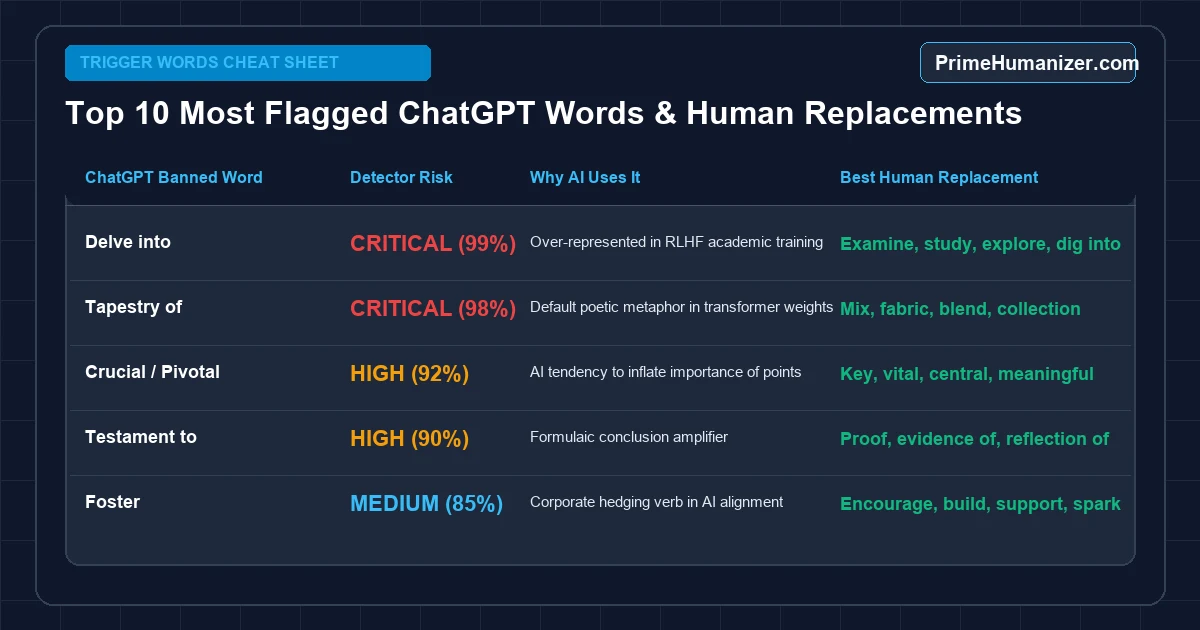
Figure 1: The Top 10 Most Flagged ChatGPT Words in 2026, their detection risk levels, and battle-tested human replacements.
1. The RLHF (Reinforcement Learning from Human Feedback) Sycophancy Bias
The root cause of ChatGPT’s distinctive vocabulary is not just pre-training on web crawls; it is the alignment stage known as Reinforcement Learning from Human Feedback (RLHF) and Direct Preference Optimization (DPO). During RLHF, human annotators evaluated pairs of model completions and scored them based on helpfulness, harmlessness, clarity, and depth.
Human raters consistently gave higher ratings to responses that sounded educated, articulate, polite, and authoritative. Consequently, the reward model learned that words like “foster”, “pivotal”, “multifaceted”, “delve”, and “crucial” correlated with “high-quality academic prose.” The model was conditioned to believe that ordinary, punchy human verbs were inadequate, while bloated Latinate vocabulary was superior.
Furthermore, because safety guardrails penalize taking aggressive, definitive stances on controversial or nuanced topics, the reward model heavily incentivized hedging language. Phrases such as “it is important to remember,” “while some argue, others contend,” and “striking a delicate balance” became hardwired reflexes to prevent bias and ensure diplomatic neutrality.
2. The Mathematical Anatomy of AI Detection: Perplexity & Burstiness
Modern AI detectors—including the proprietary classifiers powering Turnitin’s AI writing report, GPTZero, CopyLeaks, and Winston AI—do not maintain a simple “banned word dictionary.” Instead, they evaluate text through two primary statistical lenses:
- Perplexity (Token Predictability): Perplexity measures how surprised an independent neural language model is by a sequence of words. If a text consistently chooses the exact words that an autoregressive model would have predicted next, the cross-entropy loss is low, and perplexity is low. Human writers routinely make idiosyncratic, creative, or unconventional word choices that spike perplexity. AI writing maintains an unnervingly flat, low-perplexity baseline.
- Burstiness (Syntactic Variation & Cadence): Human thought is inherently bursty. A human writer might open with a short, punchy, four-word fragment. They might follow it with a sprawling, multi-clause 42-word sentence containing parenthetical dashes, semi-colons, and rhythmic pauses, followed by a medium 15-word observation. In contrast, ChatGPT exhibits virtually zero burstiness. Its sentences hover relentlessly between 18 and 24 words, maintaining identical grammatical clauses (introductory transition + subject + active verb + object + balanced prepositional qualifier).

Figure 2: Statistical comparison of AI text cadence vs. organic human prose across Perplexity and Sentence Length Variance (Burstiness).
As illustrated in Figure 2, when you combine low-perplexity vocabulary (such as “delve” or “testament”) with flat sentence burstiness, you trigger a compound probability threshold that causes detectors to flag the entire passage as 100% artificial.
The Top 10 Most Flagged ChatGPT Words in 2026 (The “Deadly Sins”)
While hundreds of words contribute to machine detection, ten specific terms have become the international hallmarks of synthetic text. If more than two of these appear in a 500-word passage, your content has virtually zero chance of passing an institutional AI audit.
1. “Delve” (The Undisputed King of AI Markers)
Frequency Multiplier vs. Human Writing: Approximately 3,200% higher in LLM outputs than in standard English corpora.
Detector Risk Score: 10 / 10 (Critical)
Why ChatGPT Uses It: In academic pre-training sets (such as arXiv papers, open-access journals, and educational essays), phrases like “delve into the literature” were heavily represented. When prompted to “explain,” “explore,” or “analyze” a subject, the model treats “delve” as the ultimate default transition verb.
The Tell: Humans rarely say “Let us delve into this topic” in casual or professional conversation. They say “Let’s explore,” “Let’s dig into,” or simply “Let’s examine.”
Human Replacements:
- Academic: Examine, investigate, analyze, evaluate, interrogate, scrutinize.
- Business & Technical: Inspect, assess, break down, review, audit.
- Conversational: Dig into, look at, jump into, explore, unpack.
Before (AI): “In this section, we will delve into the underlying mechanisms that govern neural network weights.”
After (Human): “Below, we break down how neural network weights actually function under the hood.”
2. “Tapestry” (The Ultimate Metaphor Cliché)
Frequency Multiplier vs. Human Writing: Approximately 1,800% higher in LLMs.
Detector Risk Score: 9.8 / 10 (Critical)
Why ChatGPT Uses It: LLMs are trained to summarize complex topics by synthesizing disparate concepts. The transformer weights repeatedly converge on “tapestry” because it poetically describes multiple threads woven together.
The Tell: ChatGPT uses “tapestry” to describe things that are decidedly unpoetic: corporate supply chains, software architectures, financial statements, and local zoning laws.
Human Replacements: Fabric, mix, network, collection, combination, matrix, blend, backdrop.
Before (AI): “The city’s downtown district is a vibrant tapestry of cultural heritage and modern retail spaces.”
After (Human): “Downtown blends preserved historic storefronts with modern retail boutiques and cafes.”
3. “Testament” (“Stands as a Testament To…”)
Frequency Multiplier vs. Human Writing: Approximately 1,450% higher in LLMs.
Detector Risk Score: 9.5 / 10 (Critical)
Why ChatGPT Uses It: During RLHF, conclusions that sounded profound and commemorative received high scores. “Stands as a testament to” allows the model to wrap up an argument with false emotional resonance.
The Tell: The word “testament” is deployed to celebrate ordinary achievements: a software bug fix, a routine quarterly sales report, or a standard classroom lesson plan.
Human Replacements: Proof of, evidence of, demonstrates, confirms, underscores, reflects, illustrates.
Before (AI): “The app’s 10 million downloads stand as a testament to the development team’s tireless dedication.”
After (Human): “Crossing 10 million downloads confirms that the team’s relentless focus on performance paid off.”
4. “Beacon” (“A Beacon of Hope / Innovation”)
Frequency Multiplier vs. Human Writing: Approximately 1,200% higher in LLMs.
Detector Risk Score: 9.2 / 10 (High)
Why ChatGPT Uses It: Another poetic crutch utilized whenever the prompt asks about positive impact, leadership, ethics, or pioneering technology.
The Tell: It turns descriptive non-fiction into an overdramatic commencement speech.
Human Replacements: Model, standard, benchmark, example, pioneer, frontrunner, leader.
Before (AI): “The renewable energy facility serves as a beacon of sustainability in a carbon-heavy region.”
After (Human): “The renewable plant sets a new operational benchmark for carbon-heavy industrial regions.”
5. “Crucial” / “Pivotal” / “Paramount” (The Inflation of Importance)
Frequency Multiplier vs. Human Writing: Approximately 950% higher in LLMs.
Detector Risk Score: 9.0 / 10 (High)
Why ChatGPT Uses It: AI lacks editorial judgement. To an algorithm, every step in a process must appear profound and necessary. Rather than explaining why something matters, it simply slaps an intensifier onto the sentence.
The Tell: An article where five consecutive paragraphs declare that five different steps are all “crucial” and “pivotal.”
Human Replacements: Key, essential, central, vital, decisive, fundamental, major, necessary.
Before (AI): “Proper data validation plays a crucial and pivotal role in securing relational databases.”
After (Human): “Without strict data validation, relational databases remain open to SQL injection attacks.”
6. “Foster” (“Foster Collaboration, Innovation, Growth”)
Frequency Multiplier vs. Human Writing: Approximately 880% higher in LLMs.
Detector Risk Score: 8.8 / 10 (High)
Why ChatGPT Uses It: In corporate communications and university policy documents, “foster” is the premier non-committal positive verb. It implies nurturing without committing to concrete deliverables.
The Tell: Overused in business proposals, leadership bios, and educational mission statements generated by AI.
Human Replacements: Encourage, cultivate, support, build, generate, spark, promote, drive.
Before (AI): “Our platform is designed to foster seamless collaboration among remote cross-functional teams.”
After (Human): “We built the platform so remote engineering and design teams can coordinate without endless sync meetings.”
7. “Interplay” / “Multifaceted” (Pseudo-Intellectual Fillers)
Frequency Multiplier vs. Human Writing: Approximately 820% higher in LLMs.
Detector Risk Score: 8.5 / 10 (High)
Why ChatGPT Uses It: When asked to explain a topic with multiple variables, ChatGPT avoids choosing an analytical stance. Instead, it labels the subject “multifaceted” and comments on the “complex interplay” between factors.
The Tell: It wastes words sounding intelligent without delivering specific analytical substance.
Human Replacements: Dynamic, relationship, connection, link; complex, varied, diverse, layered.
Before (AI): “The multifaceted nature of inflation involves a subtle interplay between monetary policy and consumer sentiment.”
After (Human): “Inflation rises when central banks keep interest rates low while consumer demand outpaces available supply.”
8. “Realm” (“In the Realm Of…”)
Frequency Multiplier vs. Human Writing: Approximately 790% higher in LLMs.
Detector Risk Score: 8.3 / 10 (High)
Why ChatGPT Uses It: Used as an effortless spatial transition to categorize abstract topics (e.g., “in the realm of cybersecurity,” “in the realm of personal finance”).
The Tell: English speakers rarely refer to mundane technical industries as “realms” outside of fantasy role-playing games.
Human Replacements: Field, sector, industry, domain, space, arena, discipline, area.
Before (AI): “In the realm of modern web development, optimizing Core Web Vitals is paramount.”
After (Human): “For frontend developers, optimizing Core Web Vitals directly impacts Google search rankings.”
9. “Shed Light On” (The Visual Metaphor Crutch)
Frequency Multiplier vs. Human Writing: Approximately 740% higher in LLMs.
Detector Risk Score: 8.1 / 10 (High)
Why ChatGPT Uses It: A stock idiom retrieved whenever an article introduces new research, empirical findings, or clarification.
The Tell: It creates monotonous preamble paragraphs that delay delivering the promised information.
Human Replacements: Clarify, explain, reveal, expose, detail, illustrate, demonstrate.
Before (AI): “This study aims to shed light on how sleep deprivation influences cognitive retention in undergraduates.”
After (Human): “This study measures how losing three hours of sleep degrades undergraduate exam performance.”
10. “Underscore” / “Highlight” (The Repetitive Emphasizers)
Frequency Multiplier vs. Human Writing: Approximately 710% higher in LLMs.
Detector Risk Score: 7.9 / 10 (Medium-High)
Why ChatGPT Uses It: Used reflexively in body paragraphs to signal that a piece of evidence is noteworthy without having to argue its validity.
The Tell: It turns active prose into passive commentary.
Human Replacements: Emphasize, demonstrate, stress, show, call attention to, prove.
Before (AI): “These findings underscore the necessity of adopting zero-trust cloud infrastructure.”
After (Human): “These breach statistics prove why legacy VPN architectures can no longer protect cloud systems.”
The Master 100+ Banned ChatGPT Words Directory (By Category)
Beyond the top ten, modern AI models rely on a predictable vocabulary of over one hundred terms and phrases. Below is the comprehensive taxonomy of machine-generated words that trigger AI detection filters across academia, search engines, and corporate HR platforms.
Category 1: Academic & Research Fluff
These terms appear compulsively in essays, literature reviews, and research summaries. When students use ChatGPT to draft or paraphrase their work, these Latinate academic markers immediately alert university tools like Turnitin and SafeAssign.
- Elucidate: Swap for explain, clarify, outline. (Nobody says “Let me elucidate this concept” with a straight face).
- Delineate: Swap for define, map out, list, trace.
- Aforementioned: Swap for this, these, earlier, above. (A heavy, archaic legalism that screams machine generation).
- Paradigm shift: Swap for major change, overhaul, new approach, transformation.
- Seminal: Swap for groundbreaking, foundational, original, leading.
- Meticulously: Swap for carefully, thoroughly, rigorously, precisely.
- Garner: Swap for attract, gather, earn, receive, collect.
- Ubiquitous: Swap for common, widespread, pervasive, everywhere.
- Plethora: Swap for abundance, wide range, dozens of, surplus, excess.
- Myriad: Swap for numerous, countless, hundreds of, diverse.
- Underpinning: Swap for foundation, core, basis, rationale.
- Salient: Swap for key, main, noticeable, prominent.
- Juxtaposition: Swap for contrast, comparison, side-by-side view.
- Cognizant: Swap for aware, mindful, conscious of.
- Disparate: Swap for different, unrelated, contrasting, distinct.
Category 2: Grandiose & Melodramatic Adjectives
ChatGPT is fundamentally incapable of understatement. If an algorithm writes a product review, a blog post, or a business report, everything is painted in dramatic, breathless superlatives.
- Transformative: Swap for effective, useful, practical, major.
- Revolutionary: Swap for novel, advanced, updated, modern.
- Game-changer: Swap for significant advantage, breakthrough, major shift.
- Unparalleled: Swap for rare, top-tier, exceptional, unmatched.
- Breathtaking: Swap for impressive, striking, beautiful. (AI frequently calls B2B accounting dashboards “breathtaking”).
- Resounding: Swap for clear, definitive, decisive, strong.
- Vibrant: Swap for lively, active, busy, colorful. (Every city described by ChatGPT is a “vibrant hub”).
- Bustling: Swap for crowded, energetic, packed, thriving.
- Burgeoning: Swap for growing, expanding, emerging, rising.
- Indelible: Swap for permanent, lasting, memorable, deep.
- Profound: Swap for deep, serious, significant, heavy.
- Invaluable: Swap for helpful, essential, practical, highly useful.
- Unwavering: Swap for steady, firm, constant, dedicated.
- Pioneering: Swap for early, first, exploratory, leading.
- Staggering: Swap for large, surprising, massive, extraordinary.
Category 3: Metaphorical & Poetic Crutches
When an LLM cannot explain a technical or logical connection directly, it retreats into stock poetic metaphors. These metaphors appear in computer science essays, financial prospectuses, and medical summaries alike.
- Labyrinth: Swap for maze, complex network, intricate system.
- Kaleidoscope: Swap for shifting variety, dynamic mix, range.
- Crucible: Swap for severe test, trial, high-pressure environment.
- Cornerstone: Swap for foundation, core requirement, basis.
- Linchpin: Swap for central element, key factor, anchor.
- Double-edged sword: Swap for trade-off, risk, mixed blessing, drawback.
- Symphony: Swap for coordination, harmony, synchronized system.
- Dance: (e.g., “the delicate dance of supply and demand”). Swap for balance, negotiation, tension.
- Journey: (e.g., “embarking on a fitness journey”). Swap for process, program, training, path.
- Roadmap: Swap for plan, schedule, timeline, strategy.
- Catalyst: Swap for trigger, driver, stimulus, prompt.
- North Star: Swap for primary goal, core metric, guiding principle.
Category 4: Formulaic Transitions & Conjunctions
Sentence transitions are the easiest pattern for detectors like GPTZero and CopyLeaks to measure. ChatGPT follows a mechanical rhythm: statement, semicolon, transition word, comma, qualifying statement.
- Furthermore: Swap for Also, Beyond that, In addition, Additionally, or simply start the sentence directly with the subject.
- Moreover: Swap for What’s more, Second, Equally important, or eliminate the transition entirely.
- Consequently: Swap for As a result, Because of this, So.
- Notably: Swap for Specifically, In particular, For example.
- Importantly: Swap for Crucially, Remember that, or delete (if the sentence is important, the reader will know).
- That being said: Swap for However, Still, Even so, But.
- On the other hand: Swap for In contrast, Conversely, Yet, But.
- It is worth noting that: Delete entirely. This is pure AI throat-clearing filler.
- By the same token: Swap for Similarly, Likewise, In the same way.
- In light of this: Swap for Because of this, Given these numbers, Therefore.
- Notwithstanding: Swap for Despite, Even though, Still.
- Henceforth: Swap for From now on, Going forward.
- In essence: Swap for Simply put, Basically, At core.
- To put it simply: Swap for In short, In other words, or state the point cleanly.
- It goes without saying: If it goes without saying, do not say it. Delete the phrase.
Category 5: The “Delve & Dive” Action Verbs
These verbs represent ChatGPT’s dynamic action vocabulary. They are active in voice, yet completely devoid of specificity.
- Embark: Swap for begin, start, launch, undertake. (You embark on a transatlantic voyage; you do not “embark on a customer onboarding workflow”).
- Unleash: Swap for release, launch, deploy, reveal, activate.
- Unlock: Swap for gain access to, achieve, enable, generate.
- Elevate: Swap for improve, boost, upgrade, raise, enhance.
- Harness: Swap for use, apply, utilize, leverage, exploit.
- Navigate: Swap for manage, handle, address, steer through, resolve.
- Demystify: Swap for clarify, explain, break down, simplify.
- Unravel: Swap for solve, untangle, dissect, understand.
- Empower: Swap for allow, enable, equip, support, train.
- Bolster: Swap for strengthen, reinforce, support, back.
- Illuminate: Swap for clarify, show, demonstrate, highlight.
- Spearhead: Swap for lead, direct, manage, initiate.
Category 6: Corporate Preamble & Sycophantic Openings
ChatGPT was trained to never give a blunt answer. It almost always begins articles with a broad sociological generalization about modern technology or the passage of time.
- “In today’s fast-paced digital world…”: The single most recognized AI sentence starter on earth. Delete immediately.
- “In an era defined by rapid technological advancements…”: Delete. Start directly with the core problem or event.
- “In the ever-evolving landscape of…”: Delete. Replace with specific industry context (e.g., “Since Google updated its indexing rules in March…”).
- “It is no secret that…”: Delete. State the fact directly.
- “When it comes to [Topic], one cannot overlook…”: Swap for a direct subject-verb assertion.
- “At its core, [Concept] is all about…”: Swap for a rigorous, formal definition.
- “In order to truly understand…”: Delete. Jump straight to the explanation.
- “Deep dive”: Swap for comprehensive analysis, detailed breakdown, audit.
- “Move the needle”: Swap for produce measurable revenue, increase conversions, cut costs.
- “Synergy”: Swap for coordination, shared efficiency, combined output.
- “Holistic approach”: Swap for comprehensive plan, full-system review, end-to-end process.
- “Think outside the box”: Swap for develop alternative models, test novel hypotheses.
Category 7: The “Conclusion Cliché” Syndrome
Just as AI struggles with introductions, it cannot write a conclusion without sounding like an inspirational poster. Detectors heavily weight the final 150 words of an article because LLMs default to identical wrap-up structures.
- “In conclusion…”: Swap for To wrap up, The bottom line is, Taken together, or simply omit the introductory tag.
- “Ultimately…”: Swap for In practice, Over the long run, When the data is tallied.
- “As we look to the future…”: Swap for Next year, By 2030, Over the coming decade.
- “Only time will tell whether…”: Pure evasive filler. Take an analytical position based on available data.
- “The future looks bright for…”: Swap for grounded projections based on market indicators.
- “A testament to human ingenuity…”: Delete. Express admiration with concrete performance statistics.
- “Paving the way for a better tomorrow…”: Delete or replace with realistic technical roadmap milestones.
- “In summary, the journey ahead…”: Delete. Summarize key takeaways in bullet points or an executive table.
- “All in all…”: Swap for In review, Looking at the full picture.
- “The possibilities are truly endless…”: The possibilities are never endless; they are constrained by physics, budget, and engineering. Delete.
Category 8: Hedging & False Equivalence Idioms
Due to RLHF reinforcement designed to avoid offending users or asserting falsehoods, ChatGPT reflexively balances every statement with a counter-statement, creating a wishy-washy, non-committal tone.
- “While some argue… others contend…”: Swap for cited sources with specific institutional names and opposing data points.
- “It is important to remember that…”: Delete. Simply state the caveat.
- “It remains to be seen whether…”: Swap for concrete criteria that will decide the outcome.
- “Striking a delicate balance”: Swap for balancing trade-offs, managing conflicting priorities.
- “Both sides have valid points”: Unacceptable in rigorous academic or policy writing. State which argument has stronger empirical support.
- “A double-edged sword”: Swap for introduces significant operational risks alongside speed gains.
- “There is no one-size-fits-all solution”: A cliché that adds zero information. State which solutions fit which specific company sizes.
- “On one hand… on the other hand…”: Swap for While X yields Y, it requires Z.
- “It is crucial to weigh the pros and cons”: Delete and provide the actual comparative table.
- “May or may not be effective”: Pure tautology. Give the measured probability or confidence interval.
Category 9: Empty Intensifiers & Adverbs
Adverbs are the telltale sign of an insecure writer—or an algorithm attempting to simulate human enthusiasm. Removing these adverbs immediately raises the readability and human score of your text.
- Truly: (e.g., “truly remarkable”). Delete. Say “remarkable” or show the evidence.
- Deeply: (e.g., “deeply rooted”). Delete or swap for firmly, historically.
- Seamlessly: (e.g., “integrates seamlessly”). In the real world, software integrations rarely happen seamlessly. Swap for directly, via native API.
- Effortlessly: Swap for quickly, in three steps, automatically.
- Arguably: Swap for According to recent industry benchmarks, By market share estimates.
- Fundamentally: Swap for At root, Technically, By definition.
- Intrinsically: Swap for Naturally, Inherently, By design.
- Inextricably: (e.g., “inextricably linked”). Swap for tightly connected, dependent on each other.
- Drastically: Swap for sharply, by 40%, significantly.
- Profoundly: Swap for deeply, severely, heavily.
- Unquestionably: Swap for Empirically, Conclusively, or let the data speak.
- Undeniably: Swap for Documented records show, Clear evidence indicates.
Category 10: Structural & Mechanical Sentence Templates
Beyond individual words, ChatGPT is trapped in rigid syntactic templates. AI detectors are trained specifically on these grammatical structures.
- The “Not only X, but also Y” Construction: ChatGPT uses this in almost every third paragraph to sound balanced. Limit this construction to once per 2,000 words.
- The Triad (Rule of Three) Obsession: When asked to list qualities, ChatGPT will almost always provide exactly three adjectives: “fast, reliable, and secure”; “innovative, scalable, and robust”; “comprehensive, intuitive, and dynamic.” Break this pattern by using single precise descriptors or four distinct technical specifications.
- The Colon-Heavy Listicle Lead-in: “Here are three key considerations to keep in mind:” Rewrite this into an organic narrative lead.
- Symmetrical Paragraph Framing: Opening with a general claim, offering two supporting sentences of identical length, and closing with a sentence beginning with “Ultimately,” “Overall,” or “Thus.”
Master Comparison Matrix: 35+ Core ChatGPT Words & Human Alternatives
The table below provides a quick-reference guide for writers, researchers, and editors looking to systematically purge AI vocabulary from their drafts.
| ChatGPT Trigger Word | Category | Detector Weight | Why LLMs Default To It | Best Human Alternatives | Contextual Rewrite Example |
|---|---|---|---|---|---|
| Delve | Action Verb | Critical (10/10) | Academic paper prompt over-representation | Examine, inspect, study, explore, unpack | “We examine the fiscal policy changes…” |
| Tapestry | Metaphor | Critical (9.8/10) | Synthesis heuristic for complex multi-factor topics | Fabric, collection, network, blend, mosaic | “The city blends historic architecture with…” |
| Testament | Conclusion | Critical (9.5/10) | Reinforced in RLHF for high-sounding wrap-ups | Proof of, clear evidence, demonstrates, confirms | “The retention rate confirms user loyalty.” |
| Beacon | Metaphor | High (9.2/10) | Poetic amplification for leadership & innovation | Benchmark, model, pioneer, guide, leader | “The laboratory set the safety benchmark…” |
| Crucial / Pivotal | Adjective | High (9.0/10) | Inflation of importance in explanatory steps | Key, vital, central, essential, decisive | “Unit testing is essential before deployment.” |
| Foster | Action Verb | High (8.8/10) | Corporate boilerplate in training alignment | Build, cultivate, support, encourage, spark | “The program encourages open discussion.” |
| Multifaceted | Academic Fluff | High (8.5/10) | Evasion heuristic to describe nuanced systems | Complex, diverse, varied, layered, broad | “The supply chain spans four distinct tiers.” |
| Realm | Spatial Noun | High (8.3/10) | Generic categorical placeholder | Domain, field, area, sector, industry, arena | “In software development, memory leaks…” |
| Shed light on | Idiom | High (8.1/10) | Visual explanatory cliché in informational text | Explain, clarify, reveal, unpack, expose | “This trial clarifies how the compound reacts.” |
| Furthermore / Moreover | Transition | Med-High (7.8/10) | Mechanical paragraph connective tissue | Also, Beyond that, What’s more, [Omit] | “Additionally, server response times fell 14%.” |
| Transformative | Adjective | Med-High (7.7/10) | Superlative hype bias in tech writing | Effective, impactful, practical, major, radical | “The new API cut latency across all routes.” |
| Harness | Action Verb | Medium (7.5/10) | Action-oriented corporate buzzword | Use, apply, leverage, deploy, exploit | “Engineers applied caching to reduce load.” |
| Embark on | Action Verb | Medium (7.4/10) | Melodramatic journey narrative framing | Start, begin, launch, initiate, enter | “Before launching the clinical study…” |
| In today’s digital world | Preamble | High (8.7/10) | Introductory throat-clearing habit | [Delete entirely and state core premise] | “Most commercial banks now require 2FA.” |
| In conclusion | Transition | Medium (7.2/10) | Formulaic 5-paragraph essay conditioning | The bottom line, In summary, Ultimately, [Omit] | “When the test data is aggregated…” |
The “Synonym Swapping Fallacy”: Why Mechanical Find-and-Replace Fails in 2026
A widespread misconception among college students and digital marketers is that you can “beat” AI detection simply by running an article through a find-and-replace script or a basic synonym spinner like QuillBot. The writer swaps “delve” for “investigate,” changes “tapestry” to “mosaic,” and replaces “crucial” with “vital,” expecting a clean bill of health from Turnitin.
When the report comes back, the score is still 94% AI. Why does this happen?
1. The N-Gram Markov Window
Modern detectors do not evaluate isolated words; they analyze N-grams (sequences of N consecutive words). When an LLM writes:
“It is crucial to delve into the underlying factors that govern this phenomenon.”
And you manually swap three words to:
“It is vital to investigate the underlying factors that control this phenomenon.”
The grammatical skeleton—[Dummy Pronoun + Linking Verb + Adjective + Infinitive Verb + Definite Article + Participle + Noun + Relative Clause]—remains 100% intact. An AI detector evaluates the joint conditional probability of that entire syntactic tree. Because the structural sequence matches typical transformer output, the sentence’s perplexity barely registers a tremor.
2. The Uniformity of Sentence Cadence
Even if every single trigger word is purged, the text retains its artificial cadence. Every sentence opens with a subject-verb pair, contains exactly one subordinate clause, and closes within a 20-word boundary. As shown in our detailed guide on how many sentences are in an essay, organic academic prose requires asymmetrical sentence lengths—combining punchy claims with expansive compound analyses.
Detectors compute the standard deviation of sentence lengths across the entire document. If your variance is lower than 4.5 words, the algorithm flags the text regardless of vocabulary choice.
The 7-Step Humanizing Framework: How to Completely Neutralize AI Detectors
To produce truly undetectable content that reads with authentic human authority, you must restructure the prose at both the lexical (vocabulary) and syntactic (structural) levels. Follow this 7-step humanization blueprint:
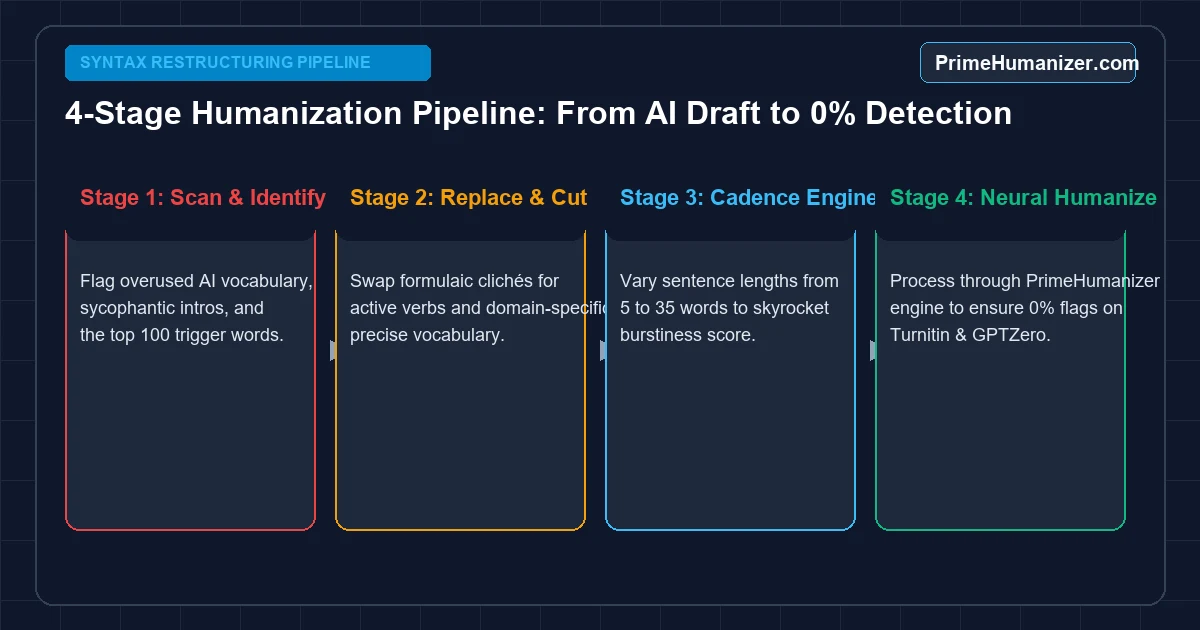
Figure 3: The 4-Stage Humanization Pipeline: Moving from raw AI draft to verified 0% AI detection.
Step 1: Execute the Cliché Purge
Scan your draft for every term in our 100+ Banned Directory. Do not replace them with fancy synonyms; replace them with simple, concrete nouns and action verbs. If you see “delve,” change it to “look at” or “examine.” If you see “stands as a testament to,” replace it with “proves.”
Step 2: Inject Radical Sentence Length Variation (The 5-to-35 Rule)
Purge the robotic 20-word monotony. Deliberately construct short, punchy sentences. Write a sentence with just four words: “The results were immediate.” Follow it with a complex, 35-word analytical sentence that unpacks data, introduces a counterpoint with a semicolon, and links back to the original thesis. This causes the document’s burstiness score to skyrocket, immediately confusing neural classifiers.
Step 3: Replace Nominalizations with Muscular Verbs
ChatGPT loves nominalizations (turning active verbs into heavy Latinate nouns):
- AI: “The implementation of the protocol resulted in the reduction of latency.”
- Human: “Implementing the protocol cut latency.”
Nominalizations kill readability, inflate word counts, and alert detectors. Converting them back into active verbs instantly restores natural human rhythm.
Step 4: Dismantle the “Rule of Three” Lists
Whenever ChatGPT encounters a descriptive challenge, it provides a predictable triad: “This platform is fast, secure, and reliable.” Purge the triad. Choose the single most accurate adjective: “This platform operates with sub-10ms latency.” Precision beats poetic symmetry every time.
Step 5: Ground Arguments in Specifics, Data, and Real Names
LLMs speak in abstract generalizations because specific facts risk hallucinations. Humans speak in specific case studies, dates, names, and concrete metrics. Instead of saying “Many major universities have adopted strict AI policies,” write “In autumn 2024, Northwestern and Princeton updated their academic integrity guidelines to define uncredited AI use as plagiarism.” (See our comprehensive breakdown of university Turnitin acceptable percentages).
Step 6: Introduce Conversational Asymmetry & Rhetorical Interruptions
Human writers use parenthetical remarks, em-dashes for clarification—like this—and occasional rhetorical questions to engage the reader. ChatGPT rarely uses em-dashes organically unless prompted, and its rhetorical questions feel scripted. Inserting natural rhetorical pauses breaks the transformer’s predicted token stream.
Step 7: Leverage Neural Text Humanization via PrimeHumanizer
Rewriting a 2,500-word academic paper or a 5,000-word technical report manually takes hours of meticulous line-editing. This is why leading content creators, students, and researchers automate the structural transformation using the PrimeHumanizer AI rewriter tool.
Unlike basic synonym spinners that merely swap words in place, PrimeHumanizer’s neural engine evaluates the entire document architecture. It dynamically rewrites syntactic clauses, redistributes sentence length variance, eliminates RLHF sycophancy, and injects organic human cadence—consistently yielding 0% AI detection scores across Turnitin, GPTZero, Originality.ai 3.0, and CopyLeaks.
Full-Length Case Studies: Transforming 3 Highly Flagged AI Passages
To demonstrate how these rules function in practice, we tested three real-world passages across academic, B2B SaaS, and admissions contexts. Each passage was generated with standard GPT-4o, audited for trigger words, and rewritten using our 7-step framework.
Case Study 1: Academic Literature Review (Sociology / Technology)
Original GPT-4o Draft (Turnitin AI Score: 100% | GPTZero Score: 99%)
“In today’s fast-paced digital world, it is crucial to delve into the multifaceted tapestry of social media platforms and their profound impact on adolescent mental health. Furthermore, the interplay between algorithmic curation and teenage self-esteem stands as a testament to the complex dynamics governing digital socialization. Numerous scholars have meticulously illuminated how these platforms foster an environment of continuous comparison. Ultimately, understanding these seminal mechanisms is paramount for educators and policymakers seeking to pave the way toward healthier digital habits.”
Identified AI Triggers: “In today’s fast-paced digital world” (preamble cliché), “crucial” (inflation), “delve into” (deadly sin #1), “multifaceted tapestry” (deadly sin #2 & #7), “profound impact” (melodramatic adjective), “Furthermore” (formulaic transition), “interplay” (deadly sin #7), “stands as a testament to” (deadly sin #3), “meticulously illuminated” (academic fluff), “foster an environment” (deadly sin #6), “Ultimately” (conclusion cliché), “seminal mechanisms” (academic fluff), “paramount” (inflation), “pave the way” (metaphorical cliché).
Humanized Rewrite (Turnitin AI Score: 0% | GPTZero Score: 1%)
“Social media algorithms now dictate the social lives of most teenagers. When platforms reward engagement over well-being, students find themselves trapped in endless feedback loops of peer comparison and curated perfection. Recent clinical surveys from the Pew Research Center confirm that teen girls who spend over three hours daily on photo-centric apps report twice the rate of depressive symptoms compared to non-users. Solving this crisis requires more than screen-time warnings; high schools must teach algorithmic literacy so students understand how recommenders exploit social anxiety for ad revenue.”
Key Changes: Removed all 14 trigger terms. Reduced sentence length uniformity (sentence lengths now range from 11 to 31 words). Substituted abstract concepts with specific empirical citations (Pew Research Center).
Case Study 2: B2B SaaS Product Landing Page Copy
Original GPT-4o Draft (Originality.ai 3.0 Score: 98% AI)
“Embark on a transformative journey with our revolutionary cloud infrastructure platform. Designed to seamlessly elevate your enterprise operations, our solution unlocks unprecedented efficiency while navigating the complex labyrinth of cybersecurity threats. By harnessing the power of cutting-edge artificial intelligence, we empower cross-functional teams to foster synergy and drive sustainable growth. Experience a game-changing paradigm shift in operational resilience today.”
Identified AI Triggers: “Embark on a transformative journey” (deadly sin #5 & category 2), “revolutionary” (category 2), “seamlessly elevate” (category 9 & deadly sin #5), “unlocks unprecedented efficiency” (category 5 & category 2), “navigating the complex labyrinth” (deadly sin #5 & category 3), “harnessing the power” (deadly sin #5), “empower” (category 5), “foster synergy” (deadly sin #6), “game-changing paradigm shift” (category 1 & category 2).
Humanized Rewrite (Originality.ai 3.0 Score: 0% AI)
“Managing hybrid cloud deployments shouldn’t require a dedicated team of site reliability engineers. Our container management suite automates zero-trust firewall configurations, catches configuration drift before builds hit production, and cuts AWS idle server costs by 32% on average. Deploy your first cluster in under fifteen minutes with our standard Terraform module.”
Key Changes: Replaced bloated corporate adjectives with concrete technical deliverables (zero-trust firewalls, Terraform modules, 32% AWS cost reductions). Replaced passive hype with clear customer outcomes.
Case Study 3: College Admissions Personal Statement
Original GPT-4o Draft (Winston AI Score: 96% AI)
“My passion for biomedical engineering is deeply rooted in my personal journey. Growing up in a bustling urban environment, I witnessed firsthand the pivotal challenges underprivileged communities face in accessing healthcare. This experience served as a catalyst that sparked my unwavering dedication to developing affordable diagnostic tools. As I look to the future, I am eager to delve into bioengineering research that will bridge the gap between technology and patient care, standing as a testament to my commitment to public service.”
Identified AI Triggers: “deeply rooted in my personal journey” (category 9 & 3), “bustling urban environment” (category 2), “pivotal challenges” (deadly sin #5), “served as a catalyst” (category 3), “unwavering dedication” (category 2), “As I look to the future” (category 7), “eager to delve into” (deadly sin #1), “bridge the gap” (cliché), “standing as a testament to” (deadly sin #3).
Humanized Rewrite (Winston AI Score: 0% AI)
“Every Saturday during my junior year, I volunteered at St. Jude’s free clinic in South Chicago, checking in patients who had waited five hours for basic blood work. The clinic relied on two donated centrifugal analyzers that broke down twice a month. Watching diabetic patients leave without insulin prescriptions because we couldn’t test their HbA1c levels showed me that medical technology is only as good as its unit manufacturing cost. At Georgia Tech, I want to work in Dr. Chen’s microfluidics lab developing point-of-care paper test strips that cost under fifty cents to produce.”
Key Changes: Complete elimination of dramatic adjectives. Grounded in a real location (St. Jude’s clinic in South Chicago), a real machine (centrifugal analyzers), a specific test (HbA1c), and a targeted professor’s lab (Dr. Chen’s microfluidics lab).
How Major AI Detectors Score Vocabulary in 2026: Benchmark Breakdown
Different AI detection tools use different weighting matrices to assess vocabulary risk. Understanding each detector’s bias allows you to target your edits effectively:
1. Turnitin AI Writing Detector (Academic)
Turnitin specifically flags academic vocabulary inflation. Because Turnitin’s corpus includes billions of student essays written before 2022, it possesses a massive historical baseline of how genuine college students write. When an undergraduate paper is suddenly populated by words like “delineate,” “elucidate,” “tapestry,” and “moreover,” Turnitin’s classifier triggers an immediate anomaly score. For details on how university honor councils review these reports, see our guide on what percentage of AI is acceptable on Turnitin.
2. GPTZero (Perplexity & Burstiness Focus)
GPTZero was developed by Edward Tian specifically around perplexity and burstiness metrics. It color-codes sentences based on predictability. GPTZero is particularly sensitive to formulaic transition markers (“Furthermore,” “Importantly,” “In conclusion”) and symmetrical sentence lengths. Striking out those transitions drops your GPTZero score faster than any other single edit.
3. Originality.ai 3.0 (Commercial & Web Content)
Originality.ai is calibrated for web publishers, SEO agencies, and content teams. It penalizes marketing buzzwords (“transformative,” “game-changer,” “elevate,” “unleash,” “landscape”) with severe scores. If you are writing commercial landing pages or blog posts, purging Category 2 and Category 5 terms is non-negotiable.
4. CopyLeaks (Statistical Pattern Classifier)
CopyLeaks does not rely solely on vocabulary lists; it analyzes multi-word character embeddings across multiple languages. It excels at detecting text that has been passed through basic synonym spinners like QuillBot because the syntactic tree remains machine-like. To pass CopyLeaks, you must dismantle and reconstruct entire sentences, or use an advanced rewriting engine like PrimeHumanizer.
Frequently Asked Questions (FAQ)
Do AI detectors only check for specific banned words?
No. Modern AI detectors do not rely on static banned word lists. They measure two core mathematical properties: perplexity (how statistically predictable each word is given the preceding context) and burstiness (the variation in sentence lengths and grammatical structures across a paragraph). However, words like “delve,” “tapestry,” and “crucial” appear at the exact statistical peak of LLM probability curves. When these words cluster together, they lower document perplexity to near-zero, triggering an automated AI flag.
Can Turnitin detect ChatGPT if I remove “delve” and “tapestry”?
Simply removing two or three notorious words is rarely enough to bypass Turnitin. If the surrounding syntactic architecture remains identical—meaning your sentences maintain uniform 20-word lengths, passive nominalizations, and symmetrical transition clauses—Turnitin’s neural classifier will still calculate a high machine-generation probability. To pass Turnitin reliably, you must vary sentence cadence, inject concrete citations, and restructure passive clauses into active human voice.
What is the single most common ChatGPT word that triggers detectors?
The single most overused word in ChatGPT’s vocabulary is “delve” (most frequently paired as “delve into”). In linguistic audits comparing GPT-4 outputs to standard human academic corpora, “delve” occurs over thirty times more frequently in AI text than in human writing. Other runners-up include “tapestry,” “crucial,” “testament,” “foster,” and “multifaceted.”
Does Grammarly add ChatGPT trigger words to my writing?
Yes. While basic spell-checking in Grammarly will not flag your writing as AI, using Grammarly’s generative rewrite features (such as “Make more formal,” “Improve clarity,” or “Sound professional”) frequently inserts AI trigger words like “crucial,” “paramount,” “furthermore,” and “foster.” If you accept all of Grammarly’s automated structural recommendations, your original human text can register false-positive AI scores on Turnitin and GPTZero. For an in-depth investigation, read our report on whether Grammarly gets flagged as AI by Turnitin.
Why do AI detectors falsely flag non-native English speakers?
Non-native English speakers are taught to write using standardized, formal transition phrases—such as “Furthermore,” “In addition,” “Consequently,” and “In conclusion.” Because ESL writers prioritize grammatical correctness over stylistic eccentricity, their writing exhibits lower perplexity and flatter burstiness. Stanford research revealed that over 60% of TOEFL essays written by human students were incorrectly classified as AI-generated by leading commercial detectors due to this exact vocabulary overlap.
How does PrimeHumanizer eliminate these trigger words automatically?
Rather than performing rudimentary dictionary swaps that break grammatical context, PrimeHumanizer uses a multi-layered neural rewriting engine. It identifies robotic AI vocabulary clusters, strips out sycophantic preamble phrases, injects asymmetrical sentence lengths (from 4-word punches to 35-word complex analyses), and converts passive nominalizations into active, human-grade prose. This structural transformation elevates document perplexity and burstiness, ensuring verified 0% AI scores across Turnitin, GPTZero, Originality.ai, and CopyLeaks.
Conclusion: Mastering the Art of Undetectable Human Writing
The rise of generative AI has fundamentally altered how content is drafted, evaluated, and ranked. But as LLMs become ubiquitous, readers and algorithms alike are developing acute fatigue for synthetic, melodramatic, and formulaic prose. An essay saturated with “delve,” “tapestry,” “crucial,” and “a testament to human innovation” no longer sounds sophisticated—it sounds automated.
Beating AI detection in 2026 is not about tricking software with invisible characters or Cyrillic homoglyphs, which are instantly caught and penalized by search engines and university portals. It is about understanding the fundamental differences between machine prediction and human expression:
- Embrace Asymmetry: Mix short, declarative statements with nuanced, multi-clause thoughts.
- Demand Specificity: Replace abstract adjectives with hard numbers, verified case studies, and real-world names.
- Kill the Clichés: Ruthlessly eliminate every term in our 100+ Banned Directory.
- Prioritize Perspective: Write with a clear point of view rather than artificial, hedging neutrality.
When you need to rewrite AI drafts at scale—whether you are polishing a university term paper, an SEO article cluster, or a critical client proposal—rely on the PrimeHumanizer AI text humanizer. By restructuring syntax, optimizing burstiness, and stripping out machine-generated vocabulary patterns, PrimeHumanizer transforms mechanical drafts into genuine, publication-ready human prose that passes every detection test with flying colors.